Weekly: Stabilisation in the Face of Geopolitical Turmoil
MAR 9, 2026
rypto markets hold steady at $2.25T amid Middle East tensions. BTC breaks out, liquidity surges ($100B+ Treasury drawdown), ratios base positively. Business cycle accelerates without peak risks; DeFi forms sector duopolies (top 2 grab 80% revenue). Bottoming underway despite oil fears.
Re7 Capital has been shortlisted for Risk-Adjusted Returns of the Year at the Hedgeweek® European Awards 2026, an honour that underscores our commitment to delivering institutional-grade strategies across both digital assets and traditional finance, with a focus on consistent, risk-adjusted performance.
Re7 Capital has also been shortlisted at the Hedgeweek® Global Digital Assets Awards across six categories, including Discretionary Fund of the Year (Annual and Sustained Excellence), Market Neutral Fund of the Year (Annual and Sustained Excellence), and Multi-strategy Fund of the Year (Annual Excellence).
This follows a milestone week for Telegram’s built-in wallet, which has launched yield on user holdings of BTC, ETH, and USDT, with Re7 Labs supporting yield opportunities of up to 18%.
In case you missed it
Our founder Evgeny Gokhberg joined Raoul Pal on Inside a DeFi Hedge Fund to discuss the thinking behind our market-neutral yield strategies. Watch on YouTube or stream on Spotify.
Weekly Summary
We cover:
Bottoming process indicators
Liquidity growth vs. inflation pressures
Relative ratios in market and what they are telling us
Stabilisation in the Face of Geopolitical Turmoil
Last week, we outlined our case that the market is likely entering a bottoming process.
Despite ongoing geopolitical tensions in the Middle East—putting pressure on oil prices, global trade, and inflation—we think there is a higher-than-consensus probability of volatility in risk assets surprising to the upside.
Global crypto market capitalisation was flat last week in what appears to be a bottoming level at $2.25T.
Contrary to expectations, on the 10th day of the Iran conflict, the market is now +3%.
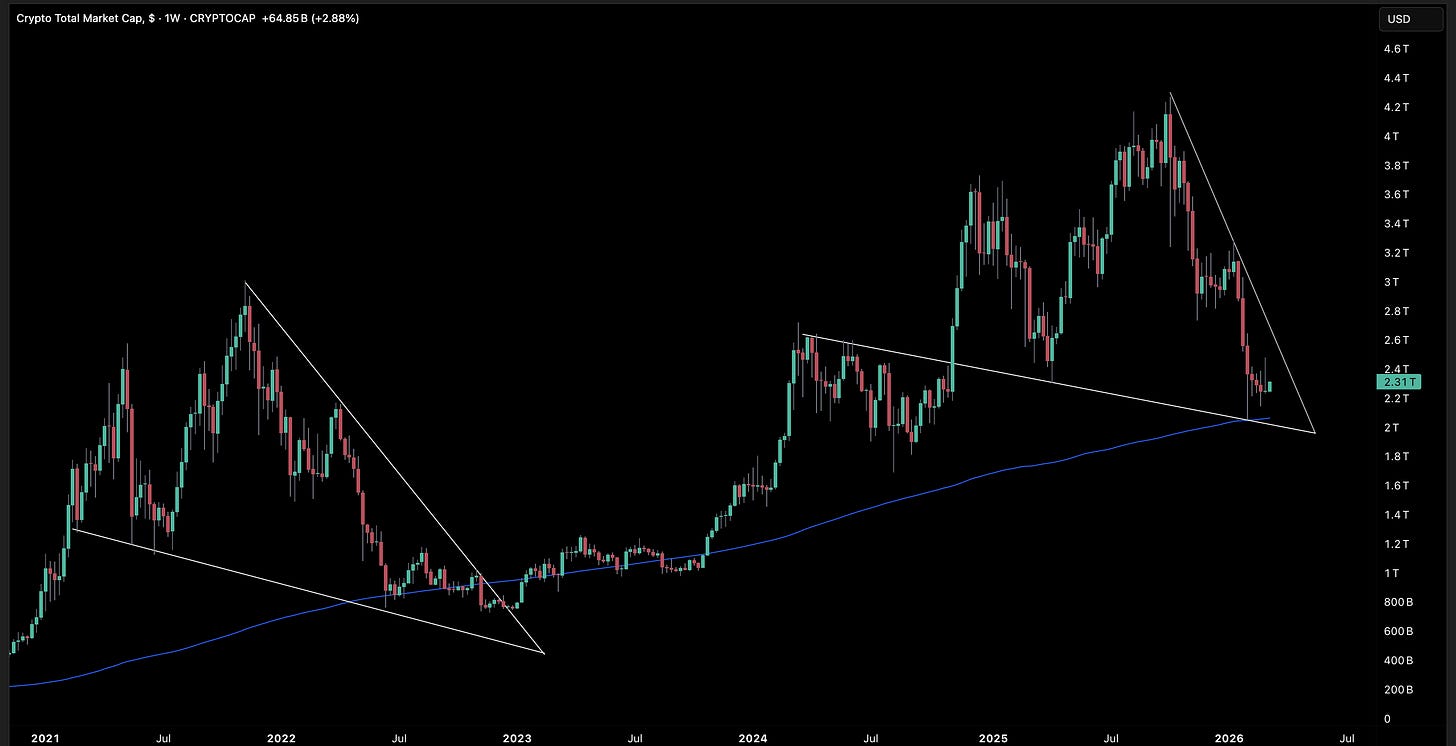
Global crypto market capitalisation (weekly).
For BTC, we’re seeing a break out of its consolidation wedge to the upside—now using its resistance as support.
This doesn’t rule out a re-test of the lows to the 200W MA but the resilience shown increases likelihood of a bottom already been put in. Any further weakness would also likely lead to deMark 13 buy counts on both daily and weekly timeframes.
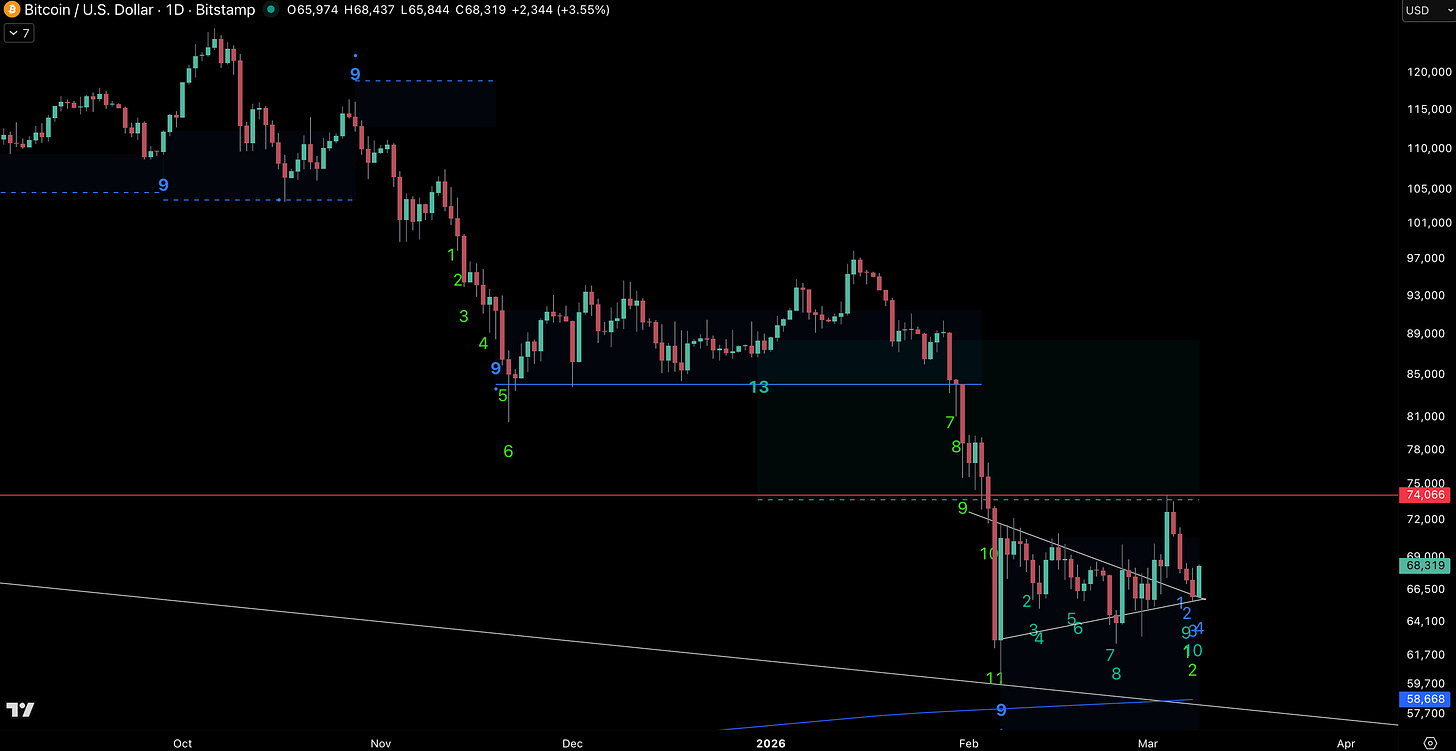
BTC/USD (weekly).
End of Cycle Fears
There are now fears that the current oil spikes marks the end of the cycle. After all, BTC is tracking the median cumulative performance of mid term years relatively well.
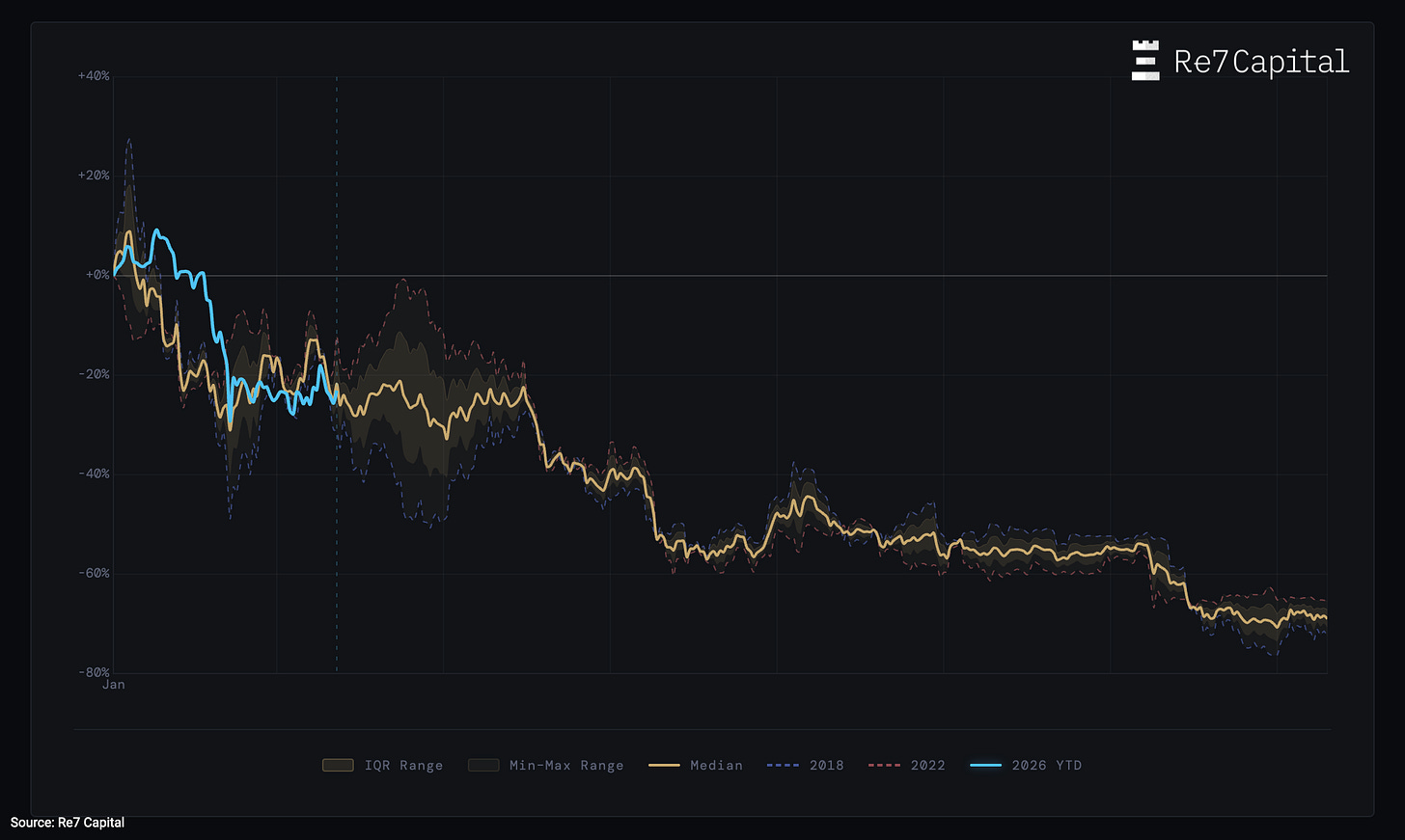
Cumulative performance of BTC/USD in mid-term years.
From first principles, risk assets are heavily influenced by narrow liquidity and crypto is no exception.
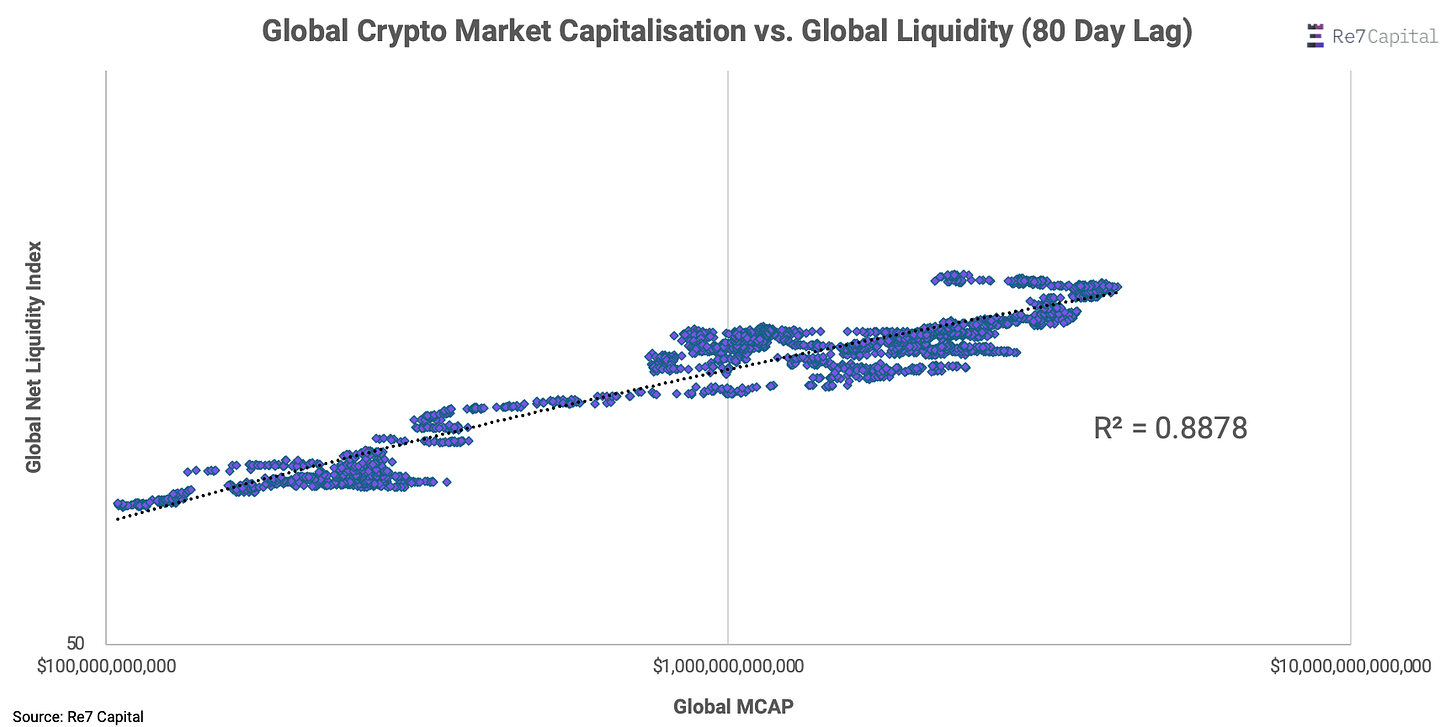
The rate of change for global liquidity continues to increase, not decrease. And likely remains the case for at least several months.
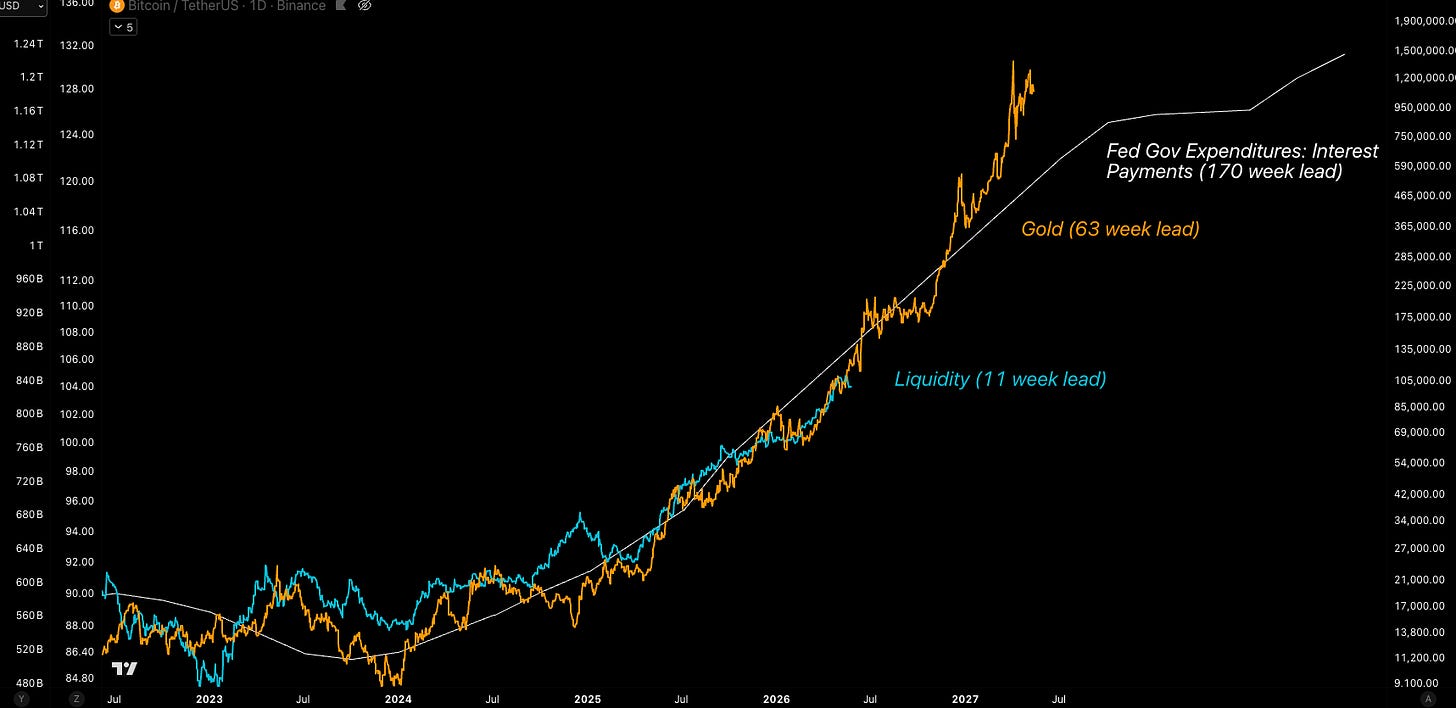
The 0.11 gap in the perfect correlation between crypto and liquidity is due to market volatility profile and directional swings in interest rates. Sustained higher oil prices is unlikely to change the broader direction for now.
The US employment data print last week only adds weight to further rate cuts.
Yes, sustained oil prices at +30% over several months can add 0.3-0.6% to headline inflation but we’re seeing other background disinflationary pressures that can offset.
Meanwhile, the business cycle is accelerating as we predicted but not near the peaks of >55-60+ we historically see with cyclical tops in crypto or equities. The market can run hotter than the crowd believes.
Why this matters is that acceleration of the business cycle has direct impact on crypto asset valuations.
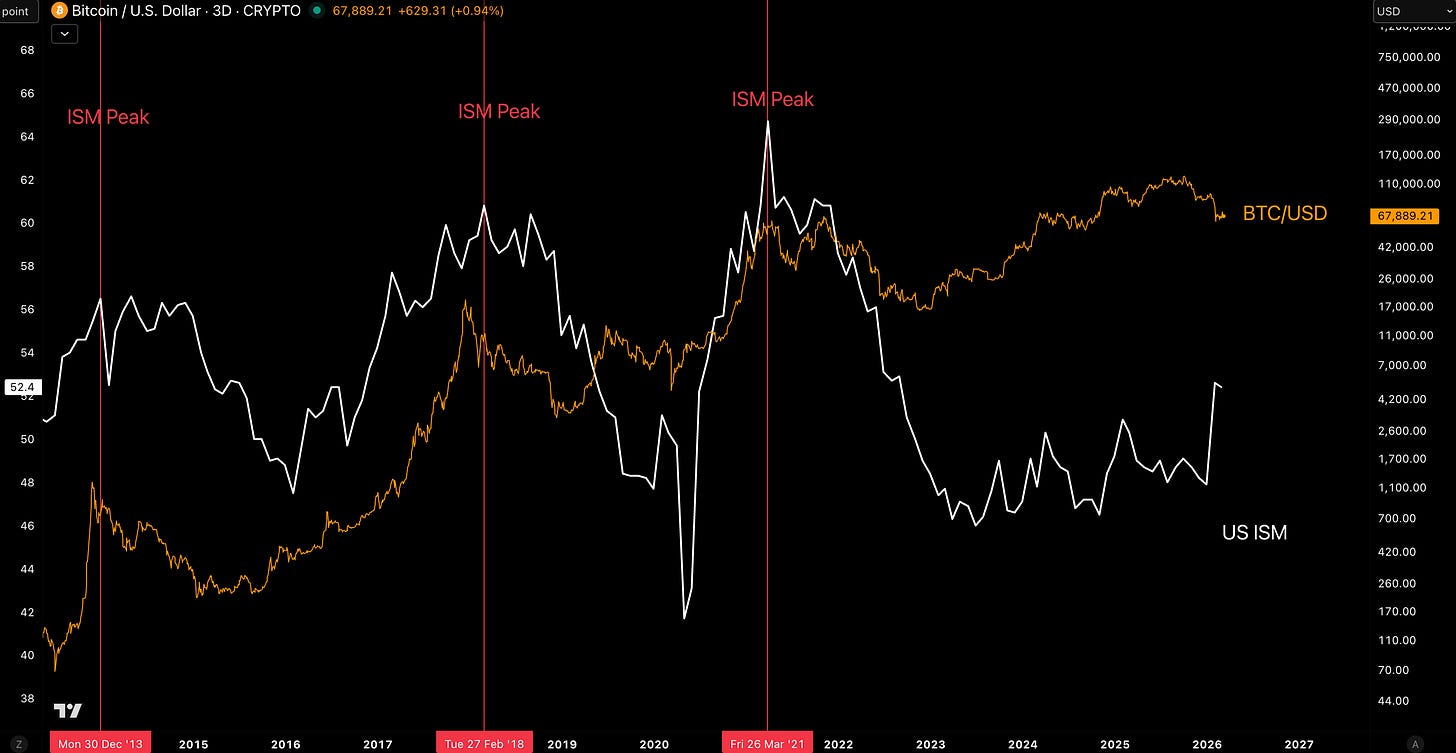
US ISM vs. BTC/USD. BTC typically peaks when US ISM is peaking >55-60+.
Liquidity Conditions Easing
All of this comes as crypto valuations have contracted 50-80% from their peaks a few months ago. Software has surged +15% from its bottom after being a consensus short.
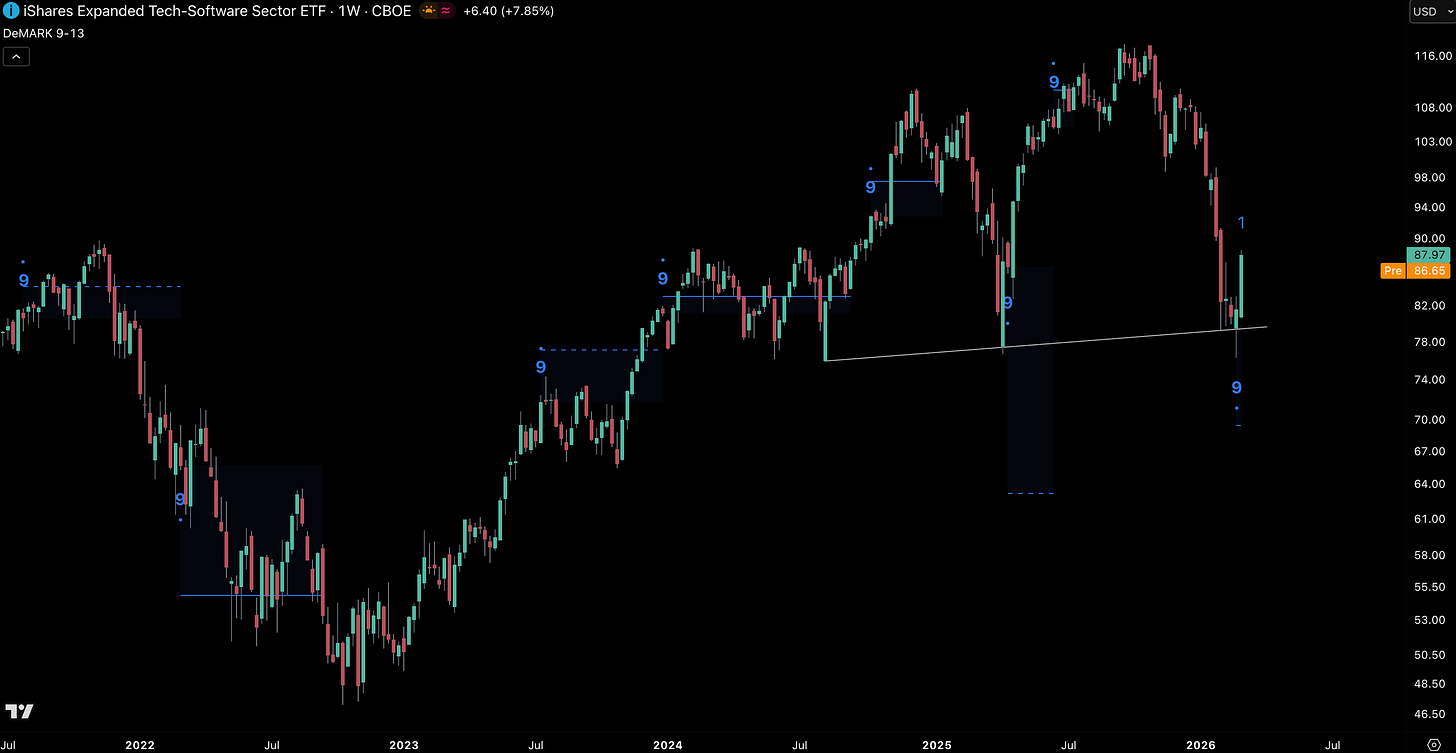
iShares IGV Software index (weekly).
We stated that after seller exhaustion, what will lift crypto and software will be US liquidity expansion.
So with prices having stabilised and now recovering, what has US domestic liquidity done in the past week since we posted the chart?
Lo and behold, liquidity is starting to pick up as >$100B starts to get withdrawn from the treasury accounts from Government spending and increased bank reserves.
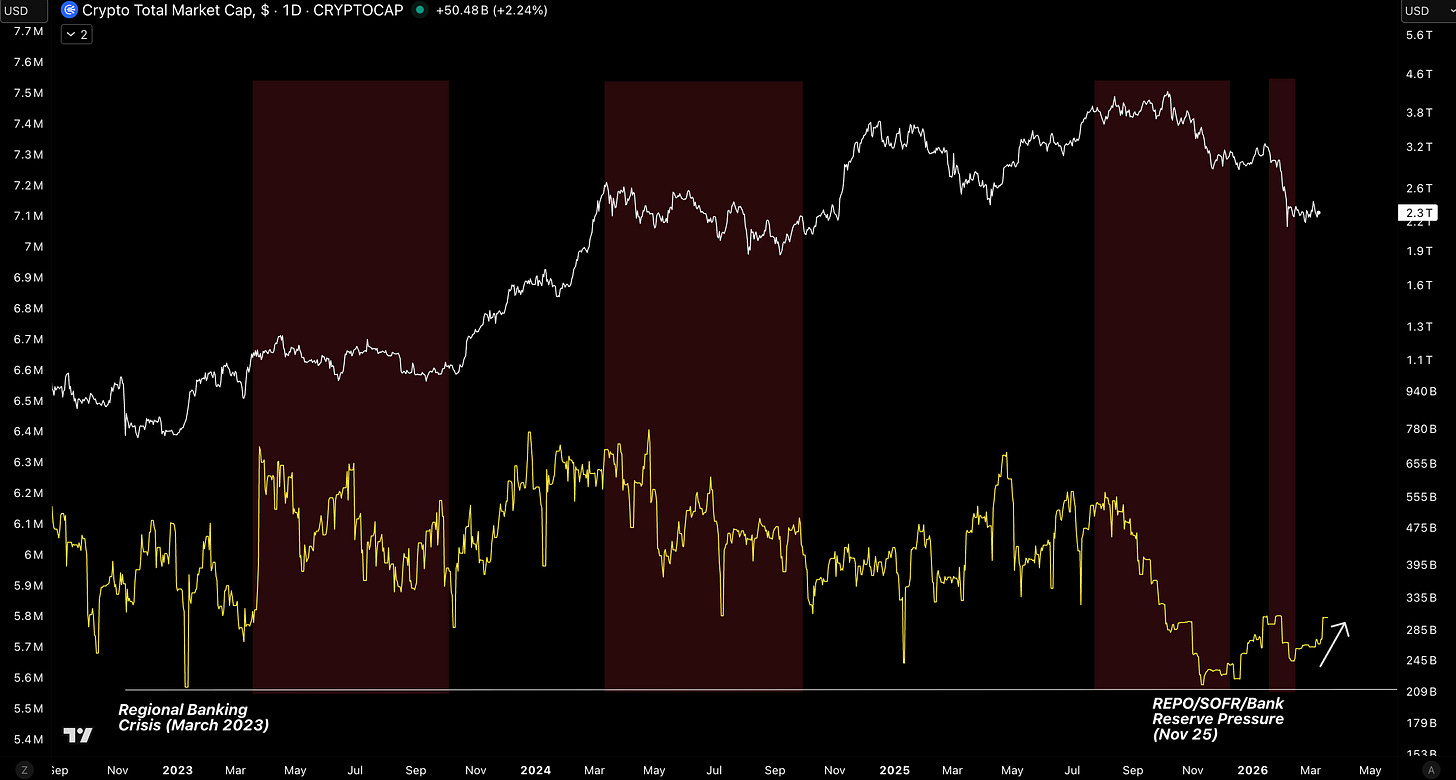
Crypto global market capitalisation vs. US domestic liquidity.
This is likely why we’re seeing short, fast recovery in risk assets so far this week despite growing concern of inflation and geopolitical risk.
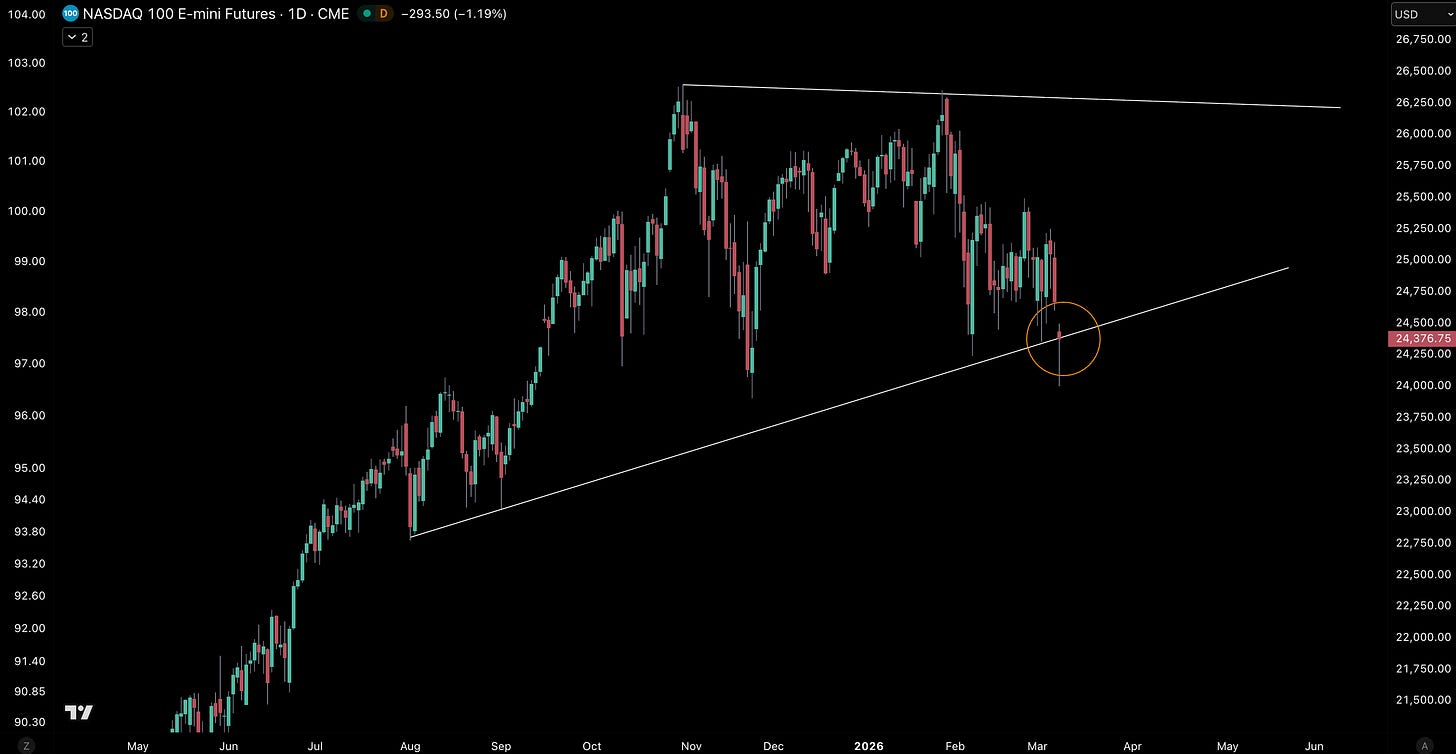
Without clear indication of a protracted war, the macro backdrop doesn’t call for a sustained correction yet. Of course, significant growth slowdown would put risk assets in a vulnerable position.
Relative Ratios
Relative ratios are also beginning to show signs of basing.
The recent price action is not characteristic of the persistent deterioration typically seen near market cycle peaks or exhaustion, but instead suggests downside momentum is starting to fade.
Take BTC/gold relative strength after deMark buy counts were printed…
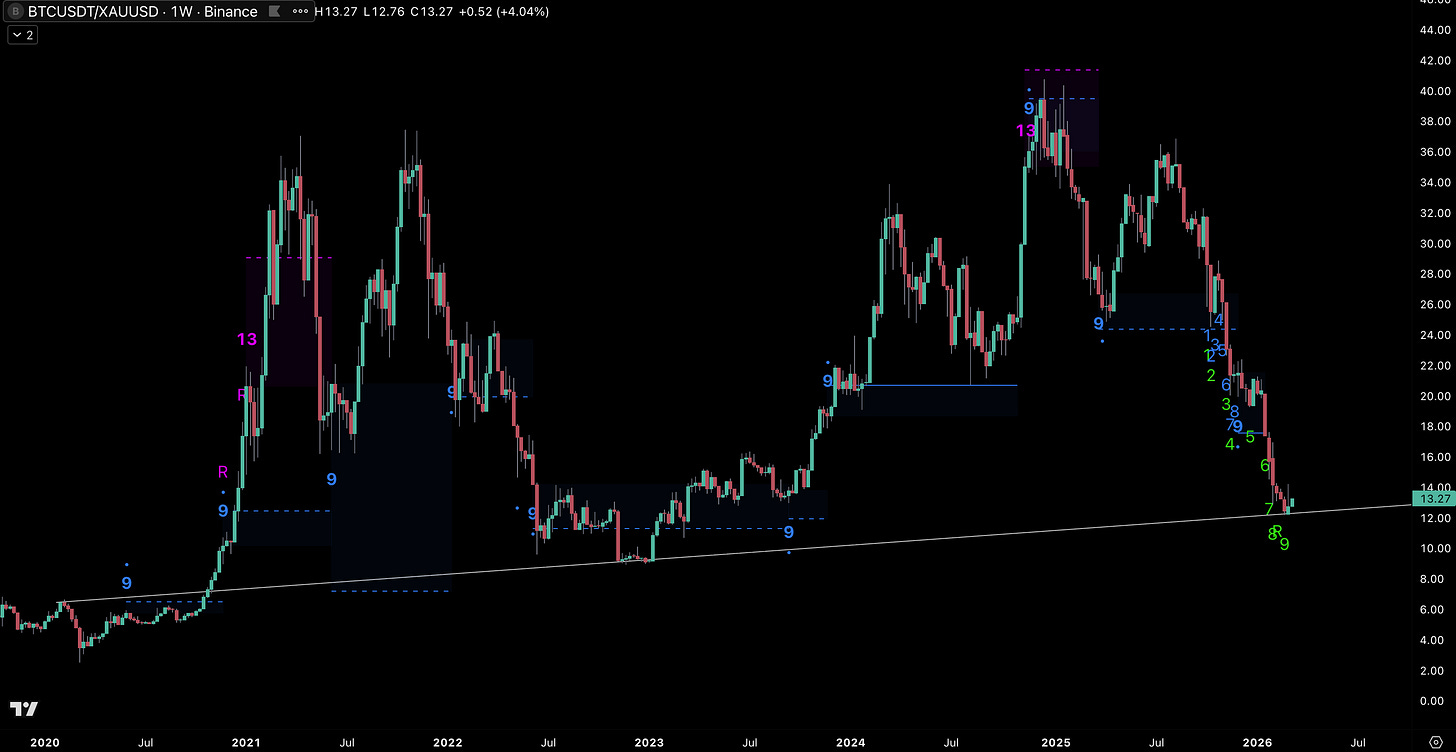
BTC/Gold ratio (weekly).
or BTC/NDQ which has been unable to get below 2023 highs or 2024 lows…
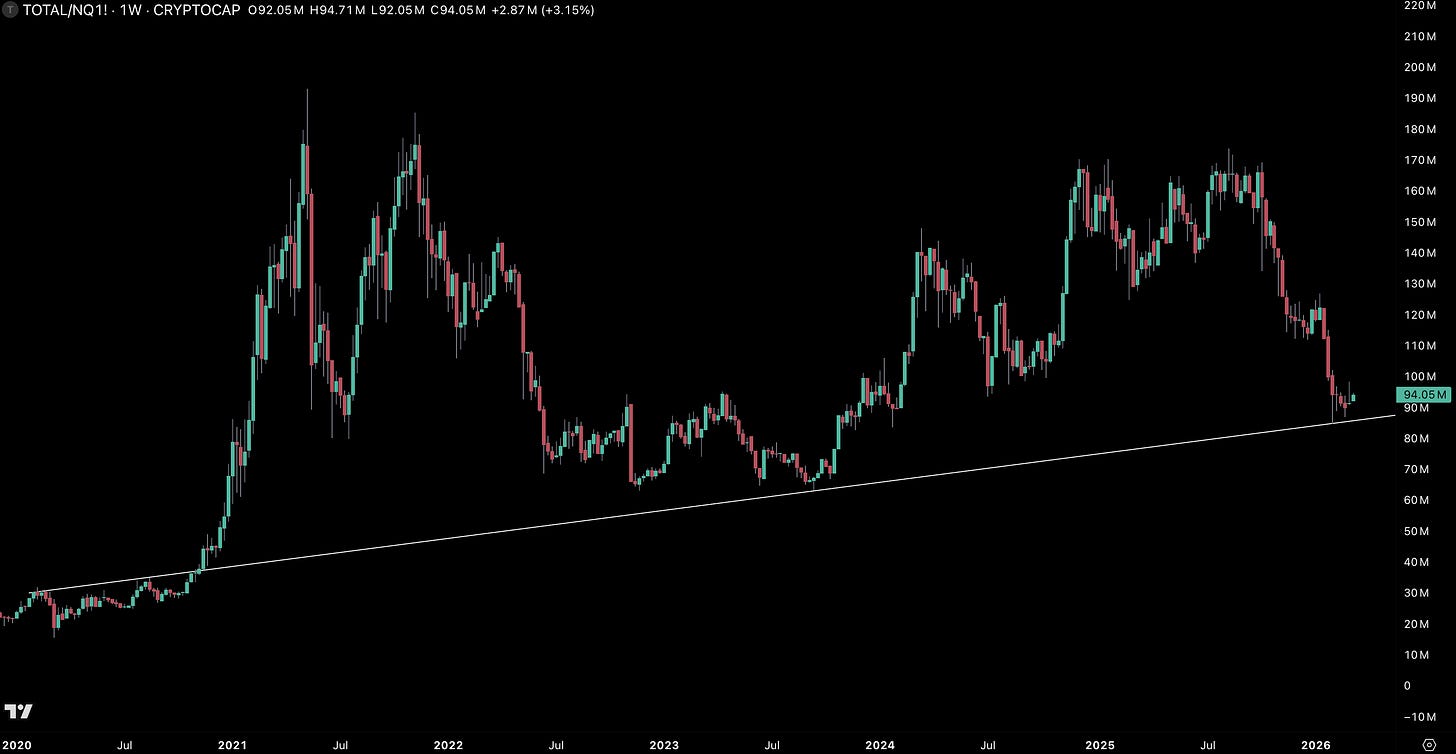
Crypto/NASDAQ ratio (weekly).
While geopolitical tensions persist, market signals suggest a potential bottoming process, supported by improving liquidity and a business cycle that is advancing but not yet at late-cycle extremes.
Although oil poses inflationary risks and risk assets would likely be impacted if this evolves into a protracted conflict, broader conditions still favour recovery, and relative strength ratios suggest that downside momentum may be fading for crypto specifically.
Insight of the Week
Data from DeFiLlama indicates that crypto markets are consolidating into duopolistic structures, with the top two players in each sector capturing roughly 80% of total revenue across the 15 major categories.
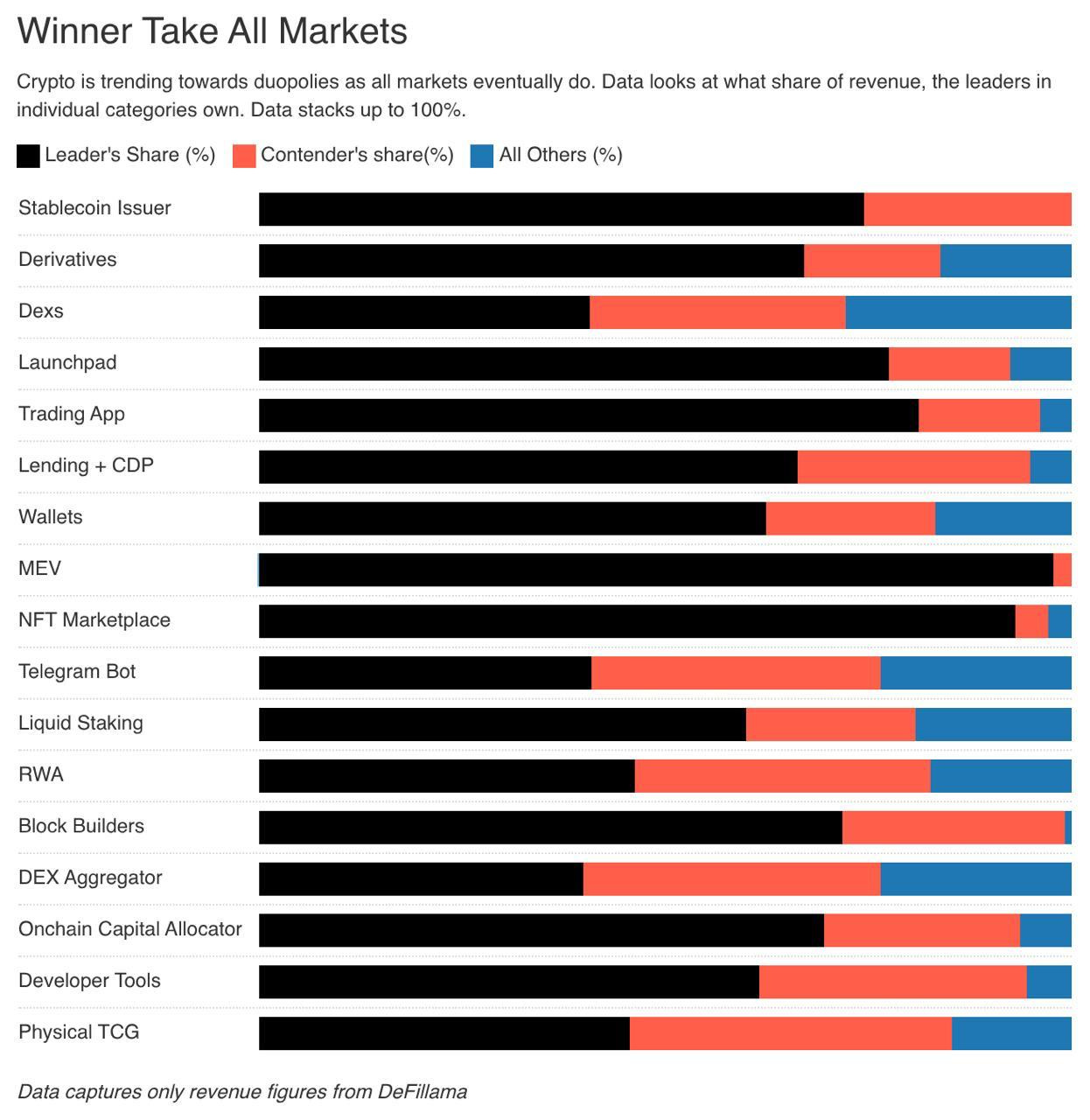
Building out this analysis further, we can see if the dominance of the top two revenue generators in each sector—e.g. DEXs, launchpads, and lending—has any relationship to the net performance of assets.
The bar chart ranks the average 30-day performance across these sectors, and no clear relationship has emerged.
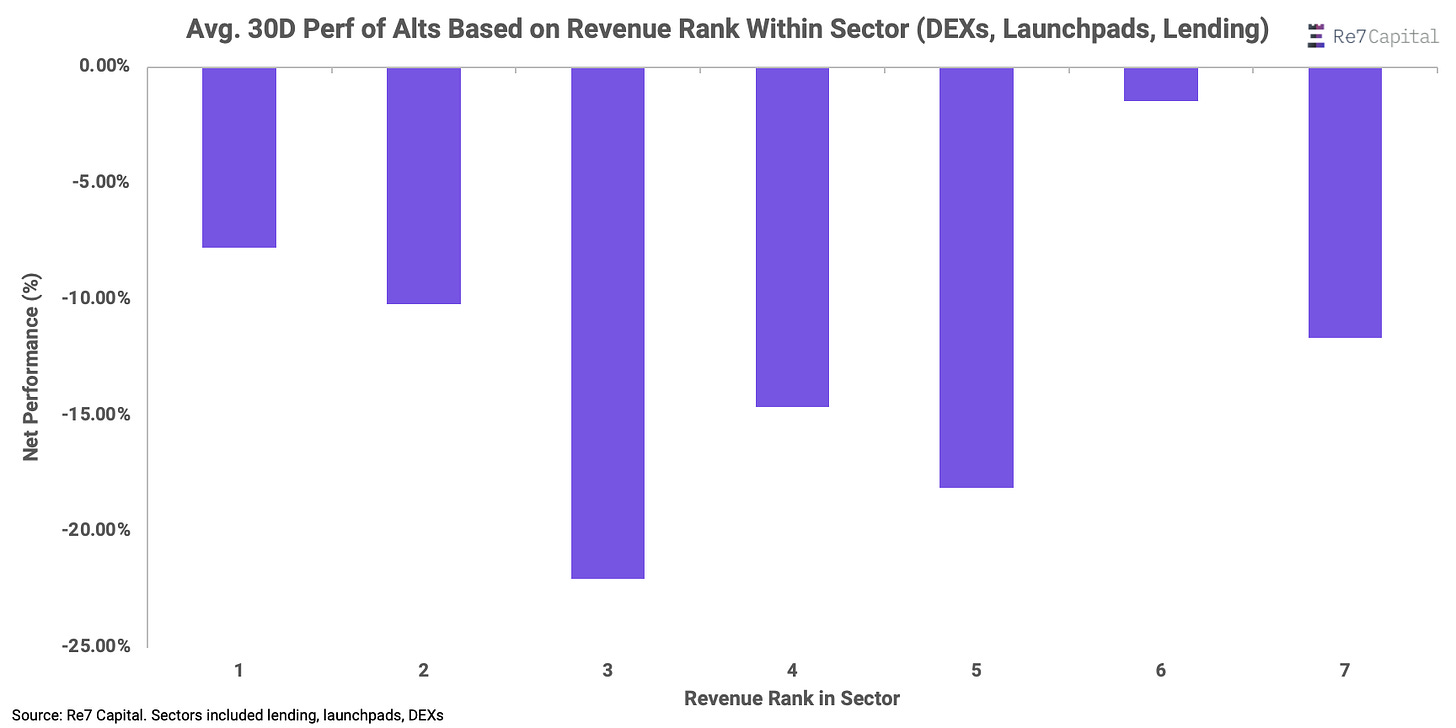
This suggests other factors—such as idiosyncratic catalysts, broader market sentiment, or sector-specific dynamics—are likely at play.
State of the Yields
DeFi Yields
Our analysis indicates that base DeFi lending rates have now converged with TradFi money markets, with on-chain stablecoin supply rates now tracking SOFR (~4%). The floor is institutional-grade but structured strategies still offer a clear premium for active managers.
Stablecoin Lending APY
Maple syrupUSDC/USDT: 4.5%
Sky sUSDS: 4.0%
Morpho curated vaults: 3-6% USDC
Fluid: 3.3-3.8% USDC/USDT
Aave v3: 2-3% USDC/USDT
Fixed-Rate (Pendle) APY
reUSDe: ~13% fixed (115d maturity)
sUSDai: ~9% fixed (227d maturity)
sUSDe: ~5% fixed
Perps LP APY
Lighter LLP: 15%
Hyperliquid HLP: 1%
Avantis (Base): 10.5%
ETH Staking APY
The base layer of DeFi now competes directly with money markets. Higher yields have typically been found within vault curation, fixed-rate lockups, and perps LP—where yields have typically generated 2-4x above the DeFi base rate.
Lido stETH: 2.4% | EtherFi weETH: 2.7% | Rocket Pool rETH: 2.1%
Looping spreads thin (~0.2% per turn) but positive at leverage
About Re7
Re7 Capital is a research-driven digital asset investment firm specialising in DeFi yield and liquid alpha strategies.
We’re Hiring, and currently looking for a Head of Legal. If you’re excited by institutional DeFi and want to help shape its future, you can learn more about this position, and others, here.
Disclaimers
The content is for informational purposes only. None of the content is meant to be investment advice. Use your own discretion and independent decision regarding investments. The opinions expressed in all Re7 public research articles are the independent opinions of the authors at the time of publication and not the opinions of the affiliates of Re7.
Please see here for full disclaimers.