The Weekly: Is Privacy Winning Mindshare Faster Than Adoption?
MAY 25, 2026
Is crypto privacy winning mindshare faster than adoption? We analyze Railgun, Zcash, NEAR Intents, Zashi, and DeFi yield trends in this week's market update.
Last week, Evgeny Gokhberg, founder of Re7 Capital, joined Jesse Knutson on Bitfinex's Bitcoin Capital Podcast to discuss what really happens when an asset used as collateral across multiple DeFi protocols gets hacked.
The full conversation is available to watch on YouTube.
Weekly Summary
We cover:
Why privacy mindshare has accelerated across crypto
Where privacy tools and networks have, or have not, gained meaningful traction relative to valuations
Market update
Is Privacy Winning Mindshare Faster Than Adoption?
Privacy and confidential transactions have increasingly taken up crypto mindshare over the past three months, driven by rising discussion around surveillance resistance, AI agents, stablecoins, and on-chain financial privacy.
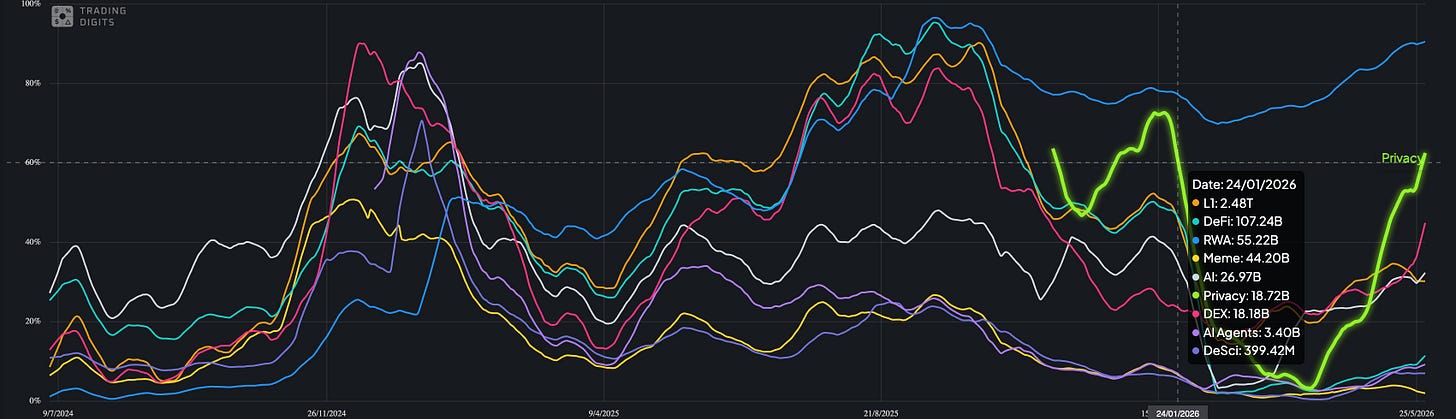
Source: Crypto Narrative Tracker. Tracks sector market cap and volume trends to identify shifts in crypto market narratives and relative momentum. Green = privacy.
However, the key question is whether that attention is translating into actual on-chain demand. To test that, we look at observable proxies across Railgun, NEAR Intents, Zashi and Zcash.
Railgun
Railgun is a privacy protocol that lets users shield assets on public blockchains, enabling private transfers and DeFi interactions without exposing wallet balances, counterparties, or transaction details.
In practice, users deposit assets into Railgun’s private balance system, transact privately, and can later unshield back to a public address.
The chart below tracks the total count of shielded and unshielded transactions to the Railgun contract and therefore a good measure of user trust, demand, and engagement.
The interactions with the contract for both has kept steady over the past 3 months. More importantly, there are less than 100 interactions daily from users seeking to shield transactions on-chain.

NEAR Intents
NEAR Intents is NEAR’s cross-chain execution layer, letting users express an outcome such as swapping or transferring an asset, while solvers handle the routing and settlement behind the scenes.
NEAR Intents weekly volume have kept steady at ~$500m YTD so discernible growth.

But not every Intent is private: most activity can still be public routing between chains.
Private or confidential transactions on blockchains like NEAR are intentionally designed to be difficult for outsiders to track. This is not a bug but rather it’s the core feature.
So to get a proxy for demand, we have to look at the visible edges of the privacy flow.
One useful signal is Zashi, the Zcash wallet integrated with NEAR Intents. Zashi lets users move into and out of shielded ZEC while NEAR handles cross-chain routing in the background.
If usage grows here, it suggests users are not just speculating on privacy as a theme. They are actively choosing private settlement when the UX is made simple.
NEAR Intents volume routed through Zashi has declined from its November 2025 peak of roughly $300m/day to around $60m/day today.
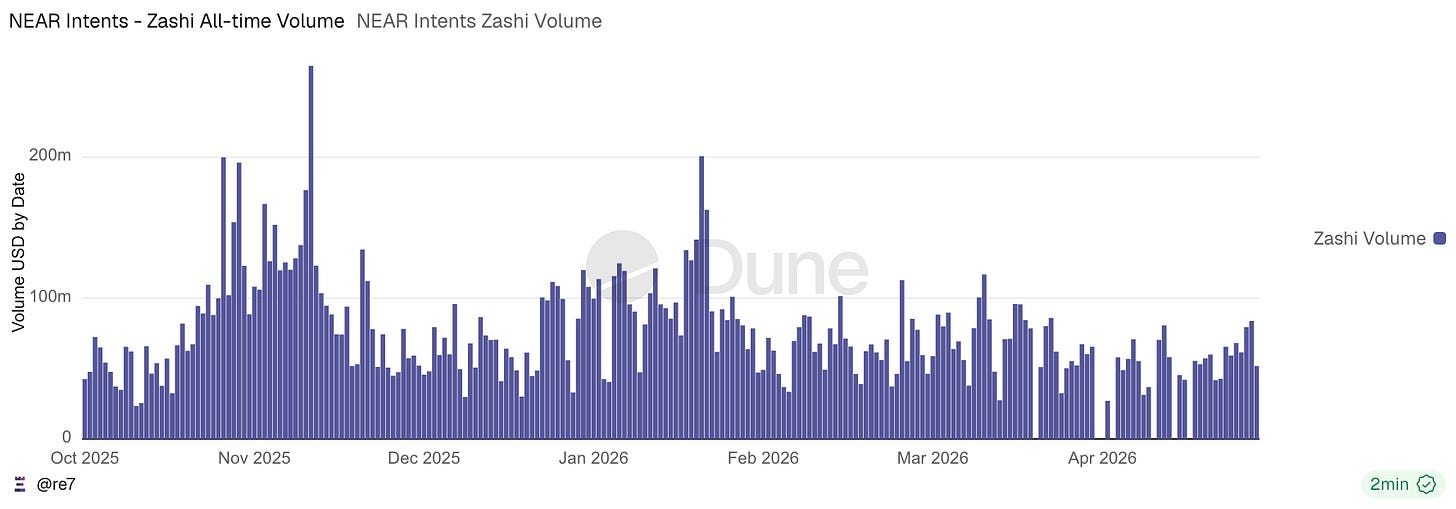
Then again, the Near team claim that >40% of NEAR transactions were confidential so the picture is mixed.
Zcash
Zcash is a privacy-focused blockchain that uses zero-knowledge proofs to enable shielded transactions where wallet addresses and transaction amounts can remain confidential.
Historically, shielded transaction growth and ZEC price action broadly trended together, suggesting price appreciation was at least partially supported by increasing usage of private settlement infrastructure.
That relationship has started to diverge. While ZEC/USD has rallied aggressively in recent months, shielded transaction growth has remained comparatively muted. The result is a widening gap between network usage and token price performance.

This divergence suggests the recent move in ZEC has been driven more by narrative positioning around privacy and confidential transactions than by a material acceleration in underlying shielded activity itself.
Closing Remarks
The broader takeaway is that privacy mindshare is growing faster than measurable on-chain adoption.
Across Railgun, NEAR Intents, Zashi and Zcash, usage looks steady but still niche. Activity has not collapsed, but it has also not accelerated at the pace implied by recent price action.
That does not invalidate the long-term thesis. Privacy infrastructure may still be early, with demand constrained by UX, liquidity fragmentation and regulatory uncertainty.
For now, the market appears to be pricing in the future potential of private on-chain settlement faster than current usage metrics can justify.
Market Update
As the US 10Y hit 2026 peaks of 4.68%, it was no surprise that the US administration was calling for the end of the Middle East conflict. Now we have a clearer path for a re-opening of the Hormuz strait and a memorandum of understanding regarding the Uranium stockpile longer-term.

As a result, treasury yields and oil are down while risk assets and precious metals are up. BTC continues its climb once again to the 200d MA, a historically important level for longer-term market conviction.

BTC/USD daily.
As Brent fell from $103/bbl to $91/bbl (orange), risk assets broadly benefited, with crypto, equities and precious metals all rallying.
Russell small caps (purple) led the move, up around +5%. Crypto beta (blue) and alt coin market (red) have been in the middle of the pack.

Relative performance of key sectors and markets over the last week.
In the current Brent pullback, however, crypto (and specifically the alt market) has been the fastest out of the gates versus other major markets and sectors.
This may signal the crypto market may be becoming somewhat overstretched after previously lagging the broader risk asset rebound.
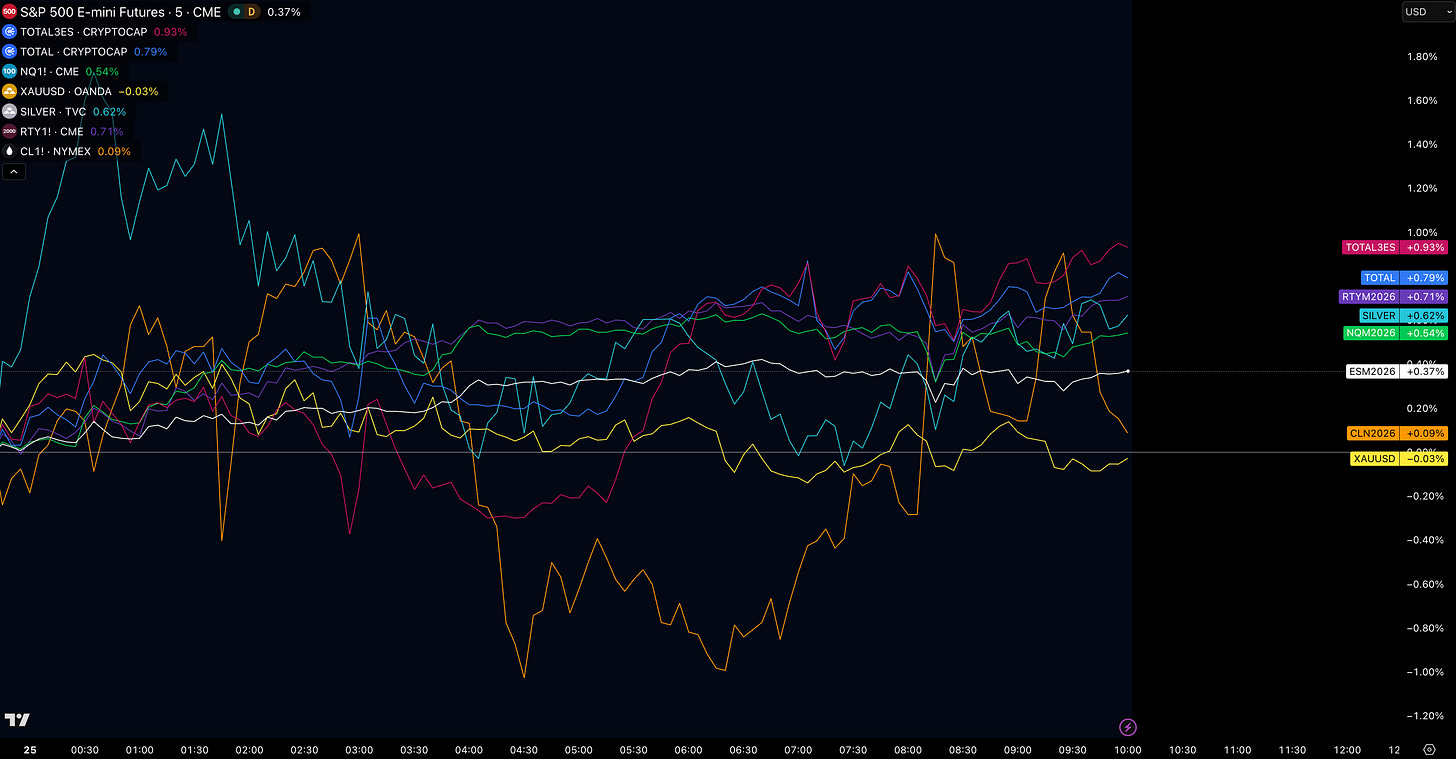
Relative performance of key sectors and markets since Sunday 24th/Iran deal headlines. Crypto altcoin market (red) is outperforming on the headline bounce so far.
Given crypto/NASDAQ ratio is just 1-3 weeks from printing buy signals on indicators like deMark, ultimately the bet is for the crypto-AI trade gap to close in what has been a summer season for risk assets (rising growth with rising inflation).
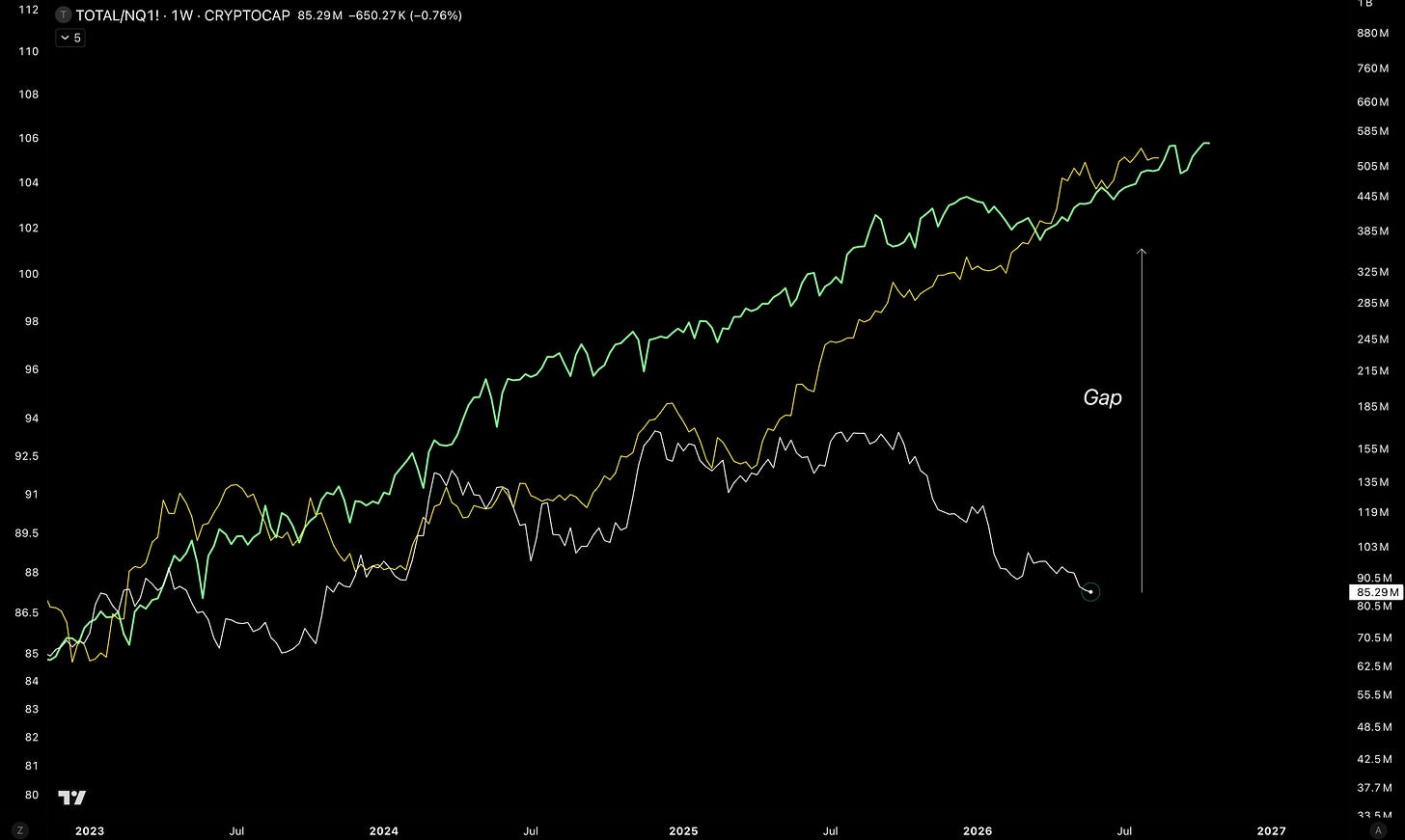
Crypto/NASDAQ ratio vs. global liquidity 12 week lead (yellow) and US domestic liquidity 21 week lead (green).
Mechanically, the gap can close from a confluence of reasons:
Investors will look for the next trade if AI/tech leadership continues to perform.
The marginal buyer is often the same speculative, liquidity-sensitive capital pool.
Crypto is increasingly a liquid second-derivative AI trade via agents, compute, stablecoins and privacy.
Cleaner institutional access rails make rotation into crypto easier than in prior cycles.
Crypto has higher macro beta once geopolitical overhangs truly fade while liquidity accelerates - relative performance this week may be early signs of this.
State of Yields
Stablecoin lending yields:
~3.8% on Aave (USDC) — utilisation rates for USDC markets are still elevated but have seemed to stabilise at ~92%.
5.12% on Aave (MegaUSD) — same as last week again. Utilisation rates at 67%.
Fixed-rate DeFi lending: yield premium in fixed markets marginally expanding from last week:
Pendle sNUSD: 8.5% (Jun 2026)
Pendle sUSDAi: ~9.7% (Jun-Oct 2026 maturities)
sUSDe: ~4.3%
ETH yield benchmarks:
Lido staking: ~2.36% - same from previous week.