Weekly: A Confused Market
FEB 23, 2026
As crypto sentiment swings between fear and hopeful recovery, this week’s note breaks down why the market remains confused, how conflicting signals shape investor behaviour, and where we see relative stability emerging beneath the noise.
Last week, our founder, Evgeny Gokhberg, joined Raoul Pal on Inside a DeFi Hedge Fund: Risk Management in a 24/7 Market to discuss the principles underpinning our market-neutral yield strategies. The conversation explored active smart contract risk oversight, dynamic multi-chain capital allocation, and the structural considerations required to manage risk in continuously operating digital asset markets.
They also examined current market conditions, assessing whether the recent drawdown reflects cyclical liquidity stress or signals deeper structural fragility. The episode offers a considered perspective on risk management, capital efficiency, and evolving market structure within digital assets.
The full conversation is available to watch on YouTube and stream on Spotify.
Weekly Summary
We cover:
Why it is a confused market at the moment
The simple state of play as we see it
A Confused Market
Market Overview
Crypto market fell 1.7% last week — the fifth consecutive weekly decline.
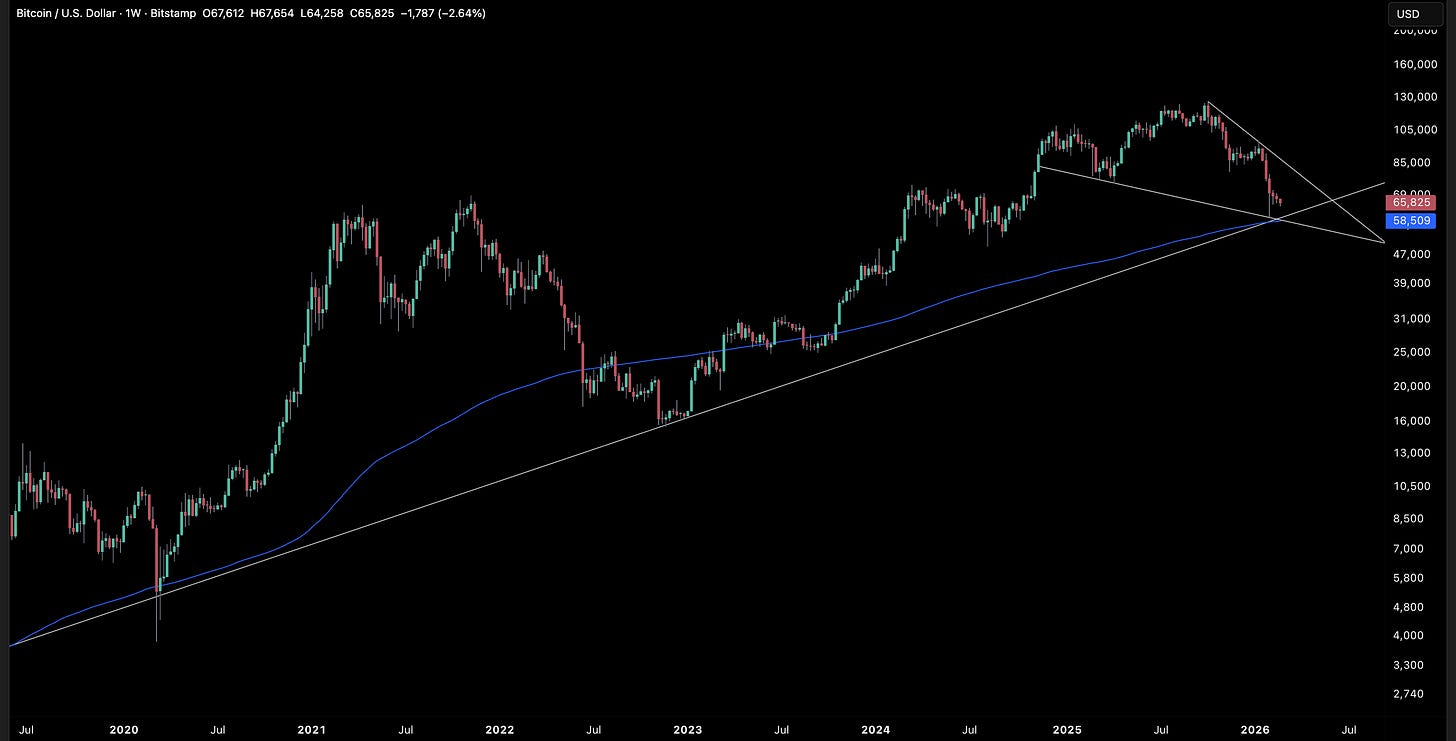
BTC/USD (weekly).
As prices edges lower to re-test the area of confluence (200W MA, 2018 support etc), weekly fear & greed has now declined to 5 - the lowest weekly print ever recorded.
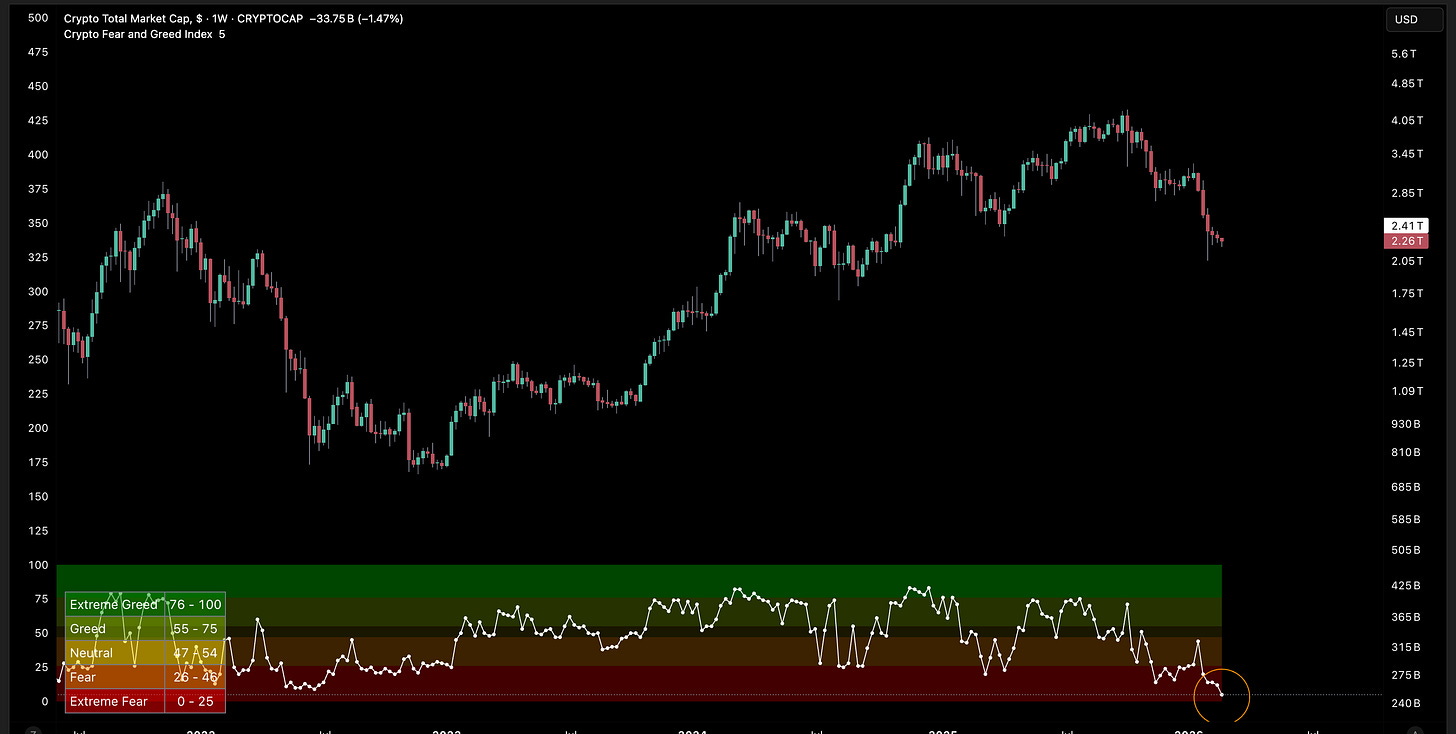
Global crypto market capitalisation ($) vs. fear & greed index (weekly).
Part of the reason we continue to see sentiment being disproportionately bearish relative to realised price action is that the market is confused.
It’s confused because countless market signals are contradicting one another, turning sentiment into a crypto game of Top Trumps.
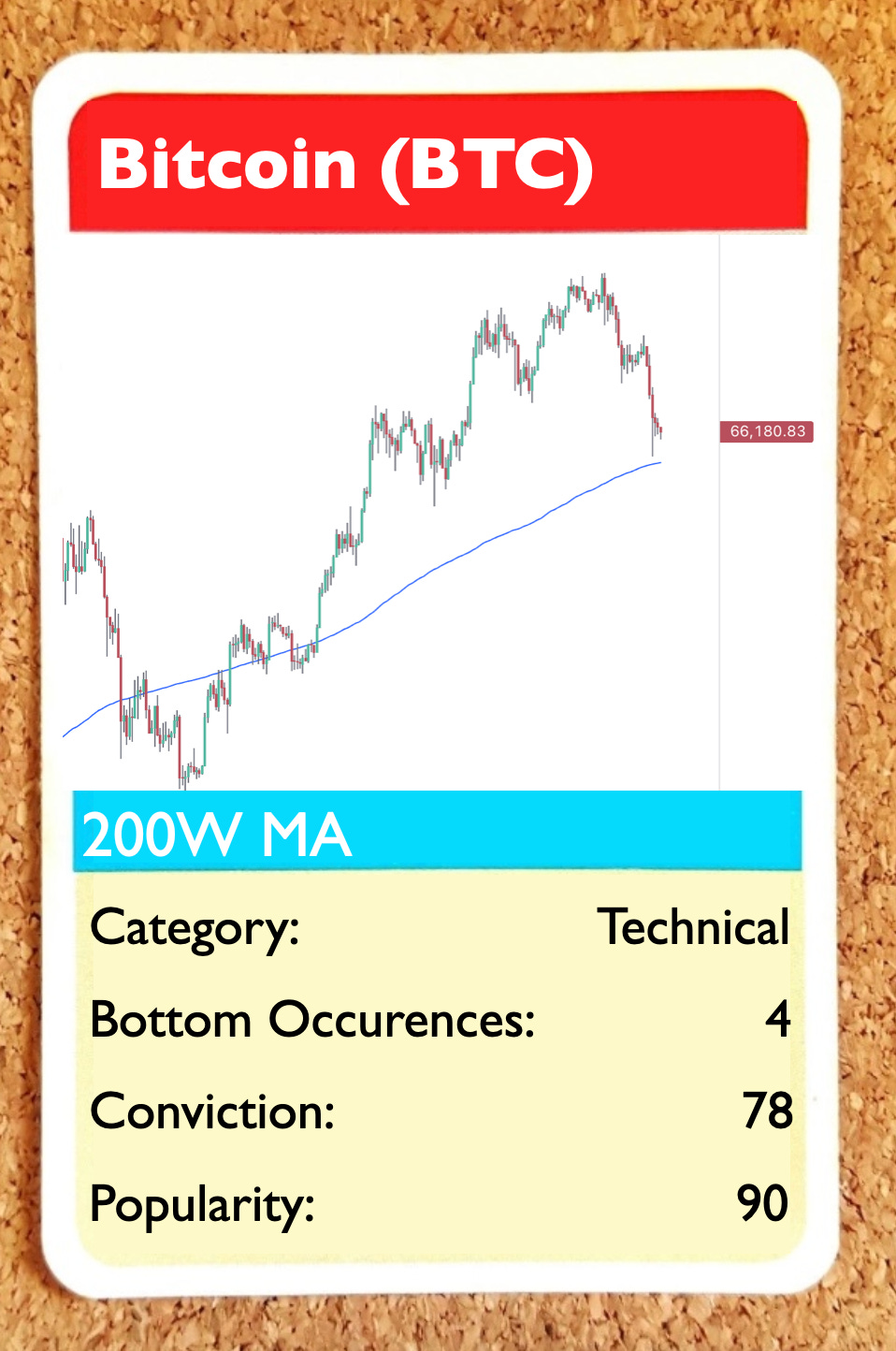
Crypto investors have been playing market ‘Top Trumps’ for months to counter opposing views.
Let’s see the games being played over the last few weeks.
First up, BTC has wicked down to its 200W moving average, a popular signal marking seller exhaustion cross-cycles.
But wait…volatility momentum is signalling a bear trend that is strengthening!
I have BAD NEWS for the perma bulls.
BTC is still strengthening its bear trend.
Volatility is a key metric used by quants to detect trends.
BTC entered its bear market when vol spiked upwards quickly. Vol then continues to climb, meaning the bear trend is strengthening. Then

4:54 AM · Feb 18, 2026 · 249K Views
348 Replies · 161 Reposts · 1.33K Likes
Sure, but we’ve seen the largest net realised loss of $1.5B in Bitcoin’s recent sell off. Futures markets have been meaningfully deleveraged allowing rallies to now form!
Last week's Bitcoin sell-off meets the criteria of a textbook capitulation event. It occurred rapidly, on heavy volume, and crystallised losses from the lowest-conviction holders.
In our latest newsletter piece, @_Checkmatey_ examines what this capitulation tells us about

3:12 AM · Feb 10, 2026 · 21.4K Views
19 Replies · 31 Reposts · 356 Likes
Glassnode disagrees, arguing that ‘participants in the base formation phase continue to capitulate. The same data can lead to opposite conclusions!
Elsewhere, liquidity contractions have been so extreme that they can only be a signal of selloffs nearing their end…
🚨 CRYPTO LIQUIDITY JUST HIT A LEVEL LAST SEEN DURING THE FTX COLLAPSE
USDT supply has fallen over -$3B in 60 days — matching conditions near Bitcoin’s 2022 BOTTOM.
When stablecoins supply shrink, it means investors are pulling capital out.
But historically, these liquidity

7:25 AM · Feb 23, 2026 · 22K Views
109 Replies · 90 Reposts · 453 Likes
For others like Mike Ippolito, it doesn’t matter when valuations have been sustained at excessively high levels. We are in a bear market for the next 9-18 months.
Some thoughts on this market:
I think it's likely we're entering a full on crypto winter. I am also open to the idea that this bear will be as bad as 2022, perhaps as bad as 2019.
The short term reason for this is that the industry is in an air gap created by unsustainable
1:40 AM · Feb 16, 2026 · 66.7K Views
99 Replies · 31 Reposts · 382 Likes
Yet, Mike also highlights alt names with growing TAMs and enhanced token alignments. The same people are broadcasting internally contradictory views.
The same news headlines are also generating opposite conclusions. Visser sees Blue Owl as the canary in the coal mine for software risk. Stephen Alpher sees it as the catalyst for BTC’s next bull run.
How is the average investor meant to make sense of all of this?
Simple State of Affairs
Crypto will likely remain correlated to software for the foreseeable future, with the latter also consolidating at its 18 year and 3 year support.
We are also just one week away from deMark count 9 to print for IGV indicating seller exhaustion.
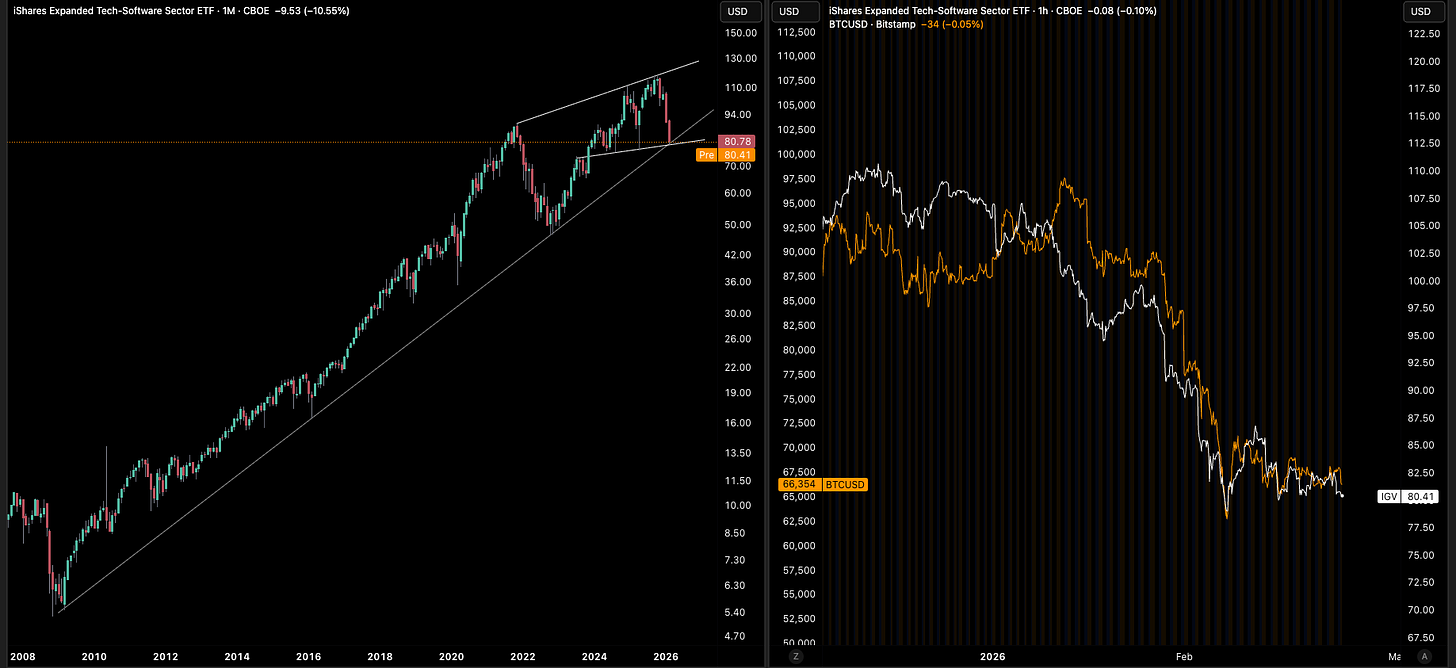
IGV monthly (left). BTC vs. IGV (right).
A double re-test of BTC’s lows — including brief lower lows — appears a reasonable base-case scenario case where investors can see if demand at the $58-$60k area can sustain.
This bottoming out process in underperforming sectors can take place before a possible renewed equity rally into late March.
This comes as crypto is hovering at its longer-term support vs. tech stocks.
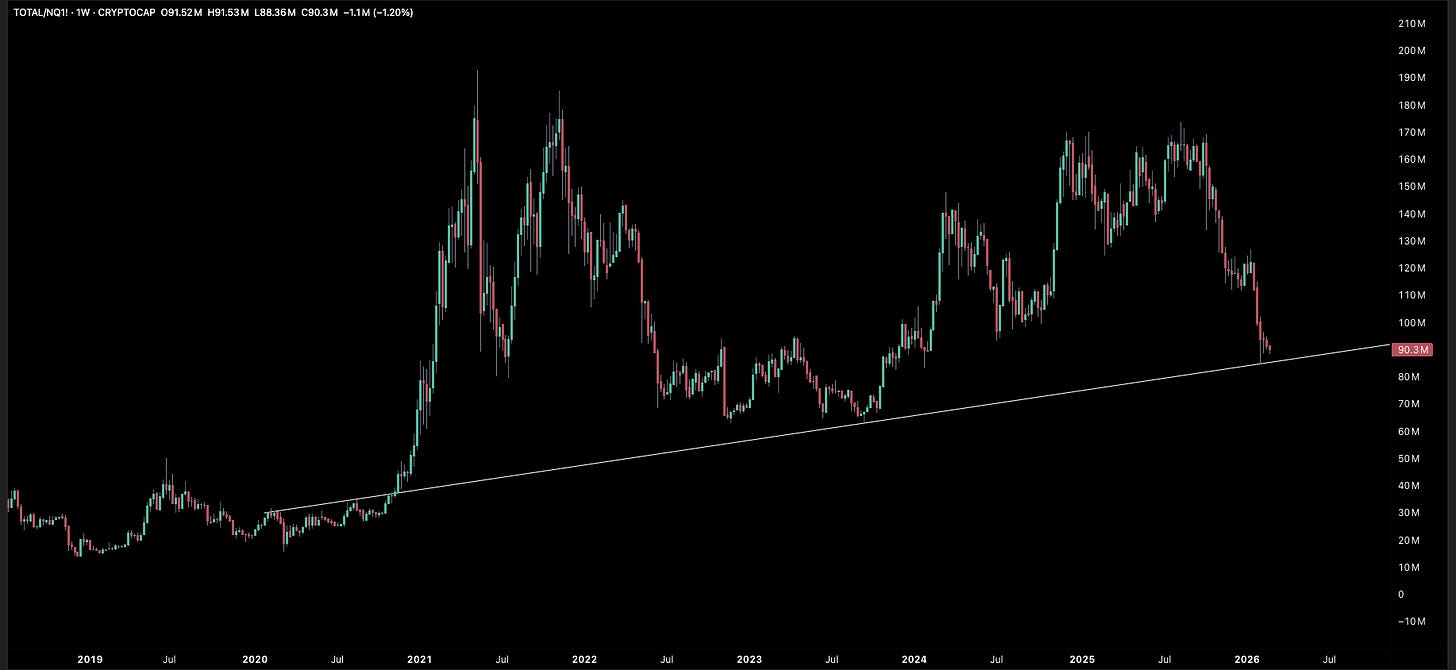
Crypto/NASDAQ ratio (weekly).
Consecutive Negative Months
Bitcoin is just one week away from 5 consecutive negative months. While it’s possible for consecutive negative months to continue, it feels that probability-wise the extent of the drawdown has already been realised.
The Dec 2018 instance was not actually the final low — BTC fell a further −7.6% in Jan 2019, extending the streak to 6 months.
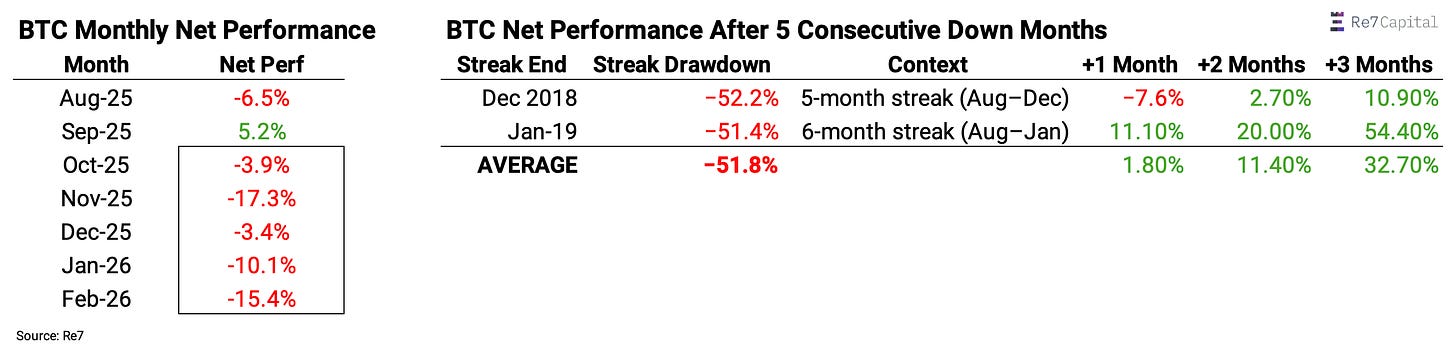
It was only at the Jan 2019 termination that the durable recovery began (+54.4% over 3 months).
This matters for the current setup: if Feb 2026 is the true end of the streak, history suggests a slow initial recovery (+1–11% in month 1) building into a strong 3-month return.
But if selling continues into March, the better analogy may be Jan 2019 — which produced the more powerful snap-back.
Integration Continues Beneath the Noise
While markets debate whether this is a bear market or a base formation, institutions appear less concerned with timing and more focused on integration.
Recent announcements over the past four weeks across traditional finance and payments highlight a continued push toward tokenised assets, stablecoin rails, and real-world blockchain adoption:
BNP Paribas is piloting a tokenised money market fund on Ethereum, signalling continued institutional experimentation with real-world asset tokenisation (RWA).
BlackRock has listed its BUIDL fund on Uniswap, bringing roughly $2.2B in tokenised Treasuries into DeFi markets.
Visa is expanding USDC-based stablecoin settlements, reinforcing blockchain infrastructure for cross-border payments.
SBI Holdings has signed an agreement supporting XRP Ledger adoption in Japan, advancing financial system integration.
PayPal reports that 39% of US merchants now accept crypto, with 84% expecting mainstream adoption within five years.
About Re7
Re7 Capital is a research-driven digital asset investment firm specialising in DeFi yield and liquid alpha strategies.
We’re Hiring, and currently looking for a Head of Legal. If you’re excited by institutional DeFi and want to help shape its future, you can learn more about this position, and others, here.
Disclaimers
The content is for informational purposes only. None of the content is meant to be investment advice. Use your own discretion and independent decision regarding investments. The opinions expressed in all Re7 public research articles are the independent opinions of the authors at the time of publication and not the opinions of the affiliates of Re7.
Please see here for full disclaimers.