Optimising Risk and Reward in DeFi - Re7 Market Neutral Strategy celebrates 5 years
JUL 27, 2026
Re7 Capital's market-neutral DeFi strategy celebrates 5 years and a 2026 Hedge Fund Journal award for best DeFi performance. Founder Evgeny Gokhberg explains how a proprietary credit-style ratings framework, hyper-selective platform vetting, and disciplined risk management have delivered double-digit returns with a default rate 20x below the industry average — even through the October 2025 flash crash.

THE HEDGE FUND JOURNAL — JULY 2026
PROFILE
Optimising Risk and Reward in DeFi
Re7 Market Neutral Strategy celebrates 5 years
Hamlin Lovell
Re7 Capital's Re7, launched in July 2021, celebrates its 5 year anniversary milestone in July 2026, and has won The Hedge Fund Journal's 2026 Digital Currency Award for best performance in 2025 and over 2 and 3 years ending in December 2025 in the DeFi (Discretionary Strategy) category. This strategy is also market neutral and the 10/10 flash crash on 10th October 2025 was its best ever day for performance.
Re7 founder, Evgeny Gokhberg, who started investing in digital assets in 2016, and has been active in DeFi from its dawn in 2019, recalls: "At the start it was like the Wild West gold rush with new platforms starting up and shutting down on the same day. Sector-wide default losses were 15% but yields were 40%". Now, sector-wide annualized default rates have fallen to around 2%, though Re7's default rates are roughly 20x lower. Innovation continues unabated, with over 1,000 new DeFi platforms in 2025 spawning opportunities ranging from zero coupon bonds to more elaborate multi-legged trades. In parallel, tokenization of TradFi assets expands the investment universe.
TradFi, credit and chess
Though many platforms that Re7 works with are "crypto native" firms and individuals, Gokhberg's career started in TradFi in hedge funds and banking. This informs Re7's holistic method of decomposing DeFi risk and reward into sources of risk, yield and profit. "Our approach is as traditional as possible. We view risk through the prism of a process somewhat analogous to credit ratings and have more in common with a traditional credit strategy than most trading strategies. We know what the left tail event is," says Gokhberg.
His risk perspective is also shaped by chess; Re7 is named after a well-known move. "Chess has taught me to be rational and strategic, which helps in this sector given the volatility and unpredictable scenarios in DeFi. The biggest mistakes happen when you assume you're smarter than your opponent or, in this case, the blockchain security universe. I never assume I am the smartest person in the room. Chess also indirectly inspired our risk management philosophy. Some risks can be quantified and measured while others are less predictable. There are known and unknown knowns and unknowns".
A hyper-selective ratings funnel
From day 1 of DeFi, Re7 categorized and analyzed every single loss event and problem to build its proprietary risk management framework. "Our job isn't to earn the risk-free rate by avoiding risk altogether, it's to be risk-managed and earn high risk-adjusted yields," says Gokhberg. "The main risk to this strategy is cyberhacks, which makes it unique and completely decoupled from other strategies allocators may hold in their portfolio, whether within or outside digital assets. We don't aim for 100% safety; we set maximum exposures based on risk ratings from AAA to CCC." Re7 requires a minimum BBB rating to invest, and none of its AAA-rated entities have collapsed, but Gokhberg is clear that zero-hacks industry-wide was never the goal.
Hacks are an accepted cost of doing business across DeFi; the question is how well a manager mitigates them. Re7's default rate sits at just <0.5%, well below the industry average. Crucially, that discipline hasn't come at the expense of returns: the strategy has delivered double-digit yields, the same way a fixed-income manager outperforms by earning more yield than the market while defaulting less than it. Gokhberg puts this down to a structured hierarchy of risk analysis: "We want to identify red flags as early as possible, size exposure down for anything rated below our threshold, and have a clear recovery plan for when something does go wrong. We avoid red-flagged entities altogether, take minimal exposure to lower-rated names, and have recovered 100% or more of capital in some cases".
Re7's proprietary risk models and ratings are not available to third parties but are shared with the platforms and protocols they apply to as part of a private "activist" campaign to raise standards throughout the space. "We take an activist approach: we share our findings so firms can improve their risk management, and where they act on that feedback, we may increase our allocation. Our mission is to make the whole space more secure, cut defaults for everyone, and make it more investible for larger institutions," says Gokhberg.
The ratings outputs look like credit ratings, but some of the inputs sound conceptually more like parts of an operational due diligence exercise or a SOC (System and Organization Controls) 2 report on cybersecurity, though certain details are specific to DeFi. "We have dozens of tick boxes like a mortgage application form and weightings for each item," says Gokhberg. Protocols or venues could be rejected for multiple reasons, including the quality of smart contracts; network capacity and congestion risk and risks of downtime. Regulatory and legal risks are also considered, for example, by excluding privacy protocols. "There is no exposure to them because some are very non-compliant," points out Gokhberg.
Man and machine
The funnel is not only algorithmic as Re7 sources opportunities through Gokhberg's extensive network across founders, protocols and VCs: "We have investigated thousands of platforms and provided liquidity to hundreds. Our bootstrapping solves the cold start problem and has helped to foster multiple ecosystems, so every startup wants to meet us".
The process combines questionnaires and human judgment. "Systems, agents and humans combine to make decisions and select platforms because some of our decision trees are too broad to be completely systematized," points out Gokhberg. Though Re7 are making more use of AI agents to help check software risk, tools and systems engineering, ultimately code is still written by humans and gut checks on individual characters are vital: "We avoided some teams that passed technical due diligence because they did not feel right," he reveals. Re7 is hyper-selective: exposed to between 30 and 40 out of thousands of platforms at any time, and between 5 and 10 out of hundreds of blockchains.
A volatile opportunity set
Re7 is constantly reshuffling the mix of approved platforms and protocols. "Conceptually the strategy is like being able to make unlimited fee-free switches between bank accounts offering fluctuating rates of interest. In fact, this is not a high frequency trading strategy as average relationship duration is 3-6 months, though real-time risk management monitoring can generate automated responses 24/7," explains Gokhberg.
DeFi yield cycles can be both shorter and more erratic than in TradFi, moving from feast to famine in a matter of months, weeks or sometimes even intraday.
The strategy dynamically and opportunistically rebalances amongst sub-strategies that can be broadly categorised as lending, staking, market making or trading. Some buckets can be empty when risk/reward is not compelling; in early 2026 funding rates in lending were too low. In theory 100% could be allocated to any of the four sub-strategies, but in practice, diversification constraints – the number of approved platforms and protocols, and maximum ratings-based exposures to them – place natural constraints and ceilings. "For instance, to allocate everything to lending there would need to be attractive opportunities spread across about 50 approved platforms. The risk limits partly reflect the fact that lending platforms have historically been hacked more frequently than automated market maker (AMM) platforms. In contrast, staking could not reach 100% as there are not currently enough approved staking protocols and platforms to maintain our required diversification," explains Gokhberg.
Fig.1 — Ratio of total $ DeFi hack volume to DeFi TVL (2021-2026)
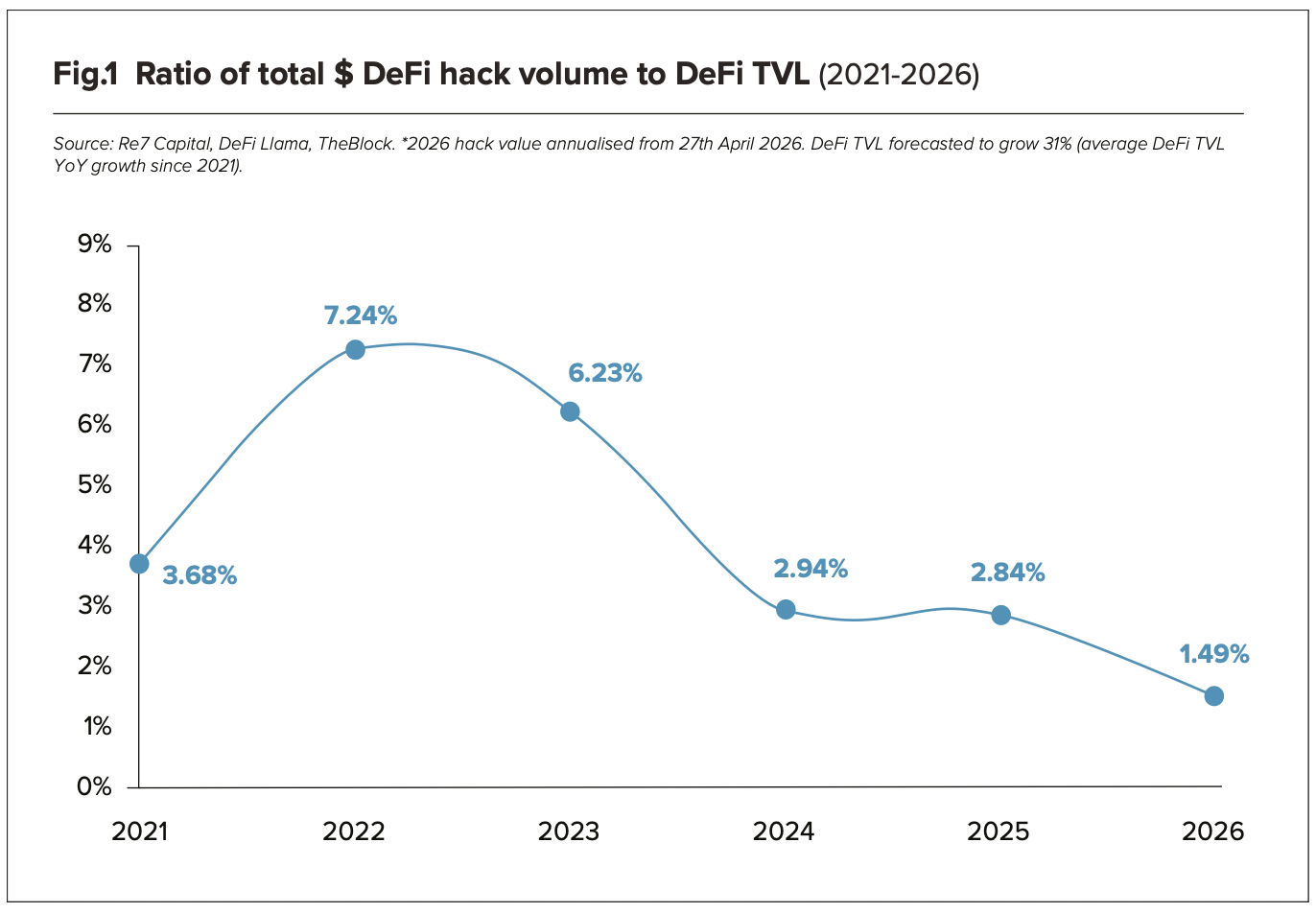
Source: Re7 Capital, DeFi Llama, TheBlock.
TVL, demand and supply
Re7's five-year average annual net returns have remained in the double digits across multiple market cycles, with comparatively low volatility. The on-chain funding rates it captures, however, can gyrate sharply in response to both supply and demand factors. In June 2026, Re7 was briefly able to obtain annualised returns of 100% on Hyperliquid, though this exceptional spike only lasted for a period of between about 8 and 12 hours. "We sometimes find on-chain yields as high as 30-50% on platforms with acceptable risk. At other times it is hard to even make 5% annualized," says Gokhberg. Re7's allocation process is built to smooth over exactly this kind of dispersion — which is how the fund nets out to a steady double-digit return per annum across market cycles.
The level of DeFi TVL (Total Value Locked), which rose roughly 10x in 2021 and 3x in 2024, is one factor, but bullish sentiment increasing demand for leverage and boosting funding rates were also needed for Re7's two bonanza return years of 2021 and 2024. Therefore, the strategy can provide some degree of call optionality on a raging bull market in certain coins.
This is like CeFi digital asset cash versus futures/perpetuals trades, but in DeFi supply of capital is also important: a glut of capital depressed yields in early 2022 while the subsequent exodus of capital pushed up funding rates in 2023 and 2024 and shortages in 2026 also briefly increased yields.
These cycles are clearly very different from TradFi interest rates, which can move in the opposite direction, steadily rising due to inflation and central bank rate hikes through 2022.
Gokhberg envisages annual returns as high as 20-35% in the most benign conditions and 10-17% in positive conditions. In June 2026 when we spoke, he was happy with 10% but returns could drop to low single digits in a challenging year such as 2022 or simply when returns are not high enough to cover risks and hedging costs. No minimum return target is set, as the strategy will only take on risk when it is adequately compensated.
Generally, the strategy uses little or no leverage, but exceptions can sometimes be made in yield farming: "Where yields are above costs of capital, we might leverage up a yield position but will only do so on the same DeFi platform. This is like leveraging a bank deposit. We are still only risking the same capital allocation," says Gokhberg. Taking one of the largest DeFi protocols, Aave, as an example, Re7 could deposit or lend stablecoins against assets, and sometimes use some leverage on its peer-to-peer marketplace.
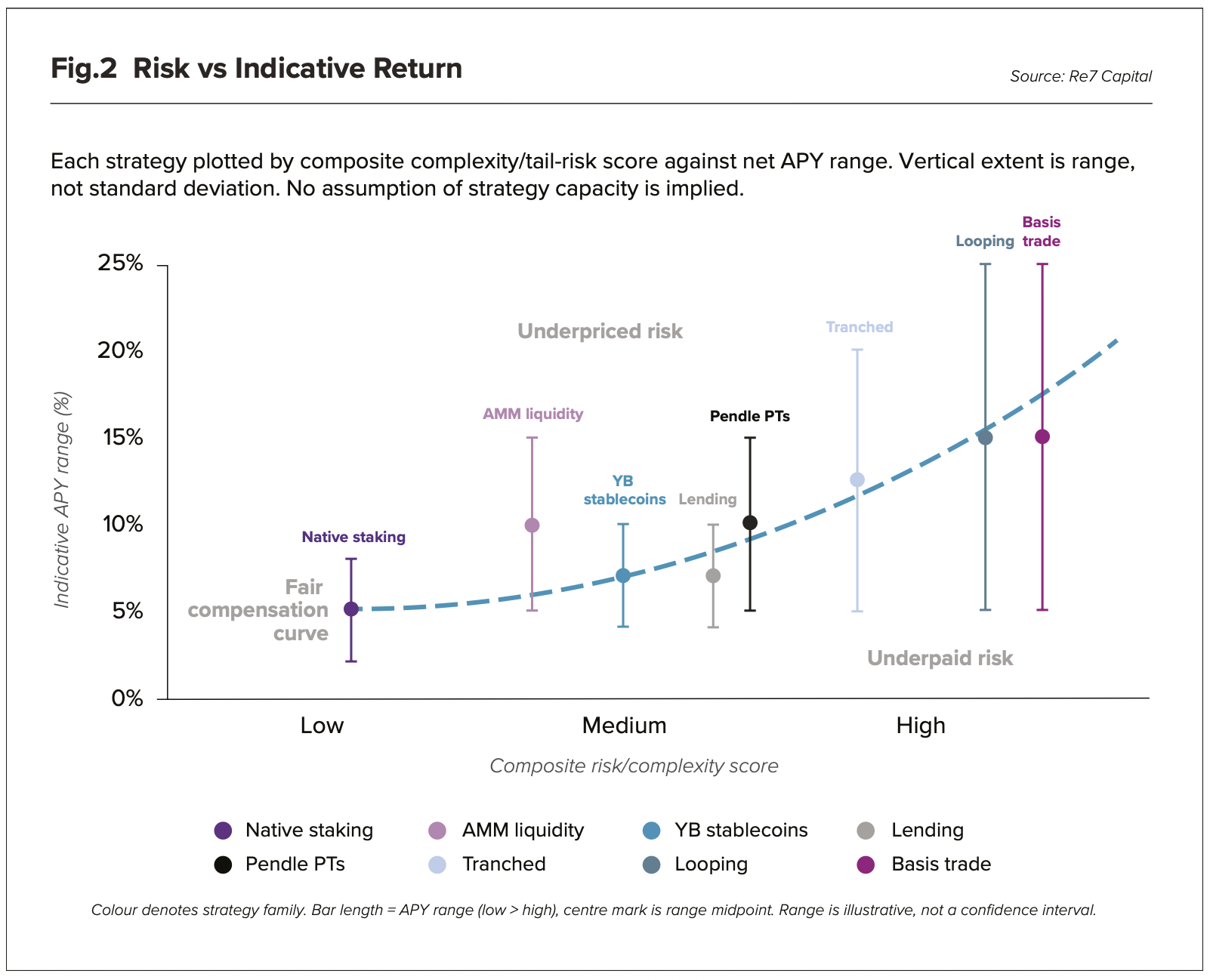
AMM liquidity mining
DeFi basis trades can be more nuanced than the more well-trafficked cash versus futures/perpetuals trades in CeFi. "The logic is the same, but we may get additional yield from DeFi, and we can work with multiple assets in automated market maker (AMM) pools," says Gokhberg.
AMM, or "liquidity mining" trades, could deposit baskets of assets including UNI (Uniswap) or ETH, in a decentralised exchange (DEX) liquidity pool and make markets in them for a few months, during which time FX kiosk trade frequency could be 1 per minute for liquid staking and re-staking. "Return drivers include leverage, funding rates, trading volume and velocity, spreads and sometimes also incentives such as fee earning tokens," says Gokhberg.
Special situations, which could include a quasi-distressed debt trade buying coins below recovery value, are by their nature intermittent and typically only two material opportunities per year have arisen. Some special situations can overlap with lending.
Delta hedging and venues
Meanwhile delta on volatile legs of trades is hedged across all strategies, typically using perpetuals, to avoid the risk of holding inventory. Hedging costs are factored into modelling. The delta hedging book primarily makes the rest of the book market neutral and usually delta hedges on different venues to optimize costs and spreads, which fluctuate and vary between venues.
Both exchange and DeFi exposures are reported to investors; most of Re7's DeFi exposure sits in non-custodial, smart-contract-based positions.
Some digital managers trading on centralized exchanges (CeFi) are approaching 100% triparty custody to mitigate counterparty risk. "Triparty exists so another FTX never happens. When we occasionally have small amounts of NAV hedges on CeFi venues we aim to use triparty custody," says Gokhberg.
Liquidation risk
Volatile markets and liquidity hiatuses have reportedly led to some traders being liquidated at a loss when prices gap below a collateral cushion threshold too fast to execute part or all of a trade. "We have never experienced losses due to price gaps because we apply conservative over-collateralised health factors and only accept blue chip collateral. Collateral factors are partly based on the volatility of the collateral," says Gokhberg, who admits that Re7's zero loss rate from liquidations is also partly thanks to the superior features of DeFi platforms: "On 10/10 some CeFi exchanges (such as Binance) closed and liquidated traders in a way that was not orderly. DeFi platforms are fully automated and so performed as expected and should not have lost a cent".
The panic was a boon for Re7 as October 10th, 2025, proved to be its best ever day and contributed most of the monthly return. "Many things worked in tandem including arbitrages between CeFi and DeFi venues," reveals Gokhberg.
Denominations, vehicles, and rails: expanding access routes
Re7 is building out a growing array of access routes in terms of denominations and vehicles or "rails" and distribution platforms. They range from giant TradFi banks, wealth management platforms, to innovative rails.
The market-neutral strategy can now be accessed through fiat USD, BTC and ETH denominations, with each in both traditional fund and tokenized fund formats. The tokenized funds can also be accessed through Telegram's wallets. Re7's market neutral funds are now supported by two world-renowned custodians, Anchorage Digital and Zodia Custody: Zodia provides on-chain representation and custody for the market neutral strategies via its Interchange settlement network, while Anchorage offers qualified custody for the mRe7ETH share class.
The tokenized ETH-denominated vehicle, mRe7ETH, is built natively on Optimism, one of the leading ETH Layer 2s. "It is a great joint venture to deploy on their blockchain," says Gokhberg. The BTC Yield fund is similarly built on Starknet, another leading ETH Layer 2 scaling network.
Re7 expects to roll out further integrations with other wallets and Fintechs.
The advantage of these different access routes is mainly convenience. "Tokenization essentially involves different tech layers and rails, replacing traditional paperwork and settlement infrastructure," says Gokhberg.
Most Re7 investors are family offices, funds of hedge funds, and crypto-native treasuries. Some corporate treasuries seeking steady yield generation are also invested.
Directional and venture capital strategies
The award-winning market neutral strategy is the most popular one given its consistency and resilience through multiple black swan events. "We also see investors showing more interest in our directional 'liquid venture' fund investing in altcoins as recent price declines have made the risk/reward more asymmetric. The altcoin space now has businesses with genuine cashflows that have been dragged down by overall sector volatility," says Gokhberg. Every crypto winter is a Schumpeterian process of creative destruction that cleanses weaker players and leaves survivors stronger and more resilient.
The venture capital fund targets very early stage agentic and consumer social ventures.
Meanwhile, the multi-strategy fund investing across market neutral, liquid directional and venture capital appeals to investors who want to maintain diversification through cycles.
Running the gamut, from liquid trading to long term venture capital, also creates a flywheel of opportunities across the firm. "For instance, a new protocol that needs liquidity could attract a venture capital investment for early-stage pre-launch tokens and receive some liquidity funding from another fund, which in turn generates arbitrage opportunities through price discovery," points out Gokhberg, who applies his cautious analytical approach to the growth prospects of the space.
DeFi, tokenization and stablecoins growth outlook
DeFi TVL has been very volatile, peaking around USD 180bn in 2021, troughing around USD 50bn for two years from about 2022 to 2024, nearly matching its prior peak in early 2026, and then dropping by 50% again. "This is natural because it is a volatile sector and procyclical due to overleverage. There are structural and legacy reasons for the inherent volatility to persist," points out Gokhberg, who sees improving opportunities for the strategy but is not a "maximalist" forecasting a complete and rapid upending of finance such as tokenized DeFi decentralized exchanges rapidly rendering TradFi centralised exchanges obsolete. Gokhberg certainly expects exponential growth in tokenization but does not see it superseding traditional exchanges as both sorts are growing volumes.
DeFi TVL is approaching USD 100bn in June 2026 and Gokhberg is confident about deploying around USD 1bn, but the best risk/return opportunities do not have unlimited scalability. The market is however growing and broadening its scope as assets, including equities and credit, get tokenized and push up the TVL measure. "Tokenization is already expanding our investment universe — from arbitrage opportunities to lending against tokenized instruments without taking credit risk. We're already running some of our favourite coin strategies on tokenized equities," says Gokhberg.
Growing stablecoin monthly settlement volumes, soon predicted to overtake ACH (Automated Clearing House), will also raise the velocity of capital, accelerate adoption and expand the opportunity set.
There is great optimism about the long delayed and much vaunted US Clarity Act. Gokhberg does not see it as a game changer for his strategies: "We do not see any direct impacts for lenders/traders and market makers, though it may reshuffle the areas for best and most sustainable alpha".
In any case Re7 will be ready to re-allocate to the best risk/reward opportunities. THFJ
DISCLAIMER: This article is for informational purposes only and does not constitute investment advice, a recommendation, or an offer or solicitation to buy or sell any fund, security, or digital asset. It is not intended for distribution to, or use by, any person in any jurisdiction where such distribution or use would be contrary to local law or regulation. Past performance is not a reliable indicator of future results, and no representation is made that any investment will or is likely to achieve returns similar to those referenced herein. Statements regarding future returns, market conditions, or strategy performance are forward-looking statements based on current expectations and assumptions, are inherently uncertain, and actual results may differ materially. Digital assets and DeFi strategies involve a high degree of risk, including but not limited to market volatility, smart contract risk, regulatory risk, custody risk, and potential loss of principal, and may not be suitable for all investors. Any views expressed are those of the individual(s) quoted at the time of publication and do not necessarily reflect the views of Re7 Capital as a firm. Prospective investors should conduct their own due diligence and consult independent legal, tax, and financial advisors before making any investment decision. This article does not constitute an offer to sell or a solicitation of an offer to buy any interest in any Re7 Capital fund, which may only be made pursuant to formal offering documents.