The Weekly: Sentiment on sentiment
APR 20, 2026
Re7's latest weekly note takes a data-driven look at crypto sentiment in 2026, finding it historically anomalous despite a resilient market recovery. Using Fear & Greed Index analysis, the note examines why caution has persisted against a constructive macro backdrop, and what that divergence may signal for the period ahead.
Last week, Re7 Capital advanced its institutional infrastructure through a new partnership with Zodia Custody, reflecting the growing demand for onchain fund structures meeting institutional security standards. Zodia Custody will support transparent onchain representation of investments in Re7’s BTC Yield and Market Neutral Strategies, providing secure custody infrastructure for these fund interests. Eligible clients will be able to hold them within institutional-grade cold wallets, ensuring investor capital remains protected.
This collaboration highlights the accelerating institutional adoption of onchain investment vehicles that combine robust operational rigour with uncompromising security. Read more on our blog.
Weekly Summary
We cover:
2026 sentiment in numbers
How 2026 compares to previous years
How sentiment is diverging from macro conditions
Market update
Sentiment on Sentiment
Re7 has regularly sense-checked market sentiment over the past few months and consistently found that positioning has skewed defensively. Divergences from broader equities in Q4 and geopolitical tension in the Middle East have only reinforced this dynamic further.
This week, we analyse the Fear & Greed crypto index data more deeply to illustrate how broken sentiment really is.
The Fear & Greed Index aggregates volatility, market momentum, social media sentiment, and trading volume into a single 0–100 score measuring the emotional state of the crypto market.
2026 in Numbers
Taking a snapshot of 2026 so far, we’re already breaking records.
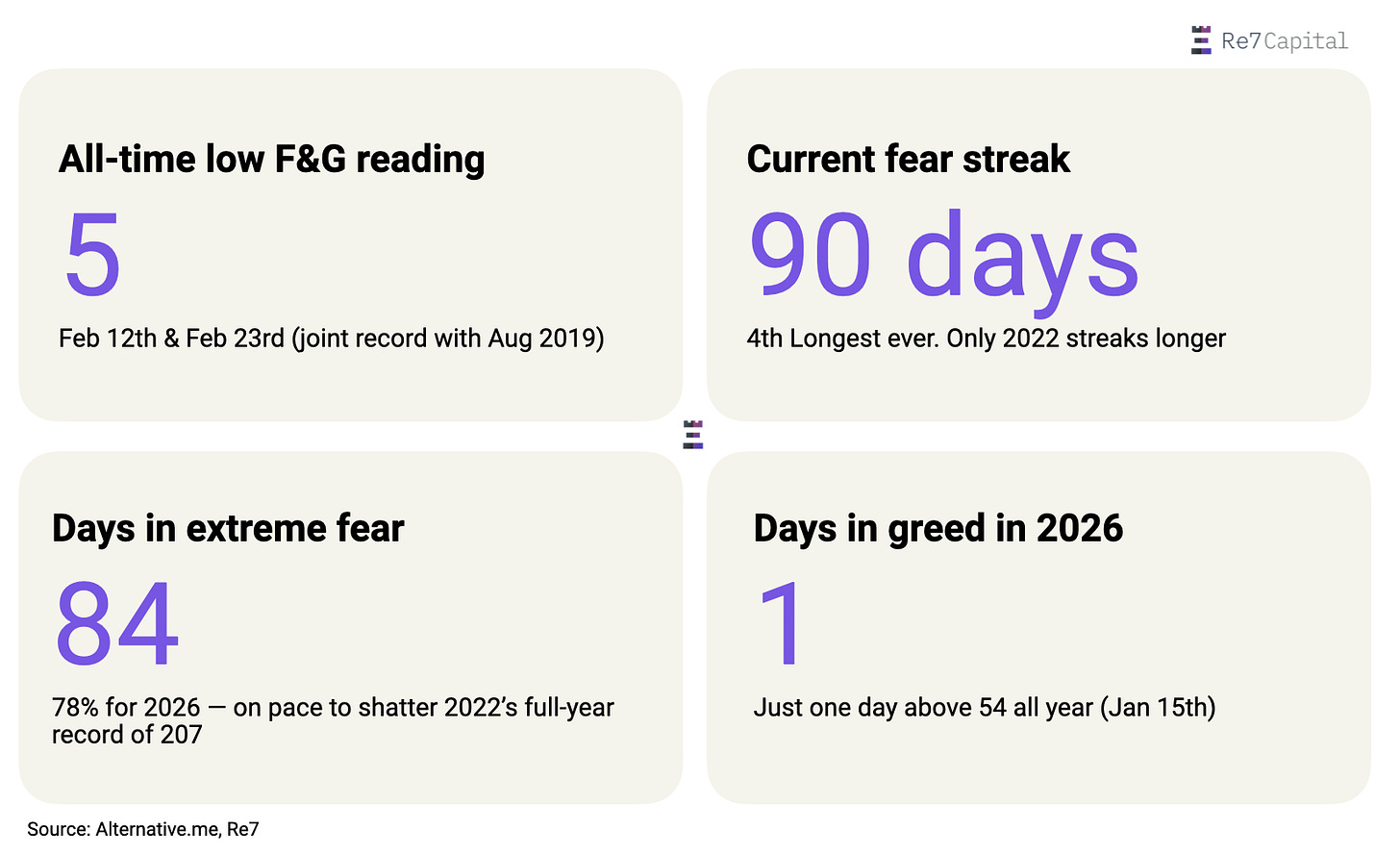
This year, we’ve already printed an all-time low in the index (5) - a joint record with August 2019.
We’ve also only had 1 day in greed — the only year this has happened in history.
At current pace, 2026 will have the most days in extreme fear, beating 2022’s bear market — a year defined by the Terra and FTX collapses and an aggressive rate hike cycle.
2026 vs. Other Years
Now, let’s zoom out a bit more.
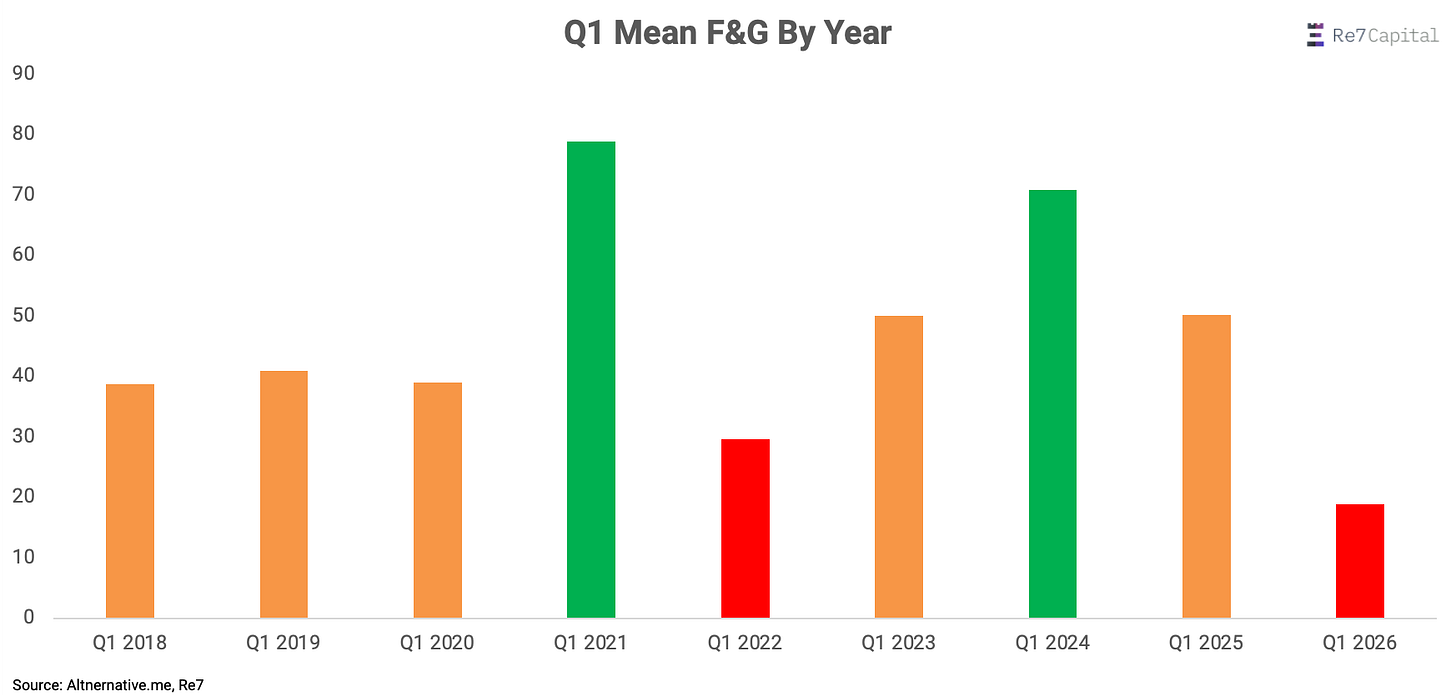
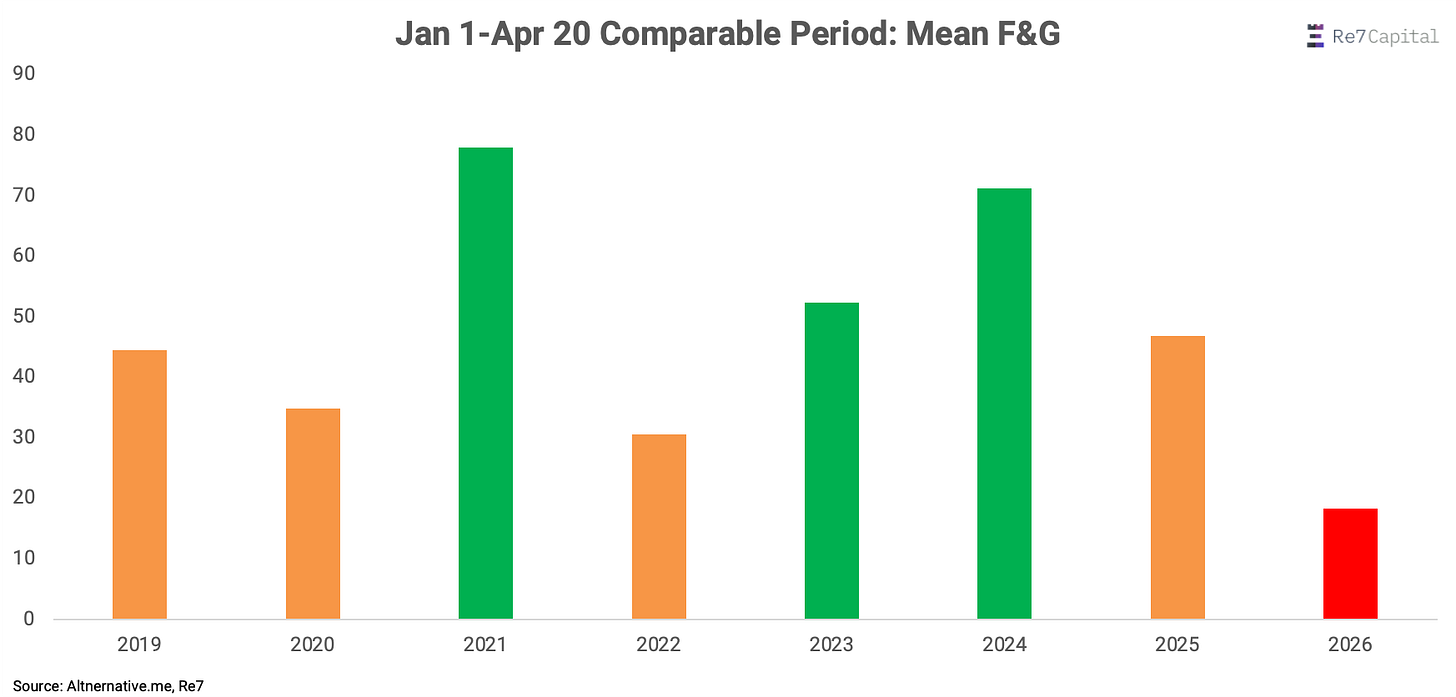
We’ve had the least optimistic start of any opening quarter on record with a mean F&G reading of just 19 — 10 points lower than 2022.
We’re only in April, but 2026 has had the highest percentage of days in fear or extreme fear on record at 95%.
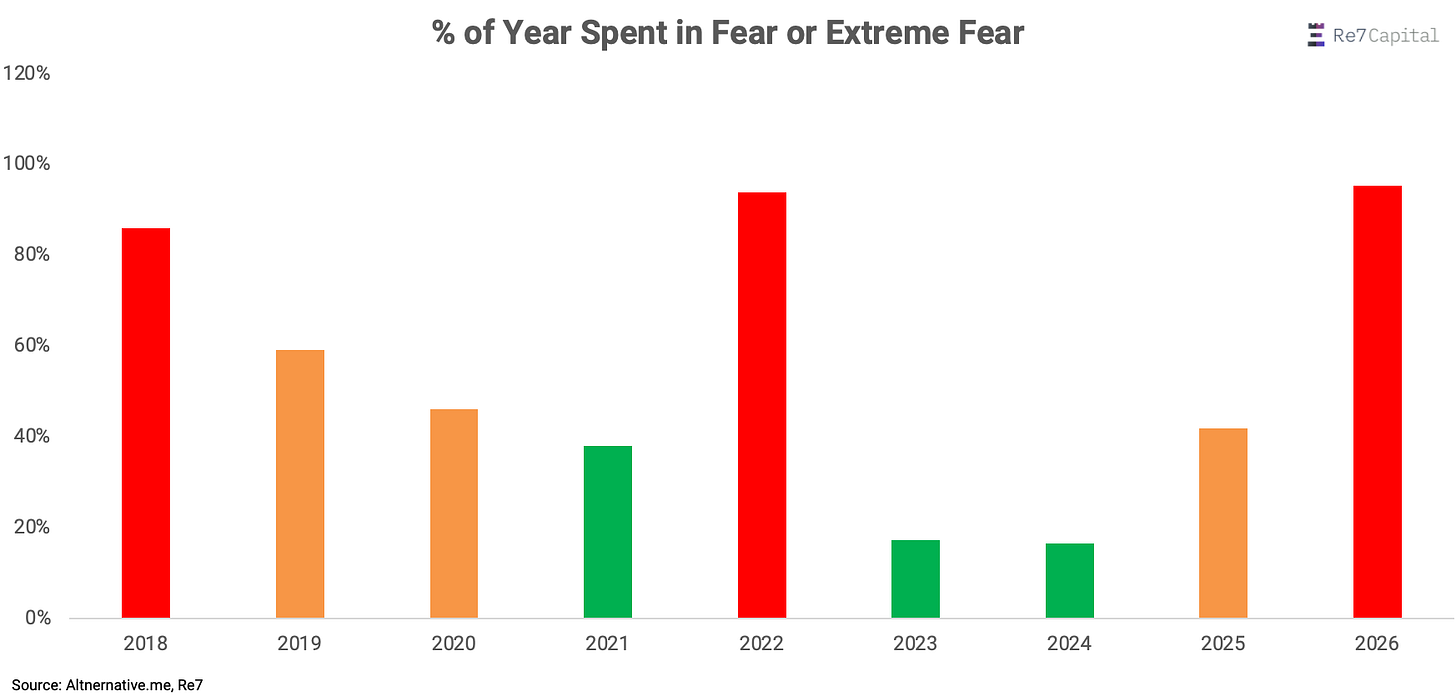
We can see this trend extend into April despite markets recovering +25% off their Feb 6th lows.
The year-to-date mean F&G reading up to 20th April (18) is almost half of 2022 (31). Yet unlike 2022, there is no single catastrophic event to point to. In other words, this is sustained, structural fear.
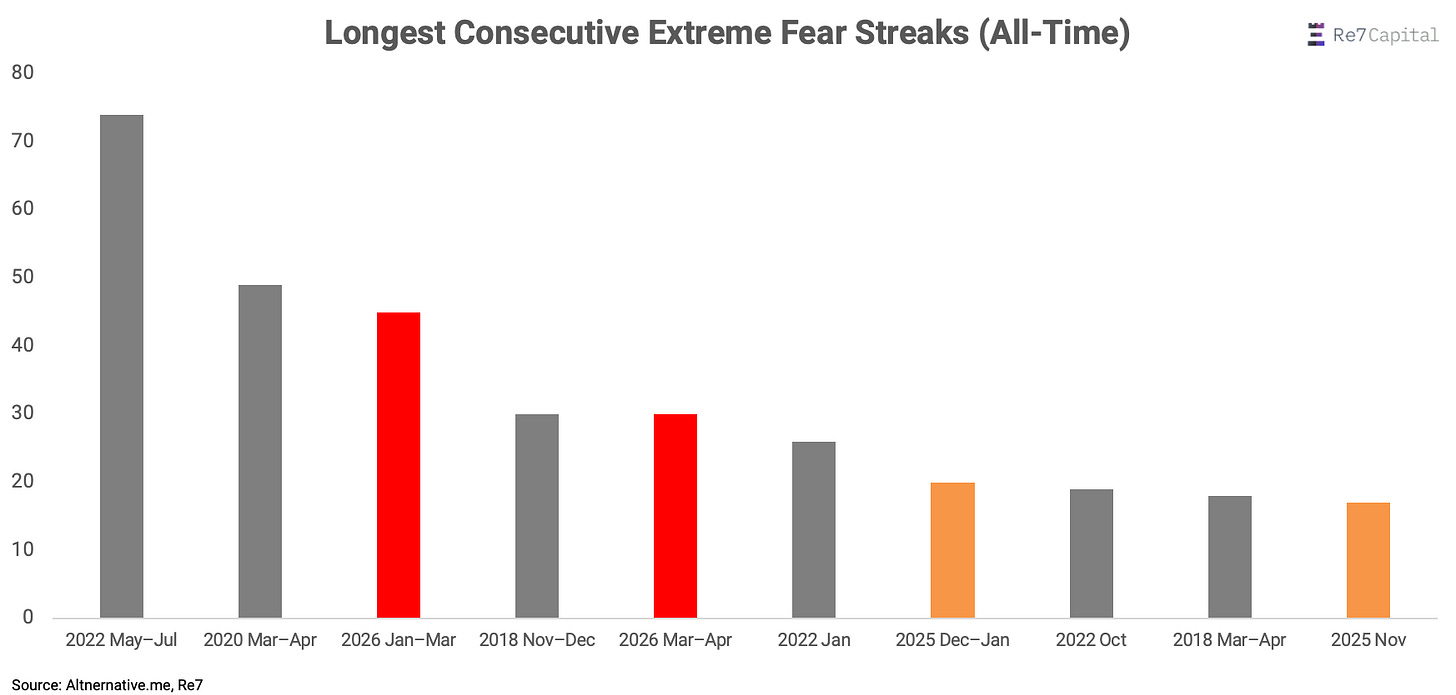
Isolating extreme fear specifically, 2026 already accounts for the 3rd- and 5th-longest sustained periods on record — and the year is only four months old.
This follows a 2025 where Q4 already showed signs of deteriorating sentiment — the 7th- and 10th-longest extreme fear streaks on record — making 2026 a continuation and acceleration of a trend that was already in motion.
Macro Context
Aside from the nominal records, what makes the current sentiment dynamic unique is the context in which it is occurring.
Historically, crypto sentiment has tracked broader economic conditions reasonably closely — periods of growth bring higher incomes, greater savings, and more capital deployment, which feeds into positive price momentum and elevated sentiment readings.
This relationship has broadly held across cycles.
What makes 2026 different is a meaningful divergence from that pattern. Despite relatively buoyant economic conditions — including stronger US ISM readings — sentiment has failed to respond.
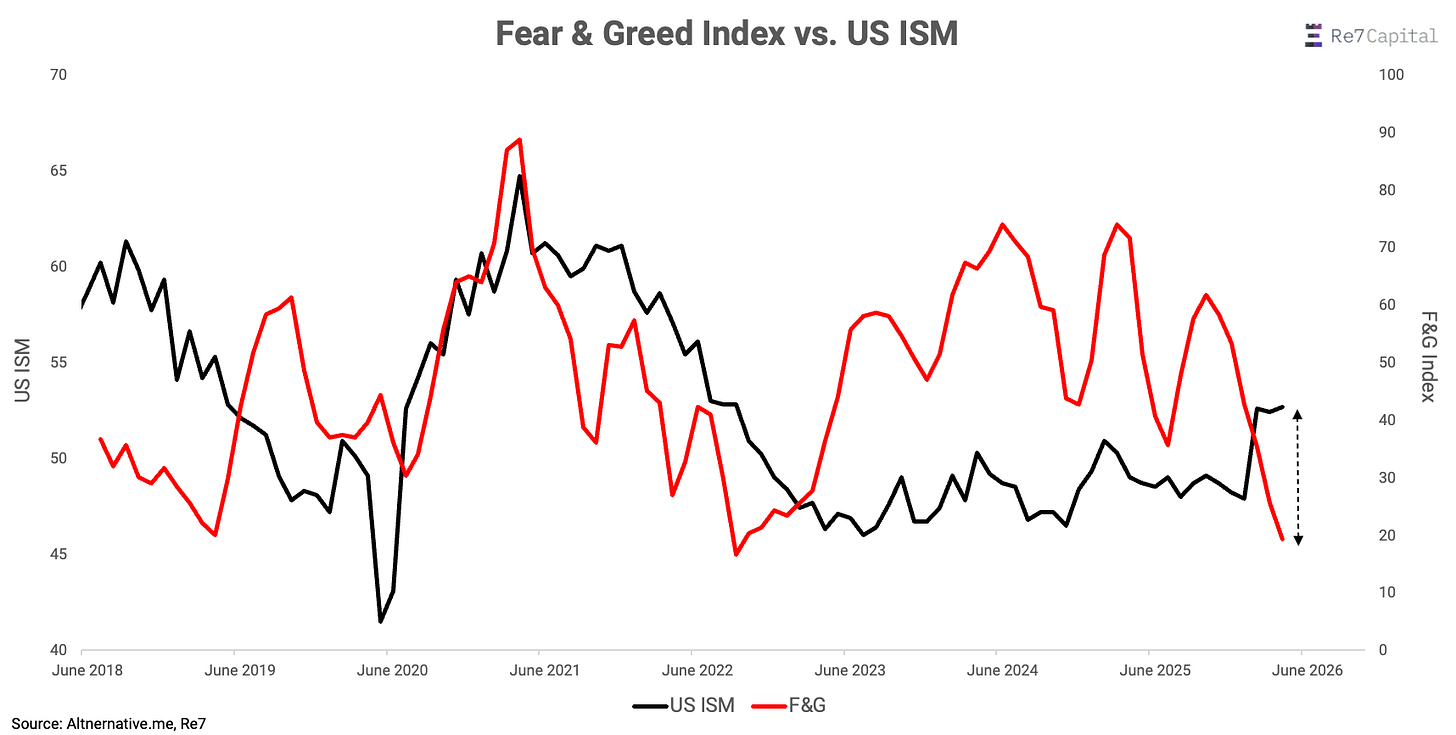
The gap between crypto sentiment and broader economic conditions is the widest we have ever recorded — not just during periods of ISM strength, but across the entire history of both indices.
The usual transmission mechanism has broken down, suggesting the fear gripping crypto markets is being driven by something beyond the macro cycle: geopolitical stress, structural positioning, and a market that has simply lost its risk appetite.
Closing Remarks
It’s clear 2026 is not just a ‘bad patch’ but a historically anomalous, prolonged period of extreme fear.
But with sentiment this compressed and macro conditions turning on the backend, the path of least resistance for sentiment feels higher. Markets rarely stay this fearful for long before the underlying currents pull them back.
Market Update
Markets are now +25% off their Feb lows with global crypto market capitalisation now at ~$2.51T today.
Last week, BTC rose +4.3% while ETH rose +3.3%.
Recent escalatory rhetoric between Iran and the US continues to moderately whipsaw market direction. Yet, the broader market pattern have remained overall robust since the Feb lows (higher highs, higher lows).
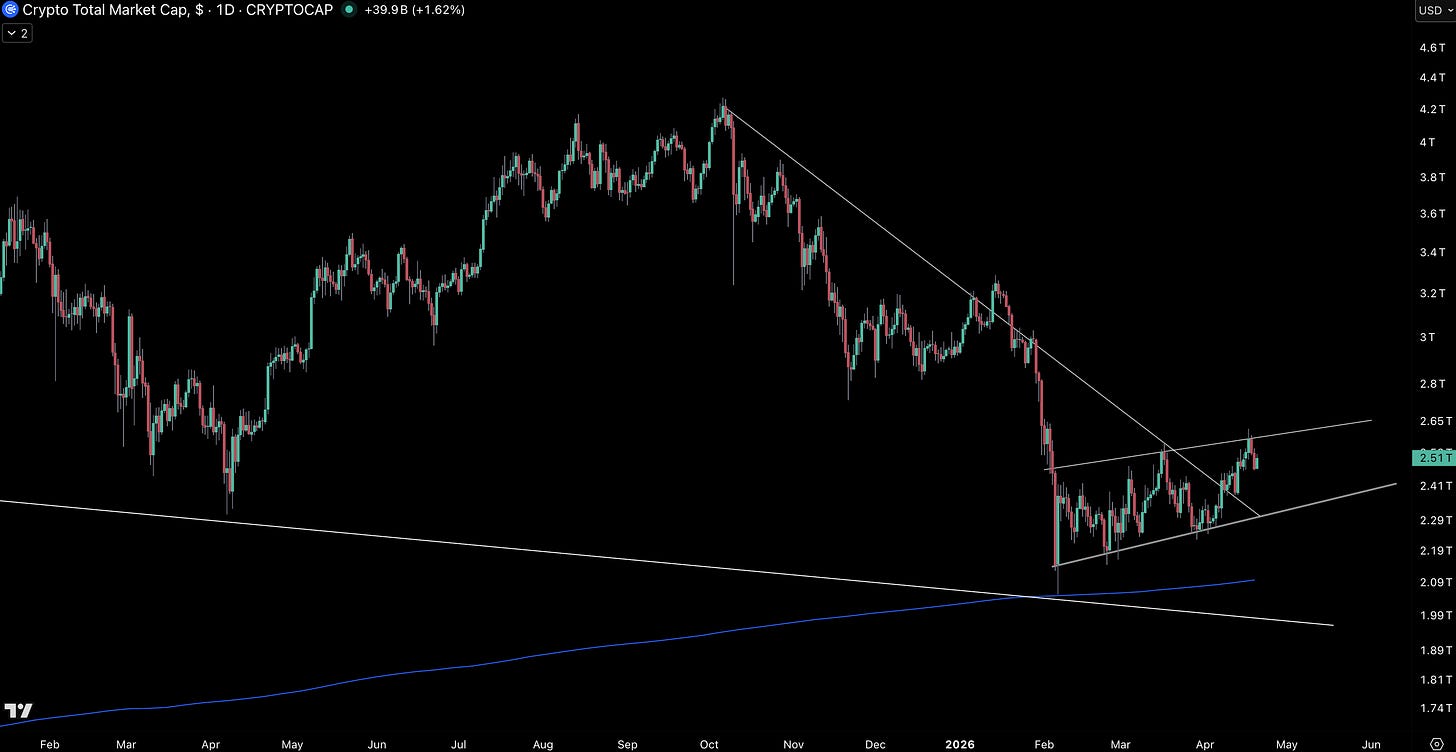
Global crypto market capitalisation ($; daily).
Risk asset remaining relatively stable with volatility indices not spiking dramatically suggests that the market is pricing in low probability of sustained escalation having an impact on valuations:
Trump will blink → too much political risk on the line to tolerate
Institutions will contain it → back channels negotiations kick in
We’ve seen this before → buy the dip reflexivity like Covid, April tariffs
Backend macro conditions remain structural driver of valuations → economic growth story intact, high net US liquidity, record bank earnings
There’s an asymmetric payoff problem: if you hedge for disaster and it doesn’t materialise, you underperform; if you ignore the risk and it does, you lose—but so does everyone else.
The result is a structurally under-hedged market, reinforced by strong earnings and ongoing AI capex.
The BTC/Brent continues to echoes this thinking, exhibiting a clear three-phase progression—drawdown (A), consolidation (B), and recovery (C).
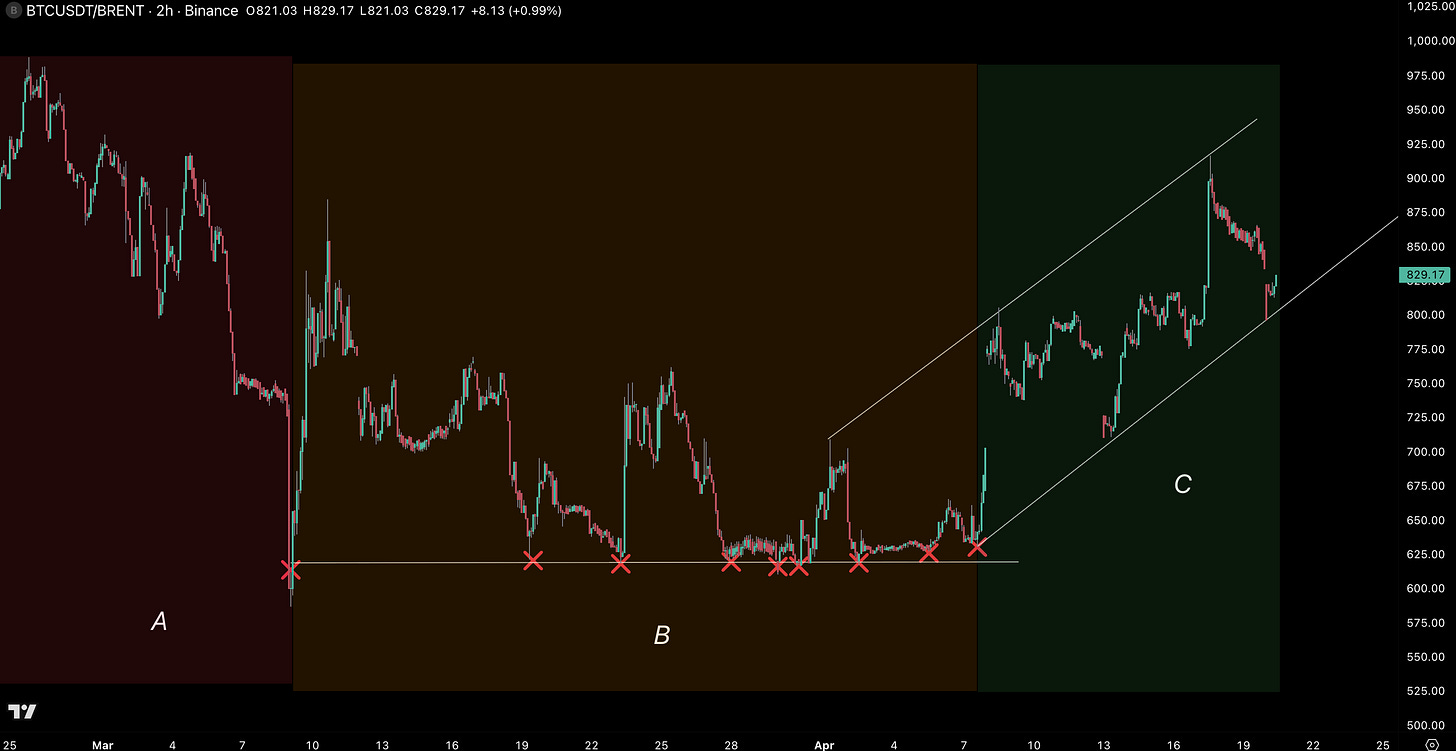
BTC/Brent ratio (2hr).
This pattern is consistent with a market that absorbs shocks without transitioning into a sustained risk-off regime.
This also aligns with the moderate Coinbase premium seen in BTC spot markets, indicating stable demand from U.S. flows and reinforcing a regime of absorption rather than systemic de-risking…
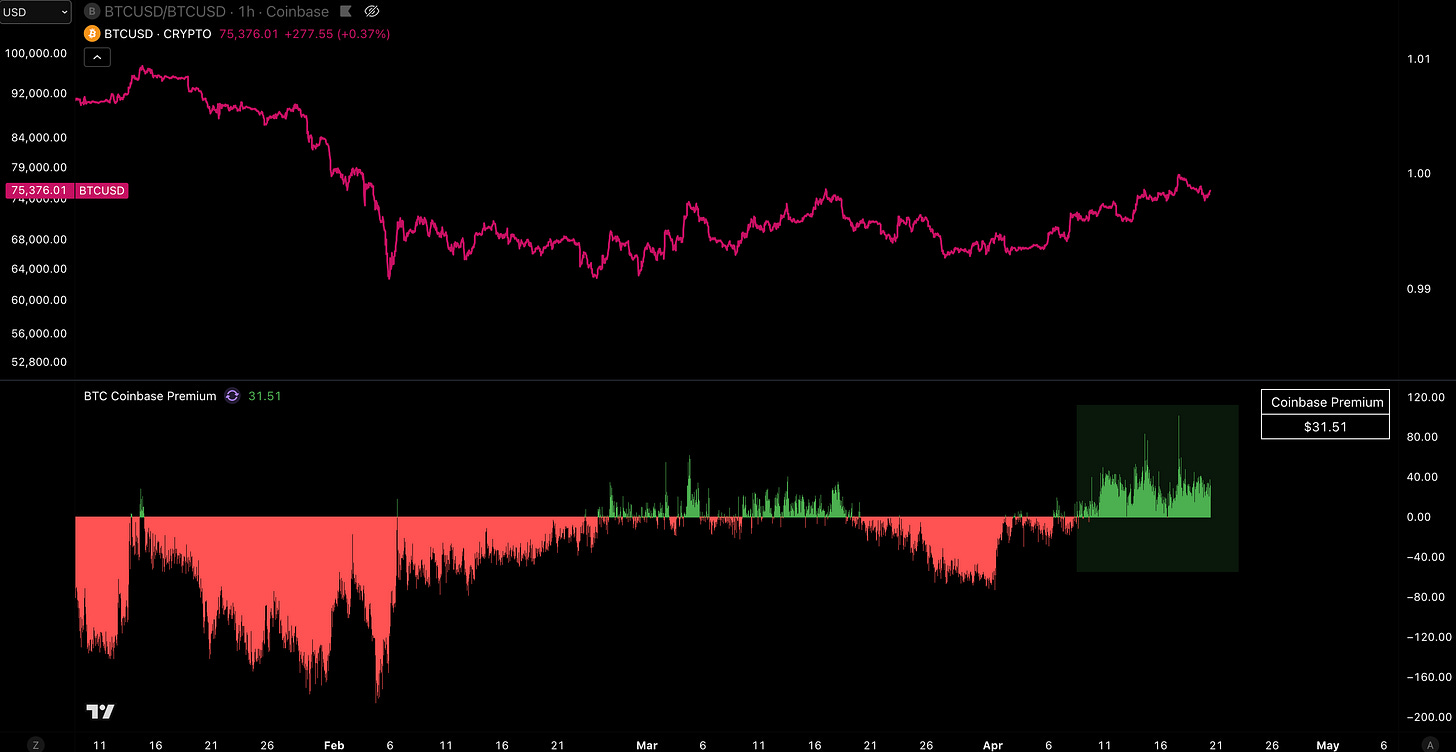
BTC Coinbase spot premium (1hr).
…and why crypto markets continues to bounce off support relative to the NASDAQ, despite the latter’s strong run in recent days.
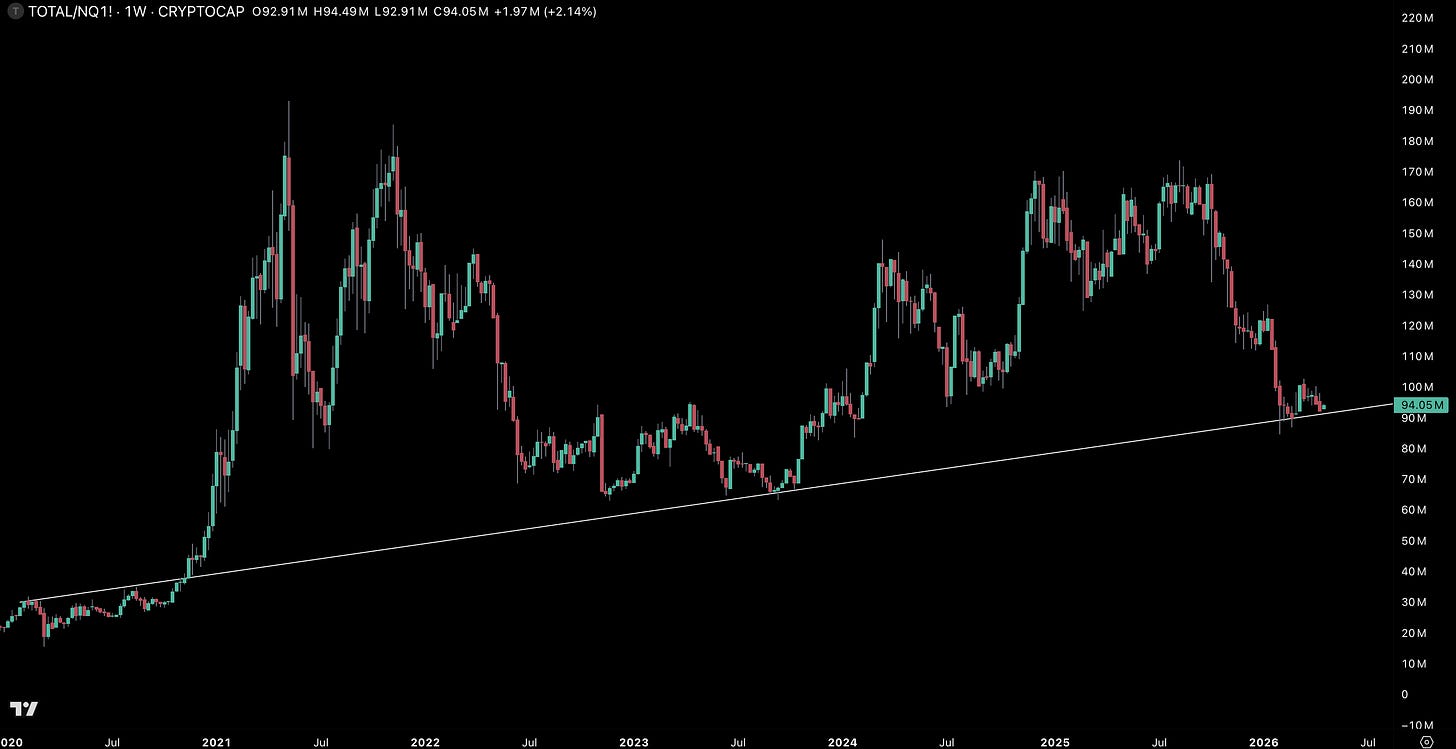
Crypto Global MCAP/NASDAQ 100 ratio (weekly).
State of Yields
Stablecoin lending yields:
~13% on Aave (USDC) — near 100% utilisation rates, which is pushing supply-side yields higher. High utilisation rates driven by significant supply pulled from markets over the weekend.
Fixed-rate DeFi lending: yield premium in fixed markets marginally expanding from last week:
Pendle sNUSD: 8.53% (Jun 2026)
Pendle sUSDAi: 7-8% (Jun-Oct 2026 maturities)
sUSDe holding: ~3.9%, slightly up from ~3.5% last week
ETH yield benchmarks:
Lido staking: ~2.6% (marginally higher over the past week)
Disclaimers
The content is for informational purposes only. None of the content is meant to be investment advice. Use your own discretion and independent decision regarding investments. The opinions expressed in all Re7 public research articles are the independent opinions of the authors at the time of publication and not the opinions of the affiliates of Re7.
Please see here for full disclaimers.