Why DeFi's Toughest Moments Make the Strongest Case for Staying In It
AUG 20, 2026
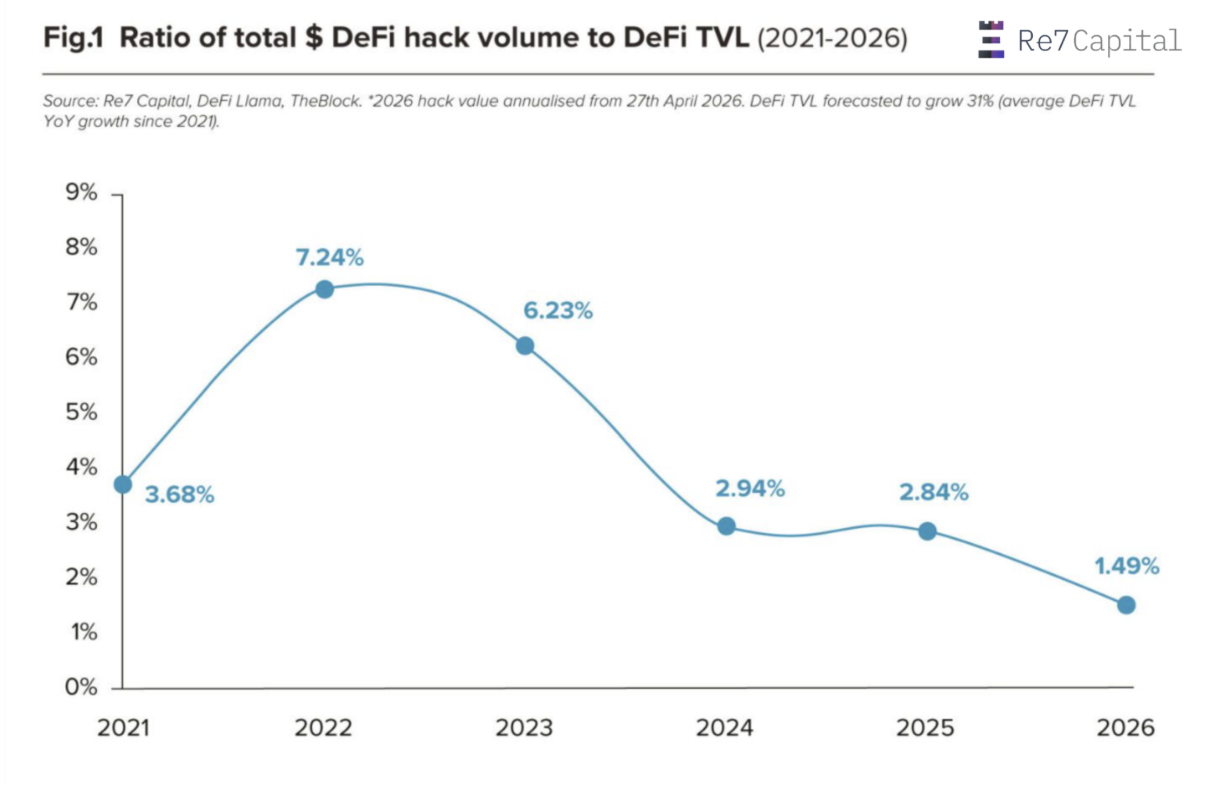
DeFi's hack-to-TVL ratio has fallen from 14% to a projected 1.49% in 2026. Re7 and Utila analyze what's really driving losses — and what isn't.
Every major scare in DeFi has often produced the same pattern: panic first, while data that tells a different story.
How RE7’s incident research, analysis from eight security firms and protocols, Utila’s examination of recent operational failures, and a five-year hack-to-TVL trend separate real risk from AI-driven panic.
Executive Summary
Earlier this year, DeFi experienced one of its hardest months on record: $635 million exposed across roughly 30 exploits, and the biggest capital flight from the sector since 2022. The instinct was to read this as proof that AI is breaking DeFi's defenses.
The research led by RE7, together with Utila’s analysis of recent operational security failures, does not support that instinct. Eight security firms and protocols were asked directly whether AI had caused a significant hack in April. Every major incident traced instead to operational, governance, or configuration failure, not a smart-contract exploit. Utila’s analysis of Drift and Resolv shows how compromised interfaces, excessive signing authority, and missing transaction controls allowed valid onchain actions to produce catastrophic outcomes.
And the multi-year trend underneath the headlines is the opposite of crisis: the ratio of hack volume to total value locked has compressed from roughly 14% five years ago to a projected 1.49% in 2026, even as TVL grows 31%.
This piece brings together RE7’s incident and market research with Utila’s analysis of signing infrastructure, transaction authorization, and operational controls. It examines what the data actually shows, where the real risk sits, and why the sector’s response to its hardest moments makes the strongest case yet for staying invested in it.
The Headline Everyone Got Wrong
Periods of concentrated exploit activity trigger the kind of coverage that reads as existential. But treated as a probabilistic risk surface — the same way credit analysts treat default risk — DeFi's "hacking rate" has been falling continuously for more than five years. One difficult period sitting on top of five years of structural improvement is not the same thing as a sector in decline. The fear cycle tends to peak precisely when the underlying data is most encouraging.
To test the "AI is breaking DeFi" narrative properly, the question was put directly to eight firms across the value chain — four auditors, two protocols, two monitoring vendors, each with a different commercial relationship to the fear itself. Not one could name a significant hack caused by AI finding a smart-contract bug. One firm reportedly called the press coverage "wildly overblown”.
Reading Sources Through Their Incentives
Every counterparty in this research sells something. Protocols downplay the threat because they want investment; auditors overplay it because they sell the cure. Both are biased in opposite directions, and the most credible conclusions are the ones that survive that adjustment.
One of the deepest-bench security firms of the eight, with everything to gain from amplifying the fear narrative. Instead, it called the press coverage overblown and located the real threat elsewhere. When the firm best positioned to sell the panic actively declines to, that's the conclusion most likely to survive scrutiny.
Where the Real Risk Lives
Look at the actual incident record, and a clear pattern emerges. Drift lost roughly $285 million — not to a smart-contract bug, but to a social-engineering campaign that compromised multisig signers through a fake interface. Resolv lost around $25 million when a single externally-owned signing key, with no multisig and no timelock, was compromised. Kelp's loss traced to a bridge running a 1-of-1 verifier setup — a single point of authorization sitting entirely outside the audited contract scope. Aave's CAPO incident triggered wrongful liquidations through an oracle configuration error, not an exploit.
The pattern holds consistently: operational and governance failures, not AI-discovered contract bugs. What's expanding is the social and operational surface, as protocols grow more interconnected and depend on more external infrastructure — bridges, oracles, signing flows — that sits outside any single audit's scope.
AI's role in this picture is to widen an existing asymmetry, not create a new one. Black hats are always-on and broadly probing, with no per-bug commitment cost. White hats are selective, picking one bug and spending their time there. As one company has put it: "The threat is that it may be the most persistent hacker, running 24/7 as long as you pay for tokens." What AI is changing today is speed — reconnaissance, fake-interface generation, social engineering — not the discovery of novel contract exploits.
Utila’s research into agentic payment infrastructure reaches a similar conclusion. The proliferation of AI does not introduce a fundamentally new category of onchain security failure. The same weaknesses continue to drive losses: exposed credentials, excessive authority, weak transaction controls, and inadequate verification of intent.
Autonomous transaction execution makes those controls more consequential. Some early agent implementations give software direct access to a raw private key, placing decision-making, signing credentials, and transaction authority within one failure domain. A prompt-injection attack, compromised runtime, or manipulated input can then instruct the agent to perform an action that remains valid at the blockchain level.
Utila’s research into agentic payment infrastructure points toward a more controlled model. An agent can propose and initiate transactions without accessing private-key material, while wallet infrastructure independently enforces approved contracts, destinations, transaction limits, and escalation requirements. The security model does not depend on trusting the agent’s judgment in every instance. It limits what the agent can authorize before any transaction reaches the chain.
How Operational Failures Reach the Chain
Drift and Resolv show how failures outside contract code become irreversible onchain actions.
In Drift’s case, durable nonces allowed the attacker to collect signatures separately and broadcast the ownership changes together, reducing the opportunity for other signers or monitoring systems to detect the takeover. Two administrators approved transactions that transferred control of the multisig because the wallet interface did not make their full effect clear.
After analysing the Drift incident, Sam Eiderman, Utila’s co-founder and CTO with extensive experience in security and cryptography, warned: “If you can’t read the fine print of the transaction payload you are signing, you might as well sign with your eyes closed.”
A multisig distributes signing authority, but it provides limited protection when every signer relies on the same compromised interface or transaction representation. Independent keys still require independent visibility into the action being authorized.
Resolv exposed another route to the same outcome. The compromised credential carried effectively unrestricted authority. No quorum requirement, maximum mint ratio, collateral-to-output validation, or policy layer could reject an abnormal issuance before execution. The contract received a valid signature and performed the requested action.
Both incidents passed through the cryptographic layer as authorized transactions. The failures occurred earlier: in how authority had been assigned, how transaction intent had been presented, and which limits governed execution. Those controls often fall outside the scope of a conventional smart-contract audit.
The Layer No One Audits
The hardest lesson from recent incidents is that audits cover a snapshot of code, not the operational environment that determines how privileged transactions are constructed, approved, and executed. They do not necessarily cover a multisig procedure that drifts over a year, the verifier topology of a bridge a protocol depends on, or the privileged key sitting in a signer’s cloud environment.
The Kelp case makes this concrete. ChainSecurity had audited a comparable LayerZero product and explicitly flagged its DVN configuration in the report — proof that a 1-of-1 verifier setup is an auditable line item, one a competent trust-model review would have surfaced. The failure wasn't an unfindable bug. It was a layer of review that most audits and all single-repo AI scanners skip entirely.
The answer is broader than additional audits. Audits remain essential for contract code and trust-model review. The operating layer also needs decoded transaction payloads, simulation, contract and function restrictions, parameter limits, role separation, approval quorums, timelocks, and continuous monitoring connected to an executable response.
Utila applies these controls before signing and execution. Institutional operators can restrict which protocols, contracts, functions, and transaction types a wallet may interact with, simulate and decode transactions before approval, set limits and approval requirements, and isolate strategies or funds under separate vault-level policies. A request carrying a valid credential can still be stopped when the action falls outside the organisation’s defined policy.
The Data Underneath the Panic
Step back from any single period, and the multi-year trend is the most important number in this piece. Hack volume against total value locked has compressed from roughly 14% five years ago to a projected 1.49% in 2026 — against 31% forecast TVL growth.
The mechanism behind the compression matters as much as the trend itself. The major incidents of the past year weren't instantaneous — they were slow and multi-transaction. Euler's exploit ran roughly 20 minutes. Kelp's attack was interrupted mid-execution. During the Resolv exploit, one affected vault's automated monitoring response meant its depositors lost nothing at all. An ecosystem growing by nearly a third while its loss rate keeps falling, and where automated response is increasingly able to act before most of the loss occurs, is an industry maturing in real time.
Recovery infrastructure is developing at the industry level too. In-protocol mechanisms like Aave's Umbrella module absorb bad debt before it reaches general suppliers.
The Bar Has Shifted — and That's the Opportunity
The question from sophisticated allocators has changed. It used to be: is DeFi safe? Today it's sharper and more specific — how does the team underwrite protocol risk, what are concentration limits, how is sizing calibrated for tail events?
For allocators, this expands the scope of protocol and manager diligence. Audit history remains an important input, and diligent managers evaluate what sits beneath it per Re7's proprietary risk framework published years ago— audit recency against current attack vectors, whether audited trust-model assumptions still match live on-chain state, and signer opsec maturity, including how independently signers verify transaction intent. For cross-chain positions, the framework also checks whether validation is multi-of-N or a single point of failure — the exact Kelp failure mode — and ranks auditors by how explicitly they document centralization risk. It extends further to monitoring depth (coverage, alert routing, detector configuration) and auto-pause/circuit-breaker maturity: deterministic logic, a human on-call, benchmarked time-to-react.
These controls determine the loss potential once an attacker penetrates the first defensive layer, and help distinguish teams that have institutionalized risk management from those relying on individual operators to catch an abnormal transaction under pressure.
That shift filters for managers who can answer credibly, with position-level risk attribution, stress-tested recovery scenarios, and explicit methodology behind every protocol decision. The gap between what the market prices during fear and what's actually occurring at the protocol level is, historically, where the most durable opportunities have emerged.
Disclaimer
This article is for informational purposes only and does not constitute investment advice, a recommendation, or an offer or solicitation to buy or sell any fund, security, or digital asset. It is not intended for distribution to, or use by, any person in any jurisdiction where such distribution or use would be contrary to local law or regulation.
Past performance is not a reliable indicator of future results, and no representation is made that any investment will or is likely to achieve returns similar to those referenced herein. Statements regarding future returns, market conditions, or strategy performance are forward-looking statements based on current expectations and assumptions, are inherently uncertain, and actual results may differ materially. Digital assets and DeFi strategies involve a high degree of risk, including but not limited to market volatility, smart contract risk, regulatory risk, custody risk, and potential loss of principal, and may not be suitable for all investors.
Prospective investors should conduct their own due diligence and consult independent legal, tax, and financial advisors before making any investment decision. This article does not constitute an offer to sell or a solicitation of an offer to buy any interest in any Re7 Capital fund, which may only be made pursuant to formal offering documents.