The Weekly: From Abundance to Scarcity: Rethinking Yield Aggregation
MAY 4, 2026
This week, we examine how the yield aggregation model has evolved as DeFi transitions from an incentive-driven growth phase to a more capital-efficient equilibrium. As yields compress and capital becomes more selective, traditional aggregation has struggled to retain relevance—prompting a shift toward RWAs, protocol-native strategies, and more active allocation frameworks.
Last week, Re7 Capital introduced the Re7 ETH Yield Strategy, anchored on Optimism and powered by the Re7 Risk Engine. The strategy delivers structured exposure to ETH-denominated yield opportunities through the same onchain architecture that underpins Re7’s broader institutional platform.
Built to generate risk-adjusted returns across the Ethereum ecosystem, the strategy combines transparent onchain representation of investor positions with institutional-grade custody infrastructure, ensuring counterparty and settlement risks remain tightly managed.
The launch highlights continued institutional demand for onchain yield strategies that align Ethereum’s growing utility with the rigor and operational standards of traditional investment frameworks. Read more on our blog.
Weekly Summary
We cover:
The state of yield aggregators
Why yield aggregators struggled to attract capital longer-term
Market update
From Abundance to Scarcity: Rethinking Yield Aggregation
DeFi once promised easy, automated yield on idle crypto capital.
Yield aggregators are protocols that pool user funds and automatically deploy them across strategies to maximize returns.
Built for a high-emissions, high-inefficiency era of DeFi, they thrived on subsidised yields and passive optimization—but as incentives faded, yields compressed, and capital became more selective, that edge eroded.
Global yield aggregator TVL has seen wild swings over the past six years. Today, it sits at just 10% of its 2021 ATH of $1.48B, despite the broader market being up 355% since that peak.
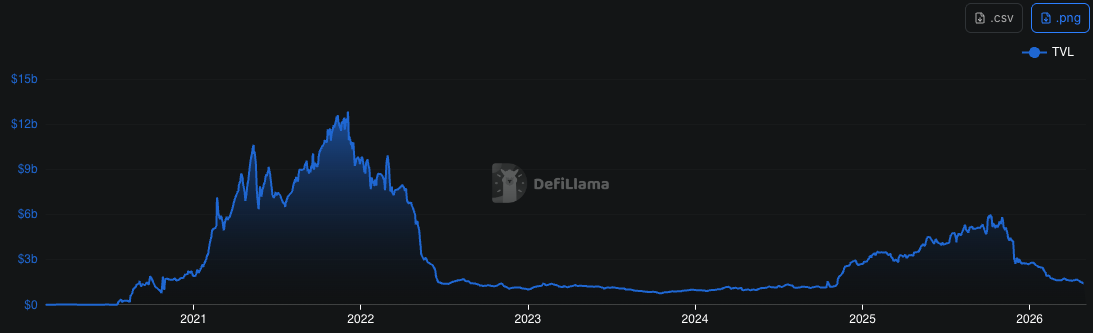
Global yield aggregator TVL ($) since 2020.
2020-2021: Heavy incentives + leverage created the bulk of expansion (e.g. COMP, CRV)
2022: Deleveraging and the incentive death (leveraged loops collapsed, market valuation fell) — the underlying yield engine broke
2023-2024: Lower ‘real’ yields, fewer reflexive loops to boost TVL — TVL stabilised because DeFi shifted from growth to an equilibrium
2025-present: RWAs, restaking, new primitives bringing in incremental capital alongside market beta lifting valuations. Yields remained compressed, capital is rotating toward RWAs and higher risk–reward yield strategies
In other words, one of the biggest drivers isn’t price but reflexivity. When incentives attract capital, that capital can boost yields and those yields attract more capital.
When that loop breaks, TVL deflates structurally. That’s why rebounds look weaker. Prices came back, but the old yield engine didn’t.
RWAs Reset The Benchmark
Tokenised real-world assets (e.g. on-chain T-Bills) effectively introduced a new hurdle rate in DeFi:
4-5% yields with perceived lower smart contract risk overall
Caters for institutional and more conservative capital
More predictable, cleaner return profile
We can see some evidence of the impact of US T-bills on yield aggregator TVL — where the recent surge of the former has coincided with the collapse of the latter’s TVL over the last year.
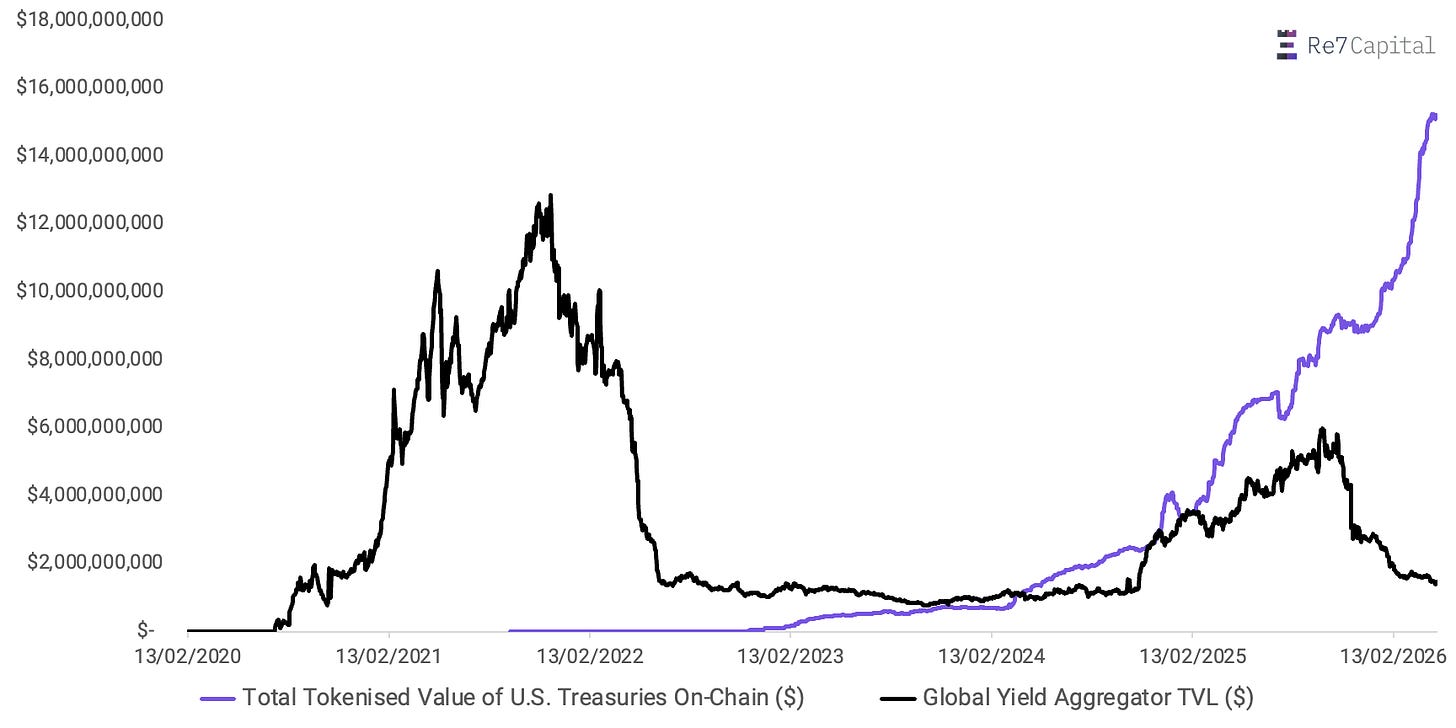
Total value of Tokenised T-Bills on-chain ($) vs. global TVL of yield aggregators ($).
Curation Didn’t Fix the Model
Several platforms tried to evolve the yield aggregation model by launching curated, semi-private vaults. These platforms prioritised access to better opportunities rather than optimising public yields.
But traction has been limited because it still relies on the same underlying engine: external incentives flowing into the platform.
As we can see in the below diagram, when the incentive layer dried up, the entire loop weakened.
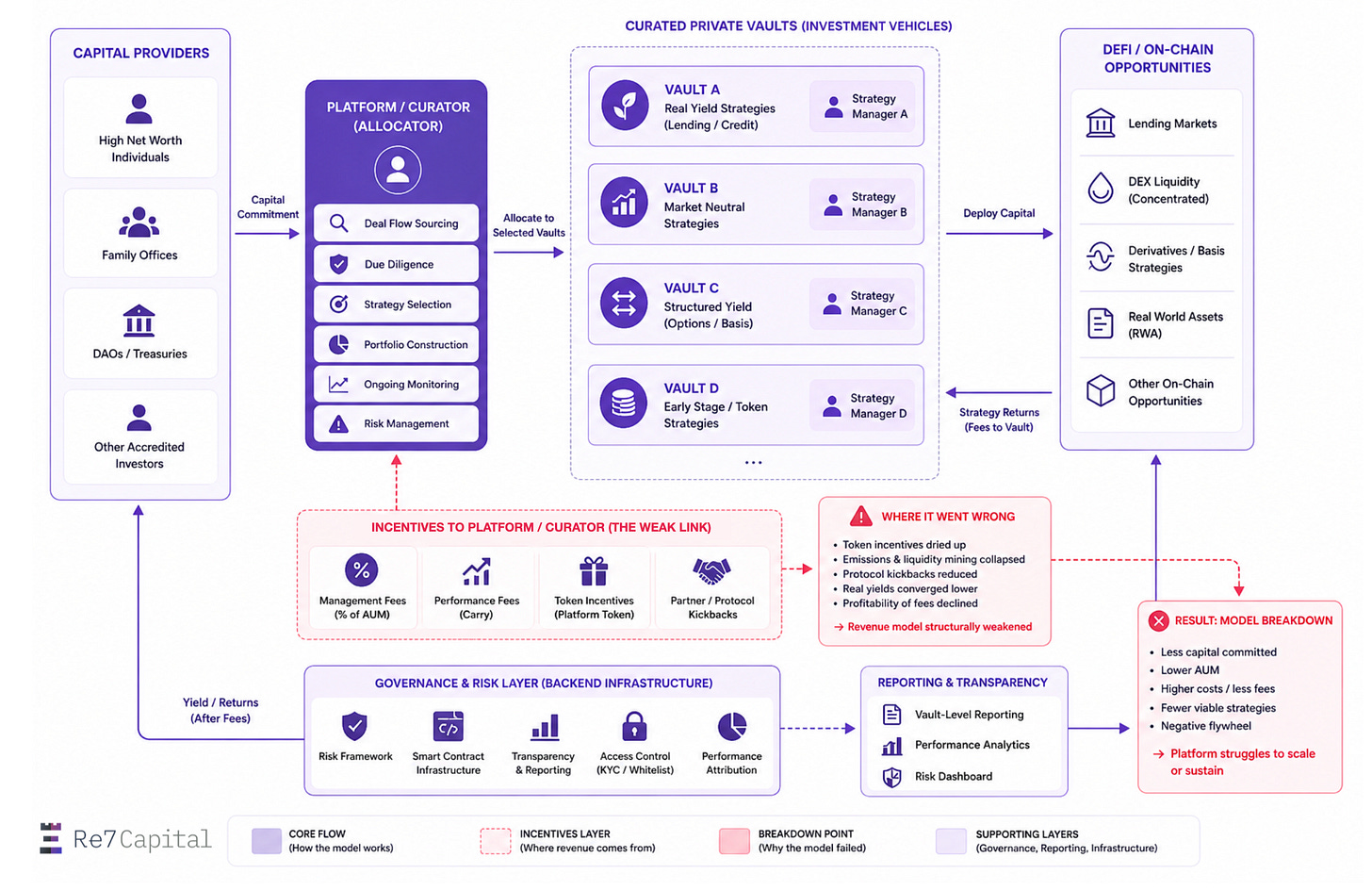
Example model of curated semi-private vault platform for yield aggregation. Red boxes highlight the weakest facets of the model.
Closing Remarks
As yields collapsed, platforms evolved—moving from passive aggregation to curated access and allocation—but still relied on the same incentive-driven engine. When that dried up, the model weakened regardless of structure.
But capital didn’t disappear—it just relocated to RWAs, protocol-native strategies, and simpler yield. The abstraction layer lost relevance in that process.
Looking into the future, they could regain relevance if they evolve into active, strategy-driven allocators—routing capital into differentiated, higher-quality yield sources rather than passively optimising commoditised ones.
When excess yield disappears, so does the need to aggregate it.
Market Update
Global crypto market capitalisation was relatively flat last week (-0.6%), finding resistance at the top of ascending channel ($2.26T) after its recent breakout.
This week looks to be more of the same with initial break above the channel again in the early hours on Monday.
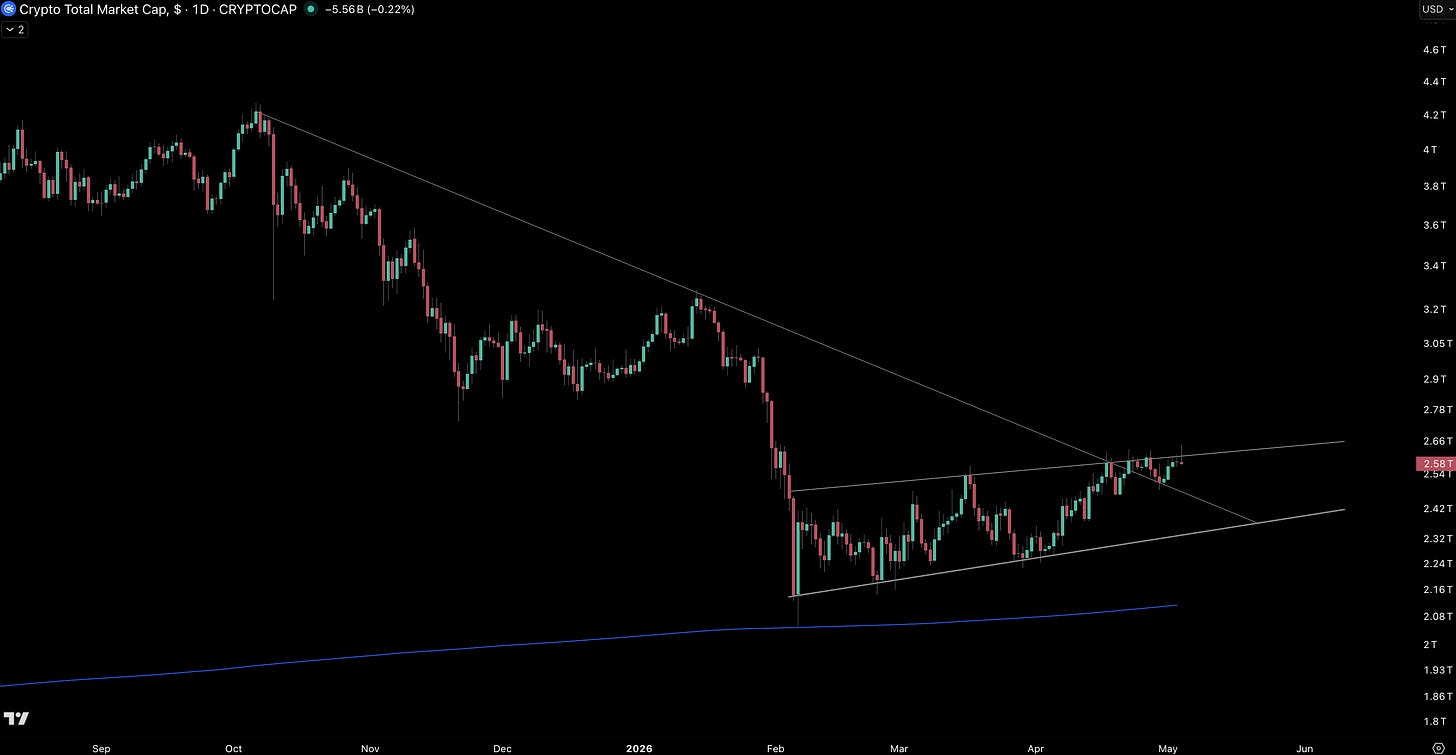
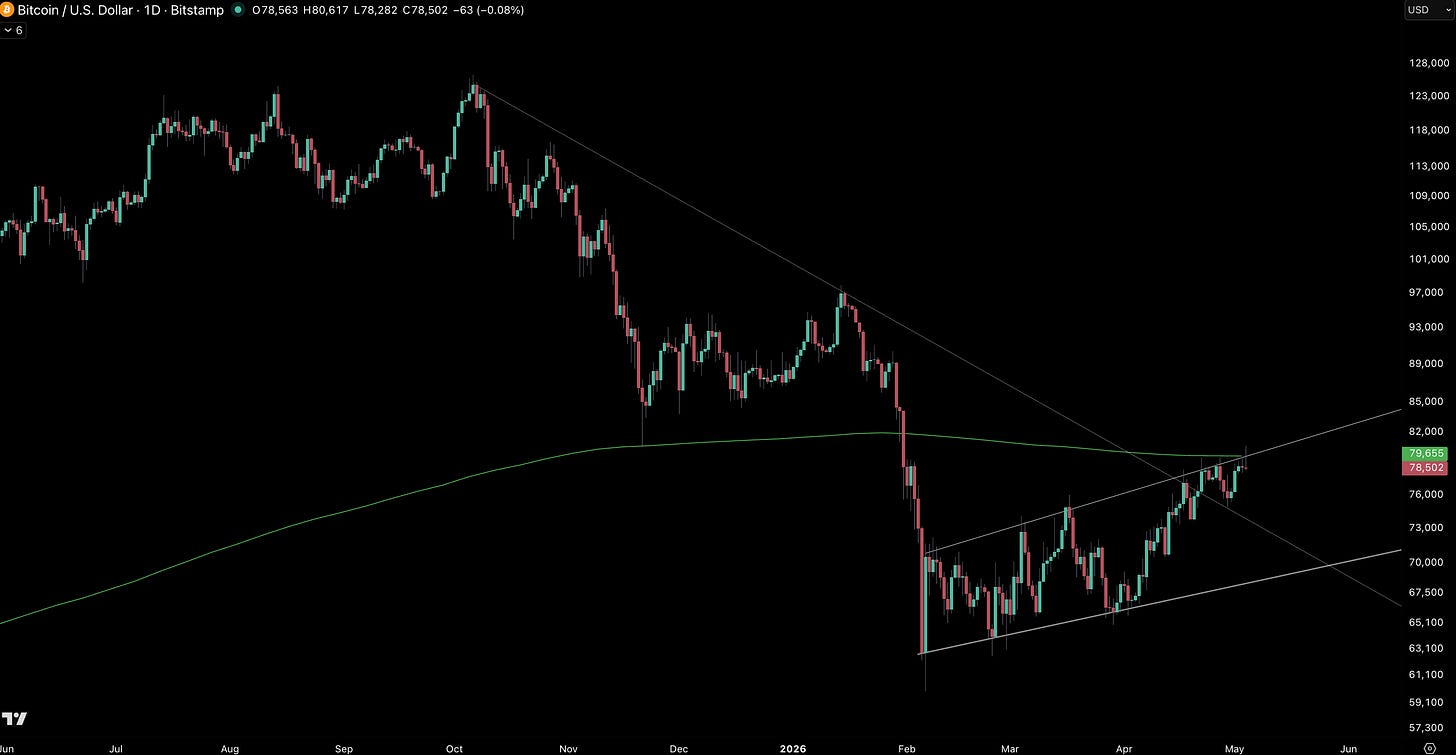
BTC is exhibiting a similar structure, acting as a high-beta proxy to broader risk, with the 120D EMA as the key level to reclaim to confirm momentum re-acceleration.
BTC briefly broke >$80,500 on Monday morning UTC — there is a heavy cluster of sellers at this level, which it needs to clear.
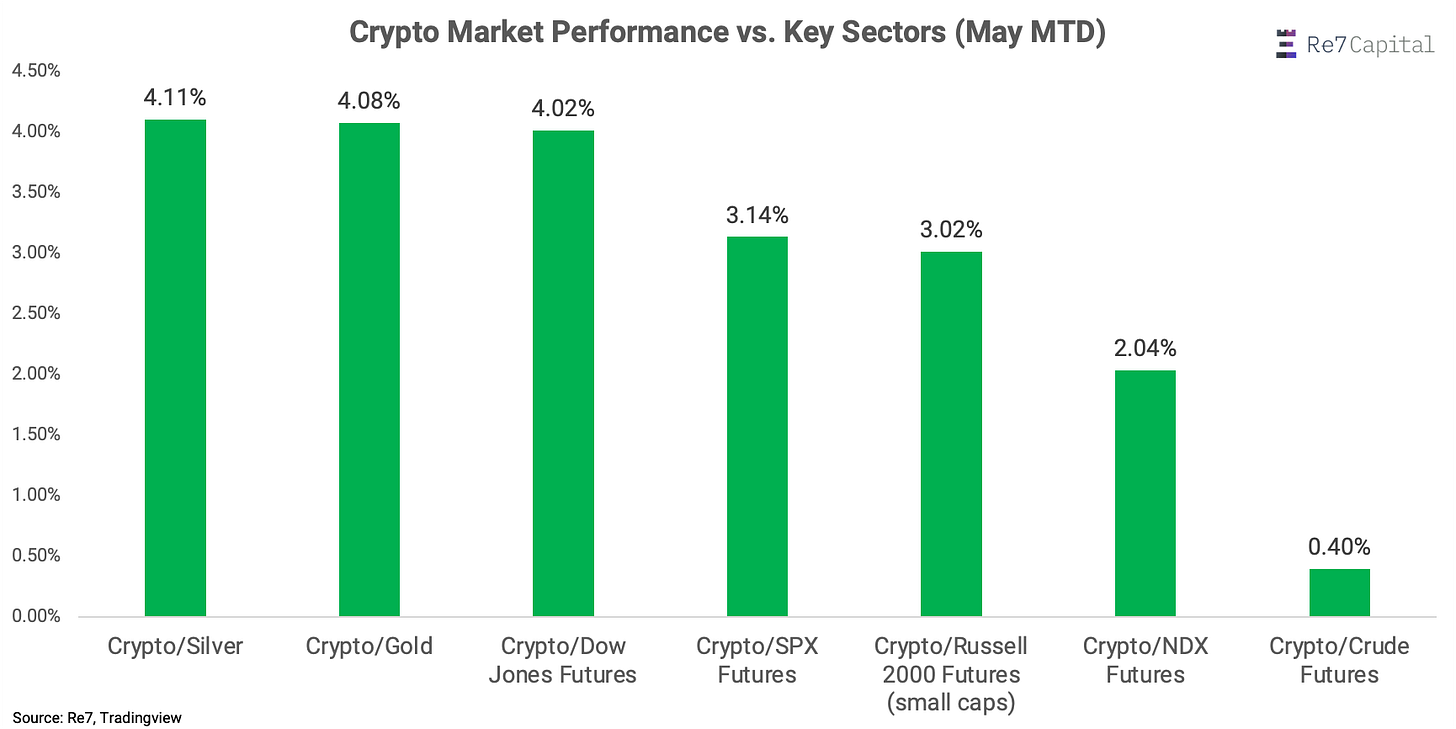
Despite the recent market chop over the last few days, the crypto market is outperforming all major assets/themes on a relative basis MTD (May).
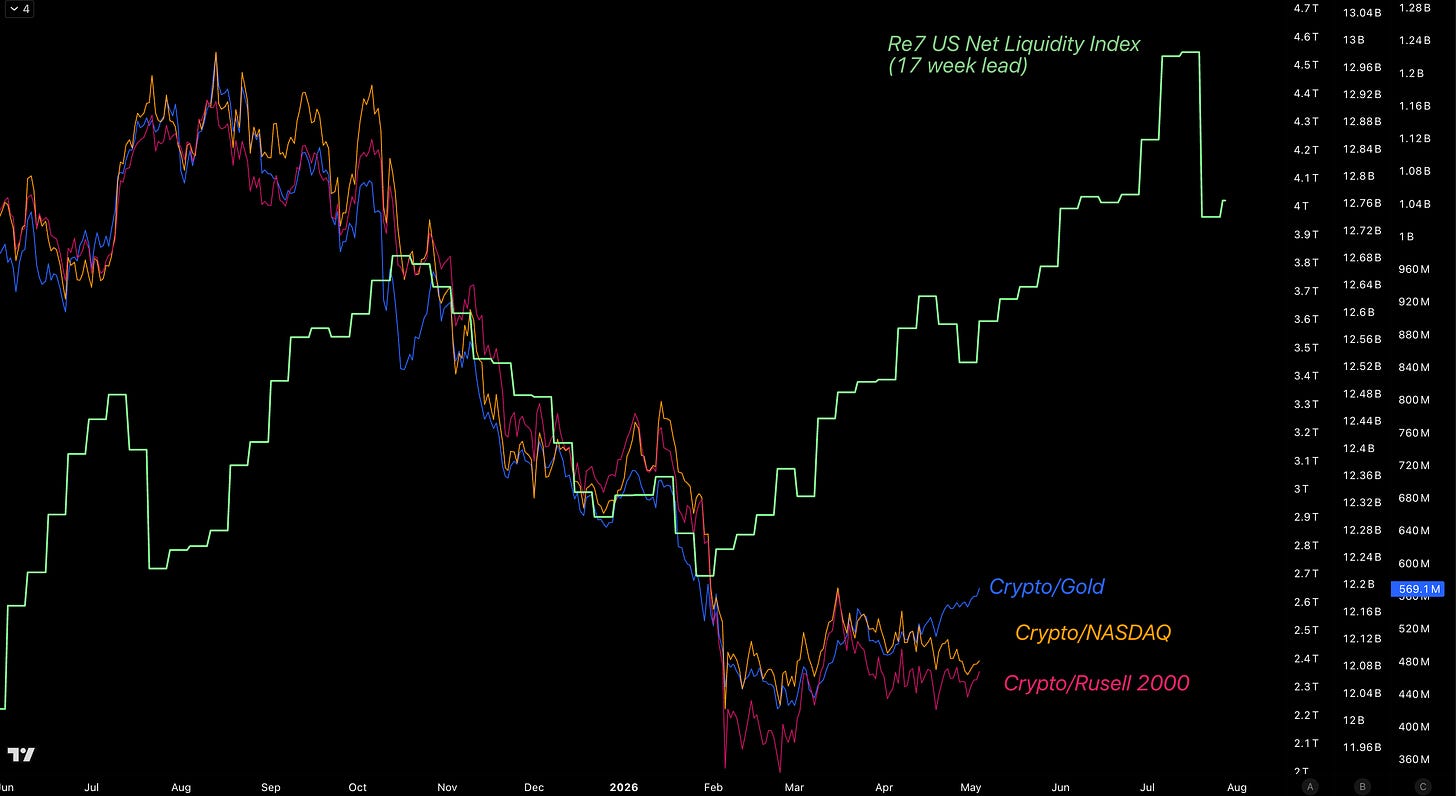
This relative outperformance isn’t surprising given the current backdrop of rising US net liquidity—where crypto, sitting furthest out on the risk curve, acts as a high-beta, low-friction expression of that environment.
…while the US are now firmly in QE (not QE!) mode, re-buying and holding US Treasuries on their balance sheet.
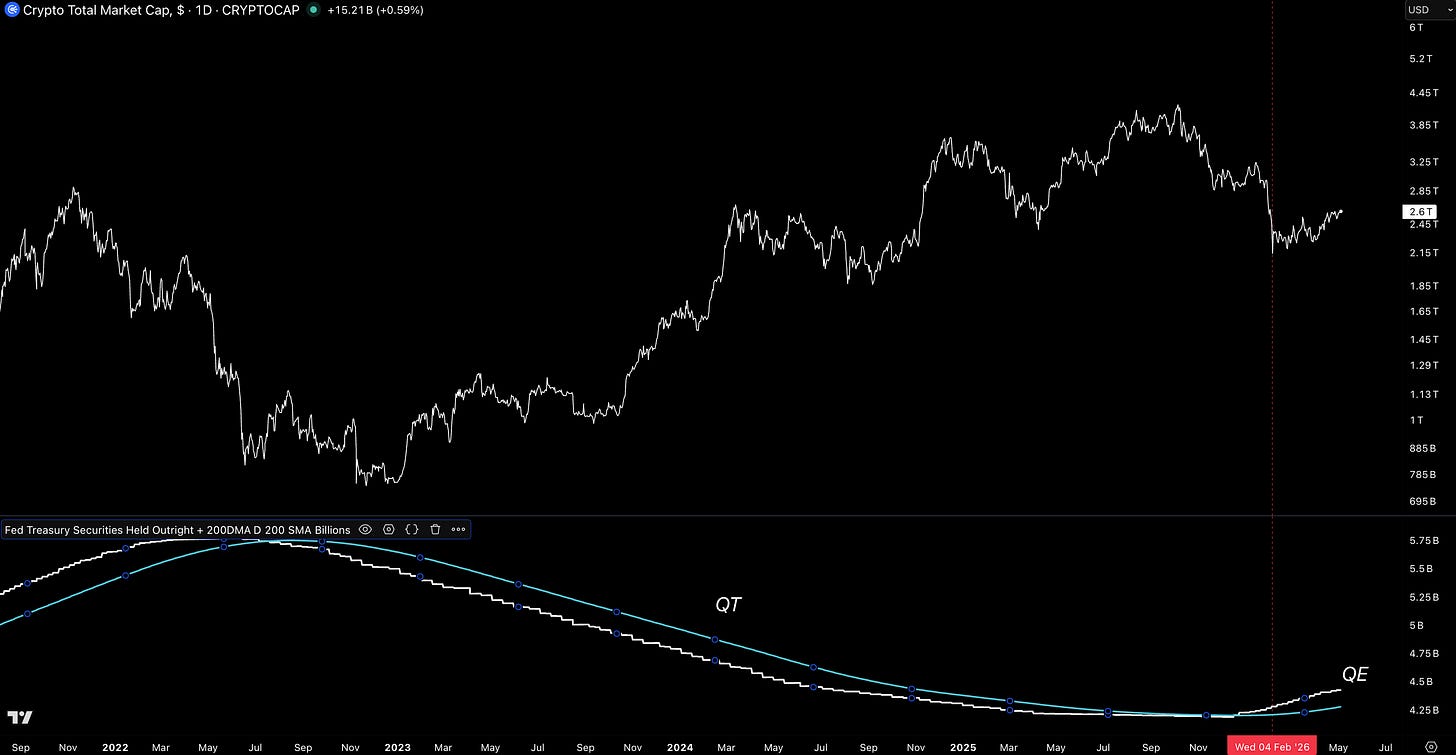
Balance sheet expansion, higher bank reserves lead to easier financial conditions.
This also explains why recent commodity-driven inflation scares haven’t weighed on crypto—liquidity is the dominant driver, and markets are looking through near-term price pressures.
If higher inflation drives real rates negative into 2026/2027, crypto stops competing with real return just as the Fed becomes boxed in—forcing a turn toward renewed liquidity as they get behind the curve (again).
State of Yields
Stablecoin lending yields:
~3.8% on Aave (USDC) — utilisation rates for USDC markets are still elevated but have seemed to stabilise at 92%.
5.12% on Aave (MegaUSD) — higher MEGA incentives driving supply side. Looping is pulling USDm out of the pool where new suppliers keep arriving for MEGA APY.
Fixed-rate DeFi lending: yield premium in fixed markets marginally expanding from last week:
Pendle sNUSD: 7.3% (Jun 2026)
Pendle sUSDAi: ~8.4% (Jun-Oct 2026 maturities)
sUSDe: ~5.3%, slightly up from ~3.9% last week as sUSDE TVL has dropped from $3.5b to $2.1b since the 18th of April
ETH yield benchmarks:
Lido staking: ~2.38% (slight drop from previous week)
Disclaimers
The content is for informational purposes only. None of the content is meant to be investment advice. Use your own discretion and independent decision regarding investments. The opinions expressed in all Re7 public research articles are the independent opinions of the authors at the time of publication and not the opinions of the affiliates of Re7.
Please see here for full disclaimers.