The Weekly: Building The Rails For The Agentic Economy
JUN 22, 2026
Crypto market update: agentic economy rails take shape via x402 payments and intent-based bridges, BTC holds $63k floor, and October seasonality/halving cycle align.
Re7 Capital wins Best Performing Fund in DeFi at The Hedge Fund Journal’s Digital Currency Awards 2026
Re7 Capital’s market-neutral fund has won an award in the DeFi category — Best Performing Fund in 2025 and over 2 and 3 Years — at The Hedge Fund Journal‘s Digital Currency Awards 2026.
Weekly Summary
We cover:
The emergence of AI agents as participants in the digital economy.
How payment standards such as x402 are enabling machine-to-machine commerce.
Why intent-based systems could become the coordination layer for autonomous software.
Market update
Building The Rails For The Agentic Economy
Much of the AI conversation remains focused on models becoming smarter. Increasingly, however, the more interesting development may be that AI agents are becoming economic actors.
Recent conversations with digital banks suggest the industry is already preparing for this shift. One bank has launched accounts designed for AI agents, while another plans to do so later this year.
The model is straightforward: agents can initiate payments across bank rails, cards, stablecoins and blockchains, while a human or legal entity remains ultimately responsible for approval and liability.
x402 And Machine-to-Machine Commerce
The supporting infrastructure is beginning to emerge. x402, a payment standard designed for machine-to-machine commerce, recently reached a five-month high in transaction count, while daily payment volume has increased from roughly $30k to $90k.
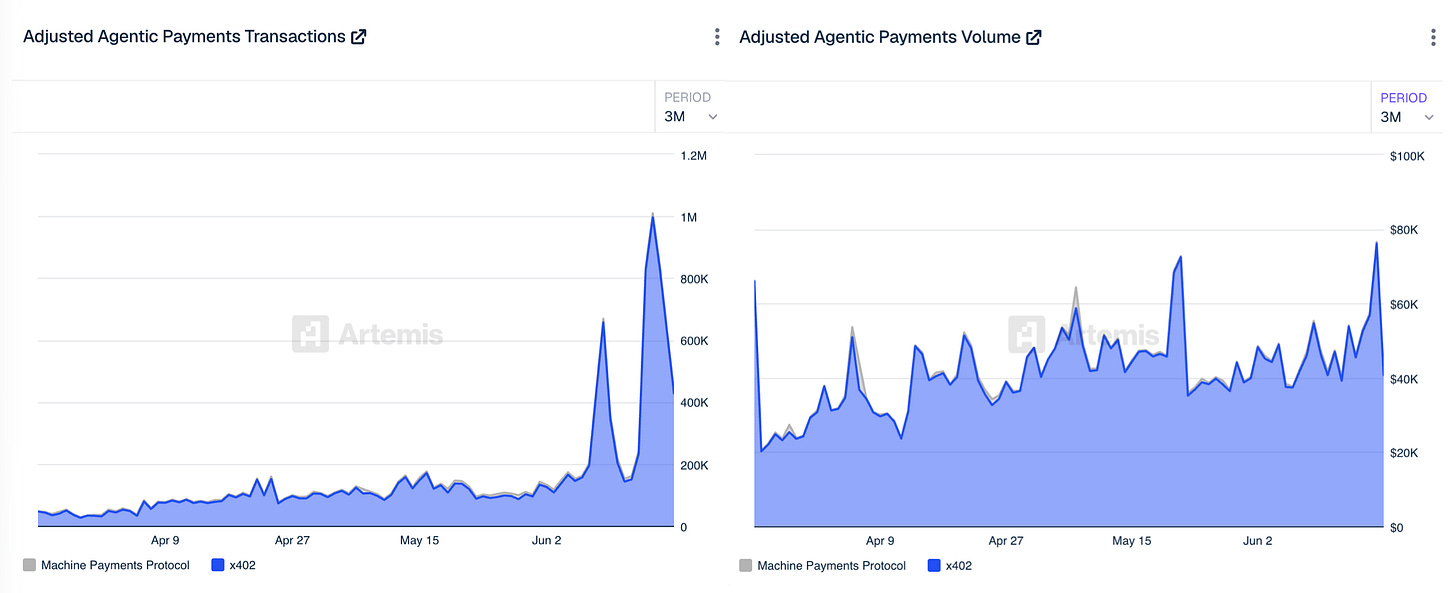
Source: Artemis
Rather than relying on subscriptions, agents can pay fractions of a dollar for data, inference, APIs and software tools on demand.
This is no longer confined to a single ecosystem. Ripple recently integrated x402 support, extending the standard beyond its original environment and highlighting a broader trend:
Agent payment standards are increasingly being adopted across networks rather than remaining tied to individual chains.
Intents Gain Share
At the same time, intent-based interoperability is gaining share. Intent-based bridges now account for more than 20% of bridge volume, roughly double their share a year ago.
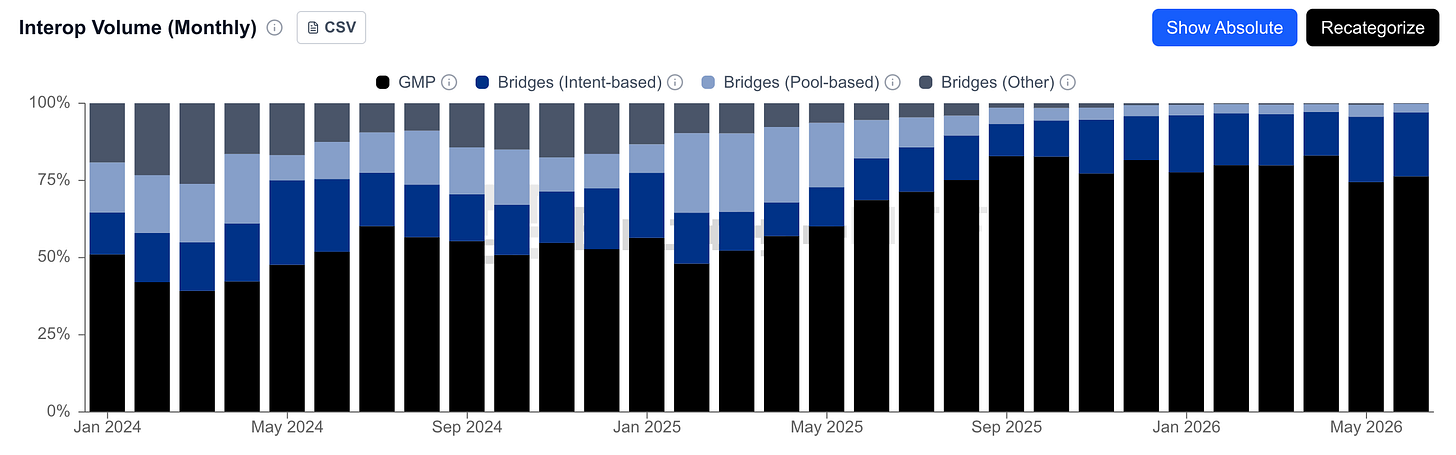
Source: BridgeWTF
Rather than forcing users—or eventually AI agents—to manually navigate chains, bridges and settlement routes, intent systems allow participants to specify an outcome while the network determines how to execute it.
Protocols such as NEAR Intents have been among the beneficiaries of this shift.
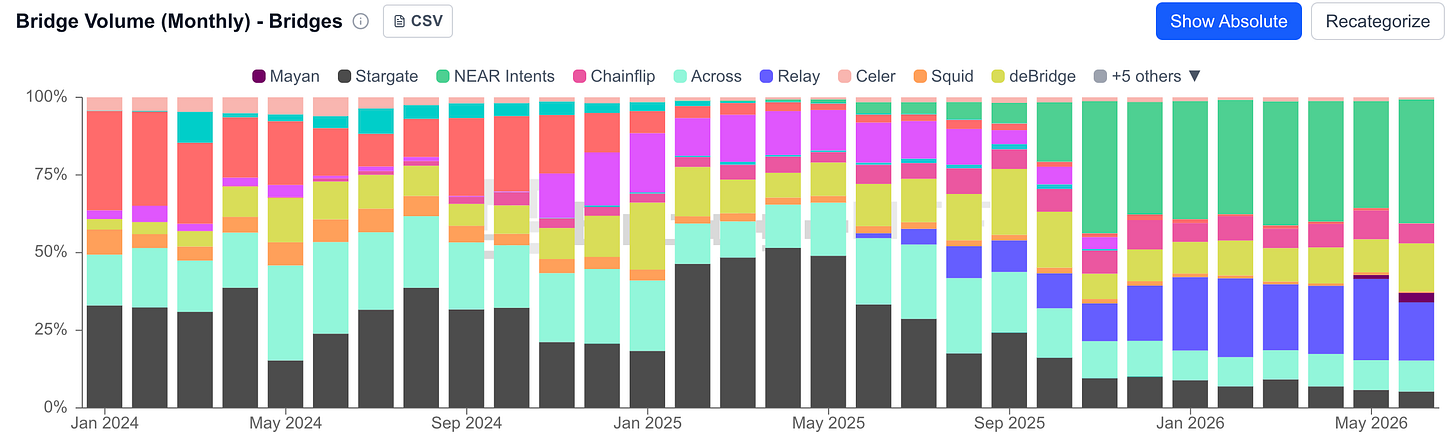
Source: BridgeWTF
The numbers remain small today, but the stack is beginning to form. Payment standards allow agents to transact, while intent systems allow them to coordinate activity across networks.
Much of crypto’s infrastructure was originally built to help humans move assets between applications. Increasingly, it is being adapted to help software transact and coordinate with other software.
If AI agents become meaningful consumers of digital goods and services, these rails could become foundational infrastructure for a machine-to-machine economy.
Market Update
Crypto markets contracted 3% last week but we’ve not seen any material technical damage. It seems that the market has been putting in a solid floor at $2.15T over the past 4 weeks - right around the 200W MA.
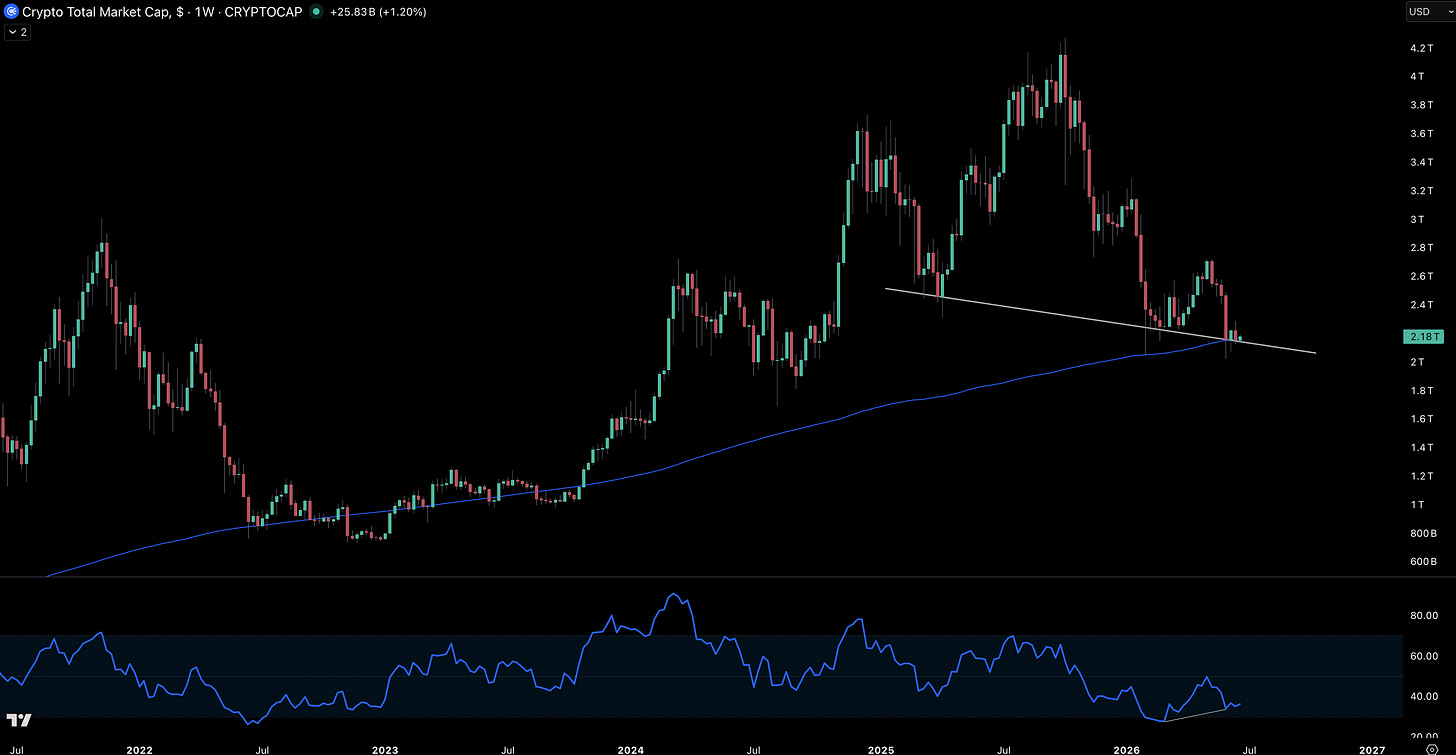
Global crypto market capitalisation index ($).
For BTC, this translates to ~$63k, where its failed to close below this level on the weekly so far in 2026.
Large-cap relative ratios such as SOL/BTC are breaking higher after weekly seller exhaustion and bullish divergence signals.
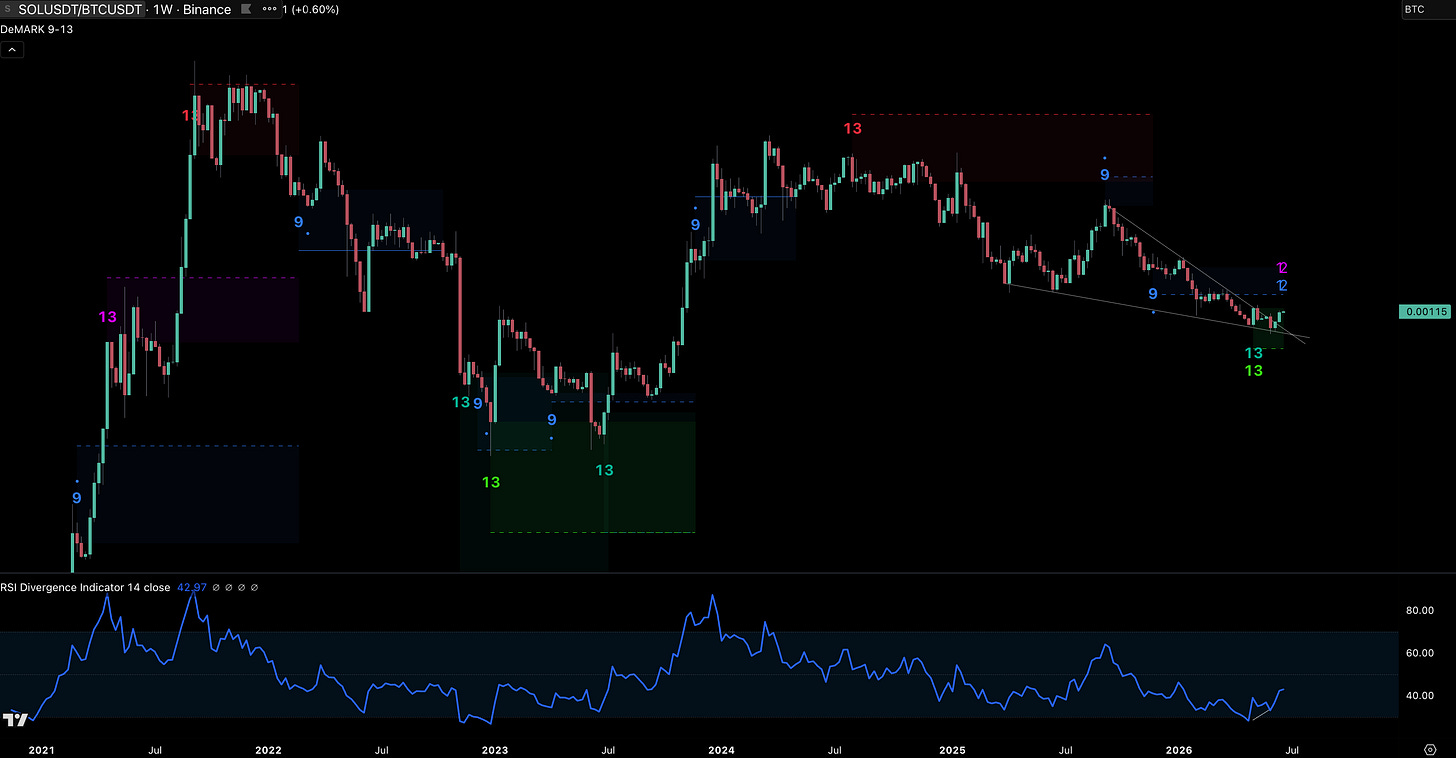
SOL/BTC ratio (weekly).
Historically, this has not been consistent with bear-market re-acceleration, suggesting sustained downside from current levels is becoming less likely.
October: A Window Worth Watching
While no seasonal pattern is deterministic, October stands out as one of the strongest months for Bitcoin historically, delivering average returns of +13.4%, a median return of +10.9%, and a positive hit rate of 67%.
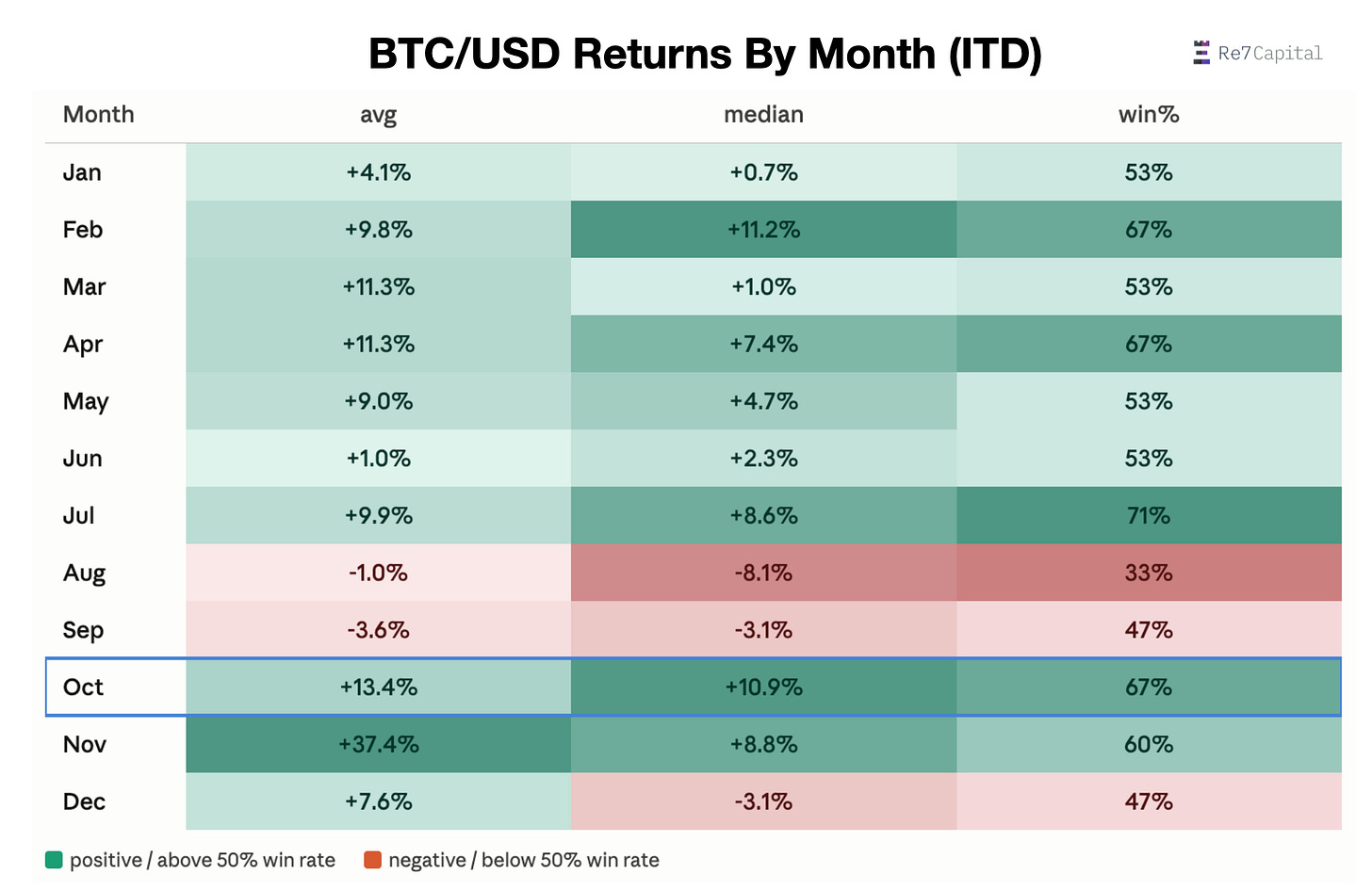
This year, the setup is more interesting because October also sits at an important point in the halving cycle. October 2026 is roughly month 30 after the April 2024 halving, marking the end of the weakest historical post-halving window.
Historically, returns improve materially after this point: the 31–36 month period has produced average monthly returns of +12.7% and median returns of +9.4%, followed by a still-positive 37–48 month period into the next halving.
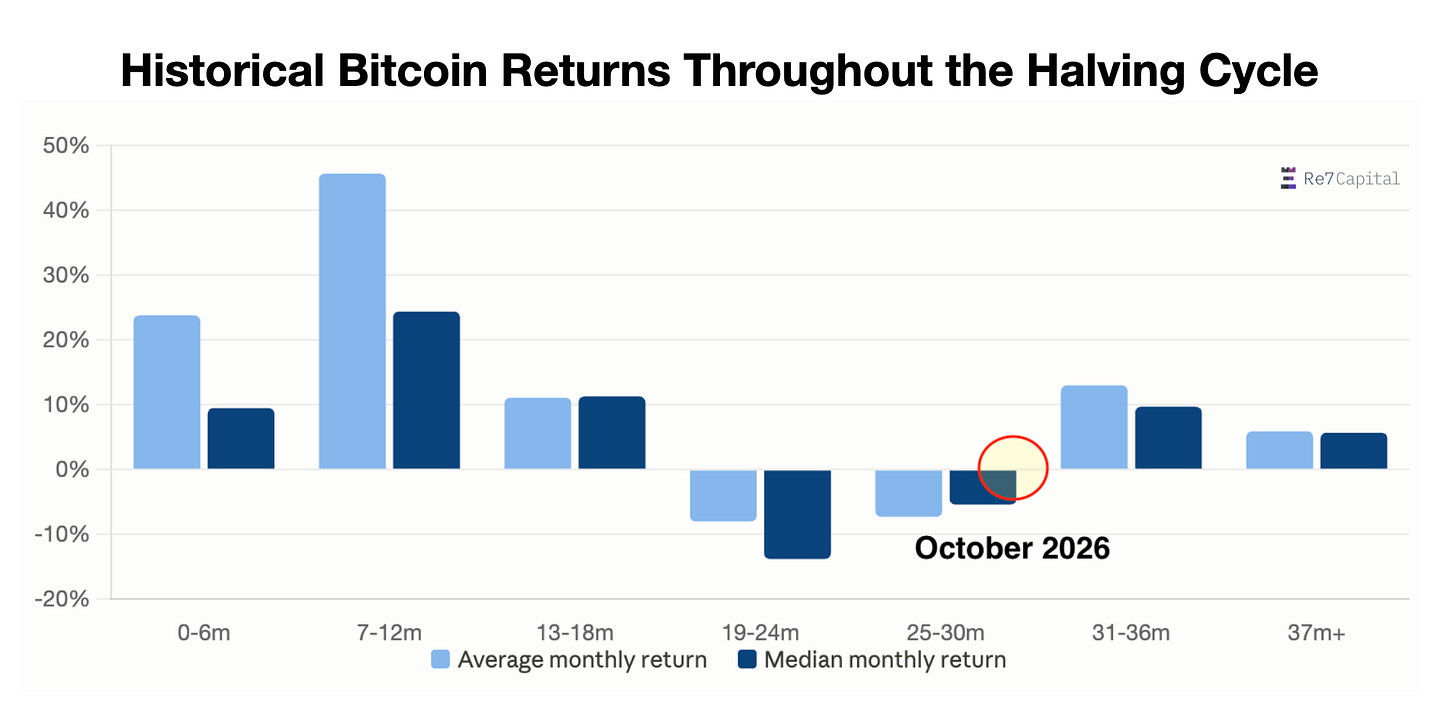
That means October is less about one isolated month and more about the potential start of a stronger 18-month cycle window.
The timing also lines up with improving forward-looking drivers. Liquidity indicators continue to point higher into Q4, with the strongest impulse expected around October.
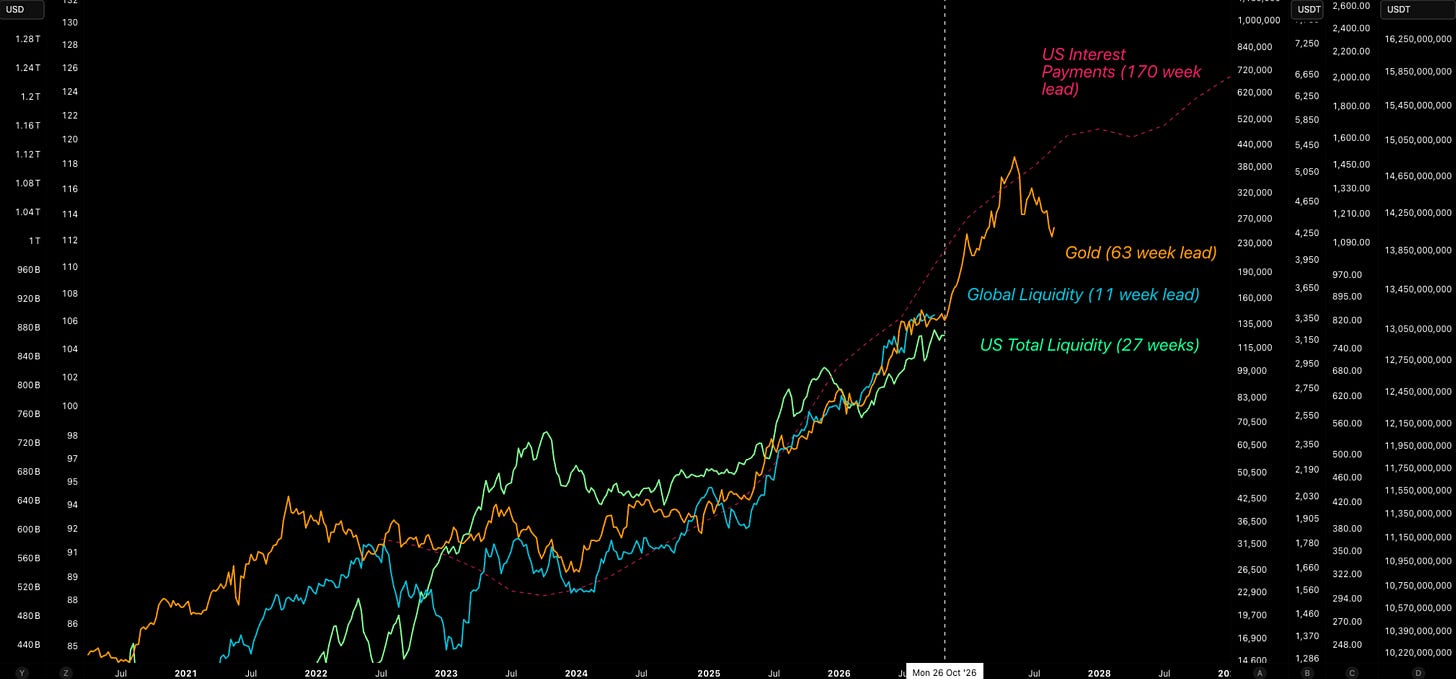
Gold’s historical lead suggests global liquidity could re-accelerate around October 2026.
The regulatory backdrop remains constructive. The market had initially focused on a July 4 target for the Clarity Act, and passage in July remains possible. However, given the limited legislative window before the August recess, a September or October timeline increasingly looks like the more realistic fallback if final negotiations, including around ethics provisions, require more time.
This comes as positioning and relative performance remain washed out. The crypto-to-Nasdaq ratio recently printed a rare cluster of weekly DeMark exhaustion signals, while momentum indicators have reached some of the most oversold levels of the past decade.
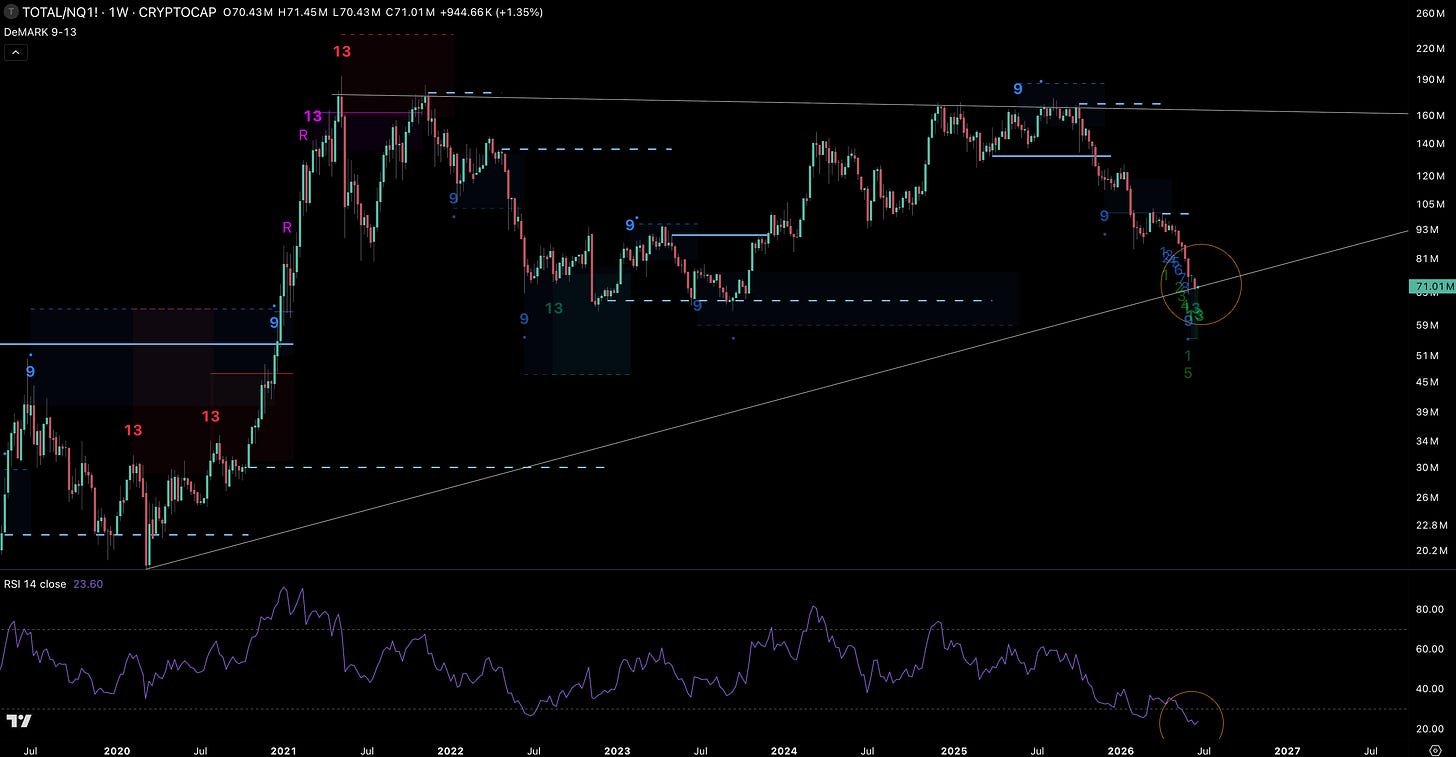
Crypto/NASDAQ 100 ratio (weekly).
A September/October window would also align with a potential BTC/Gold re-rating, should the ratio break out from the handle of its current cup-and-handle structure.
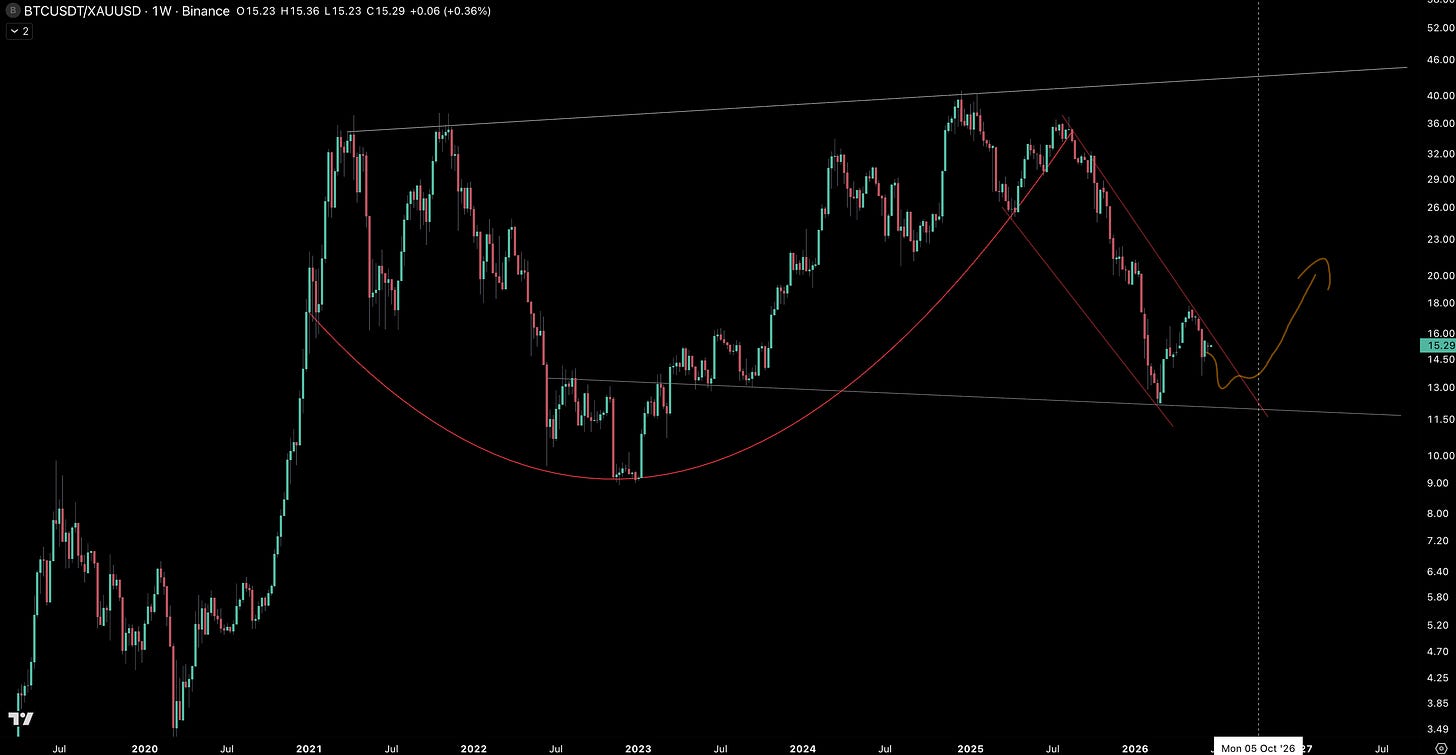
BTC/Gold ratio (weekly).
None of these factors is decisive in isolation. The more important point is the confluence: seasonality, liquidity, regulation, positioning and relative performance are all beginning to point in the same direction.
These clusters of signals often provide the most useful market insights, particularly when they emerge after a prolonged period of underperformance.
State of Yields
Stablecoin lending yields:
~3.17% on Aave (USDC) — utilisation rates have come down slightly to 89.3%. No change in yield or utilisation rates from prior week.
~4.4% on Aave (USDe) — utilisation at ~64%. Slightly lower utilisation vs. last week.
Fixed-rate DeFi lending: yield premium in fixed markets marginally expanding from last week:
Pendle sUSDAi: ~8.7% (July-Oct 2026 maturities)
sUSDe: ~4.42%
ETH yield benchmarks:
Lido staking: ~2.3% - no change from prior week.
About Re7
Re7 Capital is a research-driven digital asset investment firm specialising in DeFi yield and liquid alpha strategies.
Disclaimers
The content is for informational purposes only. None of the content is meant to be investment advice. Use your own discretion and independent decision regarding investments. The opinions expressed in all Re7 public research articles are the independent opinions of the authors at the time of publication and not the opinions of the affiliates of Re7.
Please see here for full disclaimers.
Thanks for reading Re7 Research! Subscribe for free to receive new posts and support our work.