The Weekly: The Rise of Onchain IPO Price Discovery
JUL 20, 2026
Hyperliquid's pre-IPO markets are nailing IPO price discovery. Plus: ETH's breakout, wedge pattern crypto markets, and this week's DeFi yields on Aave, Pendle & Lido.
Weekly Summary
We cover:
The rise of onchain IPO markets
Hyperliquid’s pre-IPO price discovery
Cerebras & SpaceX vs Wall Street pricing
The Rise of Onchain IPO Price Discovery
When Hyperliquid launched pre-IPO markets, many dismissed them as little more than speculative side markets. Today they look increasingly useful.
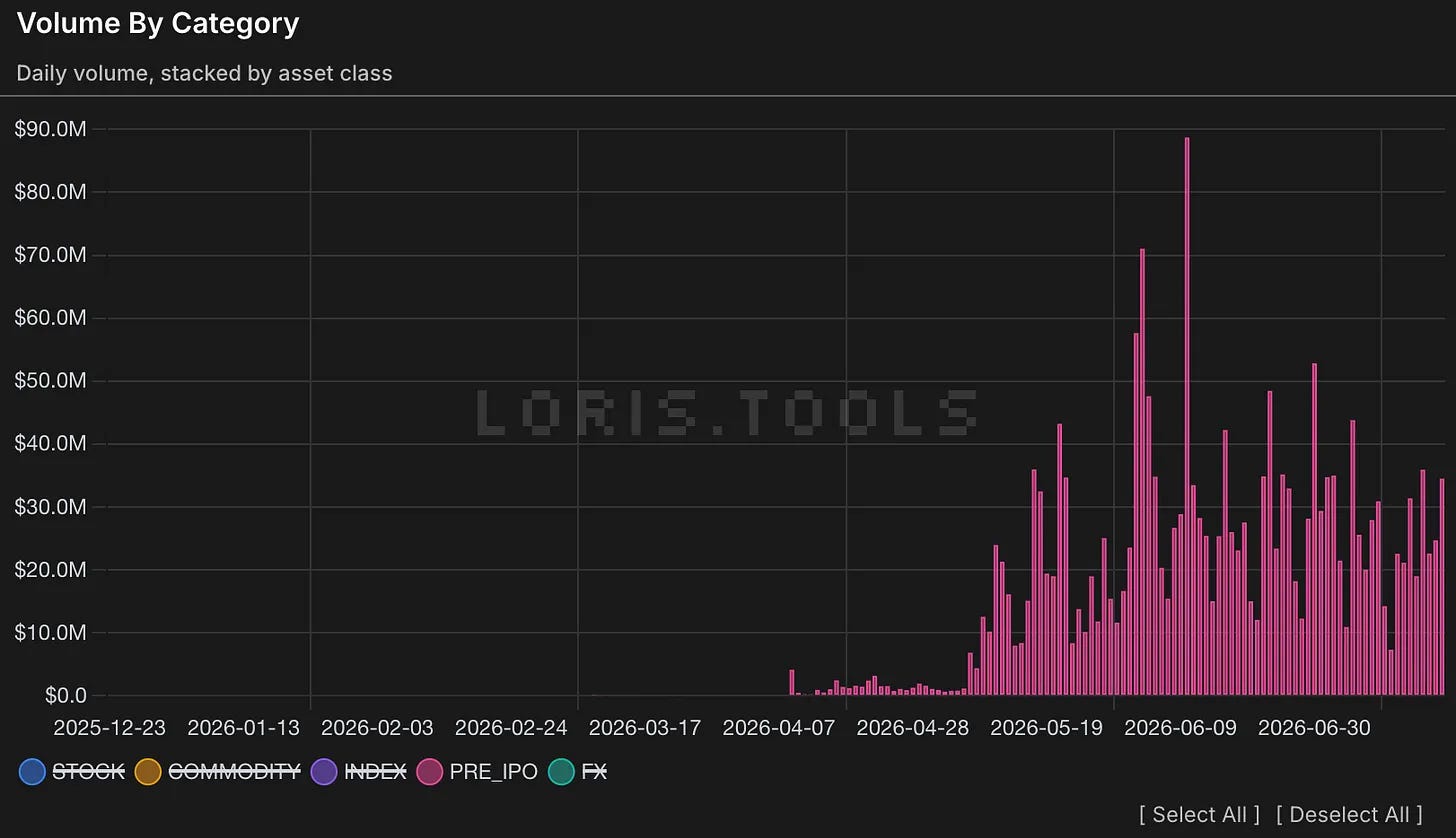
Pre-IPO trading volumes remain small, but the market is already proving to be an effective venue for price discovery.
Over the past year, Hyperliquid’s pre-IPO contracts have consistently converged towards where companies ultimately begin trading, providing an independent source of price discovery before companies list publicly.
This is despite pre-IPO markets accounting for just 0.4% of onchain RWA value today.
How Hyperliquid’s pre-IPO market works
Unlike a traditional IPO bookbuilding process, Hyperliquid simply creates a perpetual market linked to an upcoming listing.
The exchange publishes an initial reference price and then steps aside.
From that point, price is determined entirely by buyers and sellers on Hyperliquid’s fully onchain order book. There are no investment banks marketing the deal, no allocations to preferred clients and no discretionary pricing committee.
The interesting question is whether these markets are actually informative.
Increasingly, the answer appears to be yes.
Cerebras
Cerebras priced its IPO at $185 per share on 13th May 2026. On Hyperliquid, traders valued it closer to $354 before listing.
When Nasdaq opened, Cerebras began trading at $350.
Hyperliquid missed by just over 1%.
SpaceX
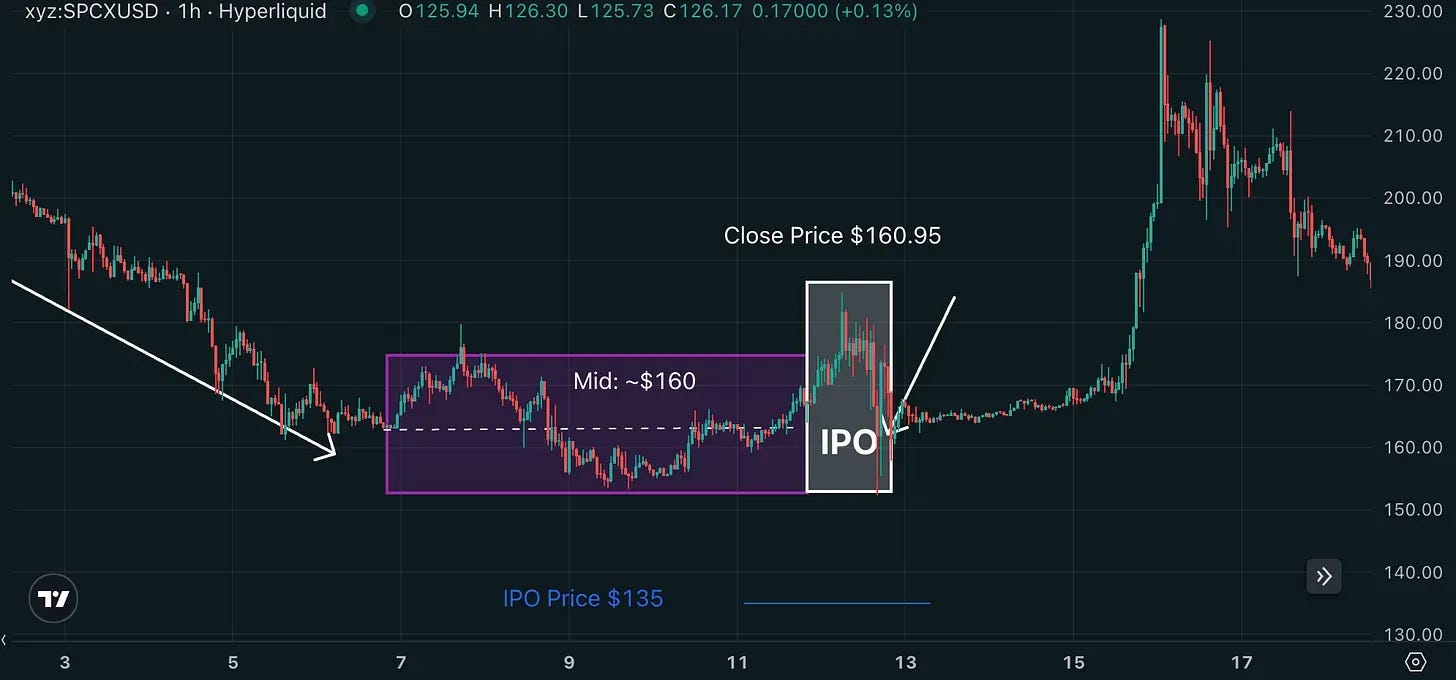
The same pattern emerged. SpaceX’s IPO was priced at $135 on 11th June 2026. Hyperliquid’s price started oscillating around $160 in the days leading up to the listing.
The stock opened at $150, before finishing its first day near $161.
Again, the decentralised market was remarkably close to where public investors ultimately valued the company.
The Next Test: CXMT
The latest example is ChangXin Memory Technologies (CXMT), whose IPO attracted demand exceeding 570x the shares on offer.
Hyperliquid launched its pre-IPO market with a $5 reference price. Within the first 24 hours, the market traded roughly $1.3 million of volume and repriced the contract to around $9, implying investors expect a materially higher valuation ahead of the company’s upcoming listing.
Why does this matter?
Investment banks deliberately don’t optimise for perfect price discovery.
Their objective is to execute a successful offering, build long-term institutional relationships and minimise the risk of a weak IPO. That often means pricing conservatively, leaving some upside for investors who receive allocations.
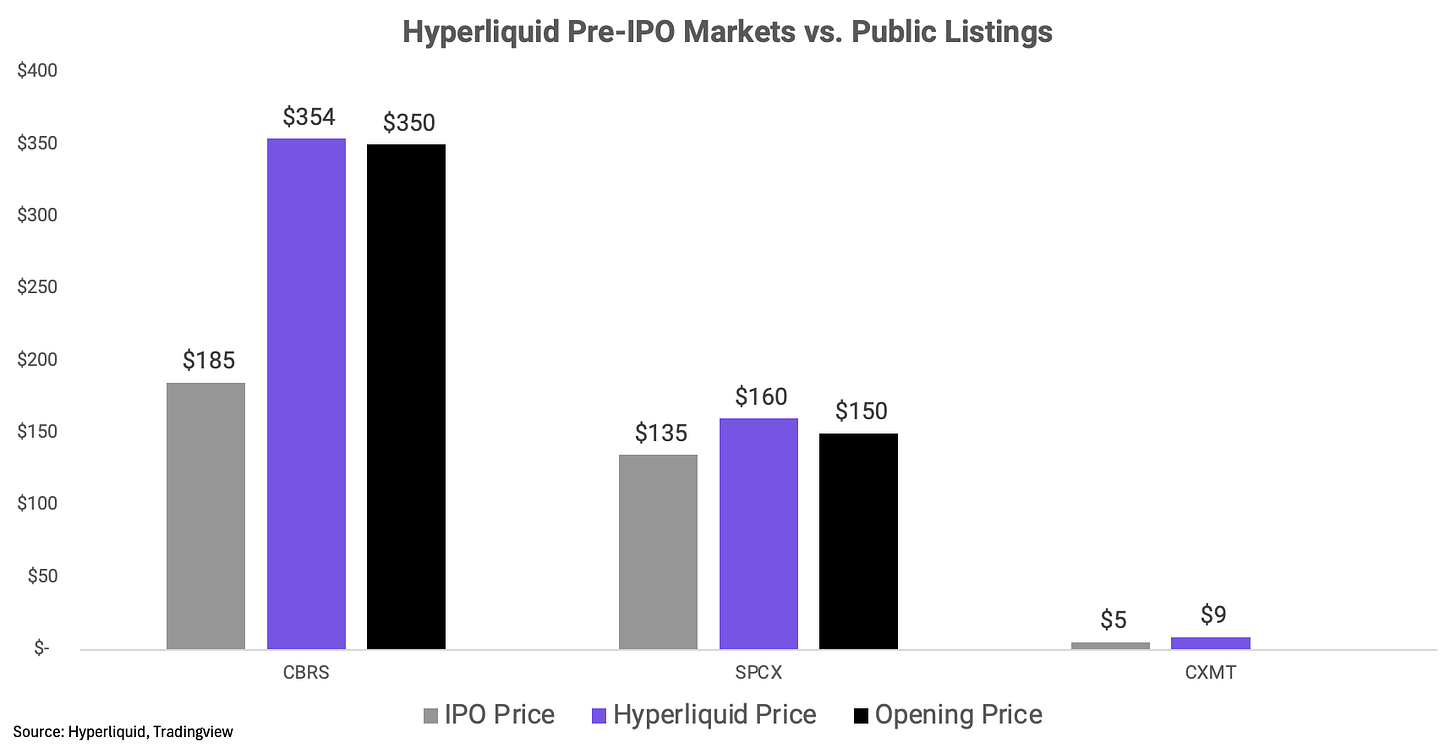
Onchain markets have provided a remarkably accurate estimate of where public markets ultimately value new listings.
Permissionless markets optimise for something different. They continuously aggregate information from anyone willing to take risk, updating prices every second as new information emerges.
They don’t replace traditional IPOs but they do provide a real-time estimate of where a broad market believes fair value lies before the opening bell.
For the first time, investors don’t need to wait until Nasdaq opens to discover what the market thinks a company is worth. The market has already told them.
Market Update
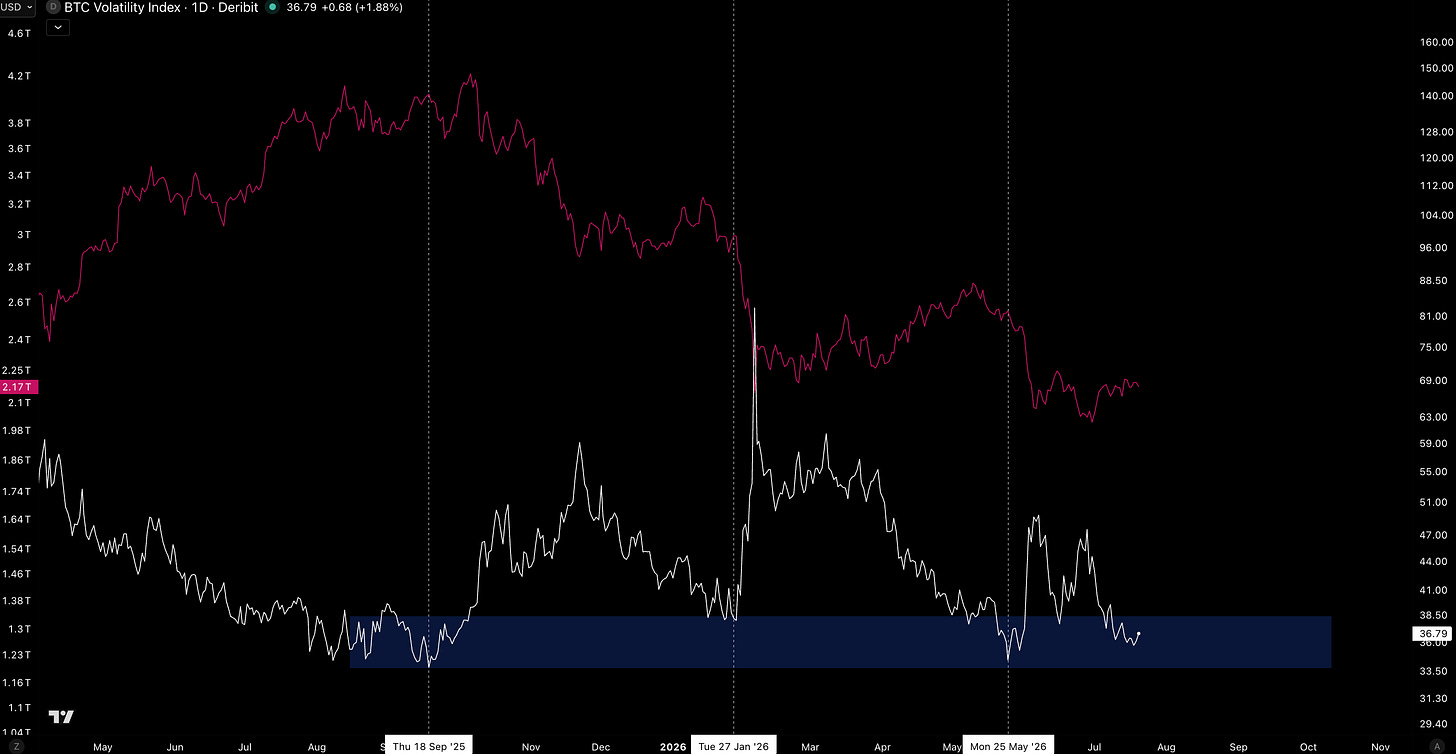
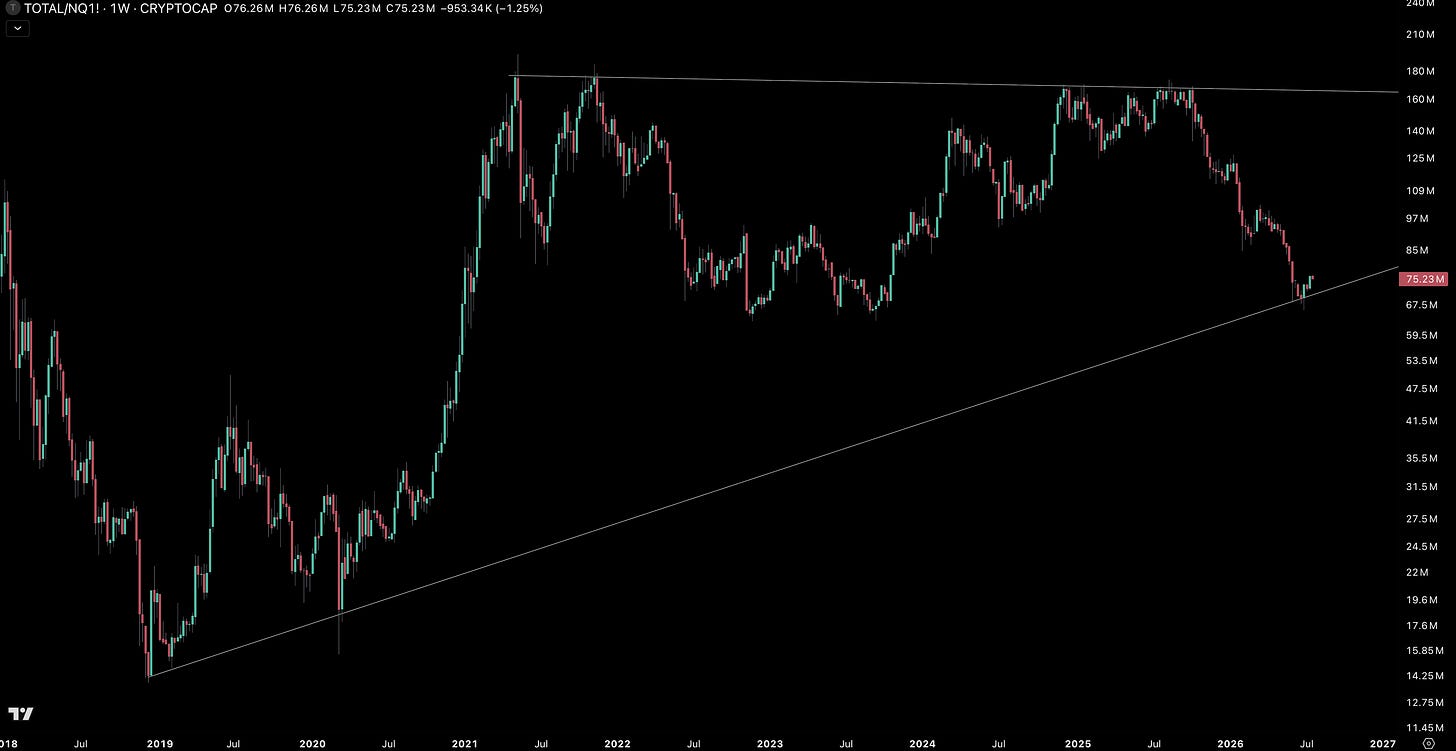
Global crypto market capitalisation has been tightening within a wedge as seller momentum has slowed significantly.
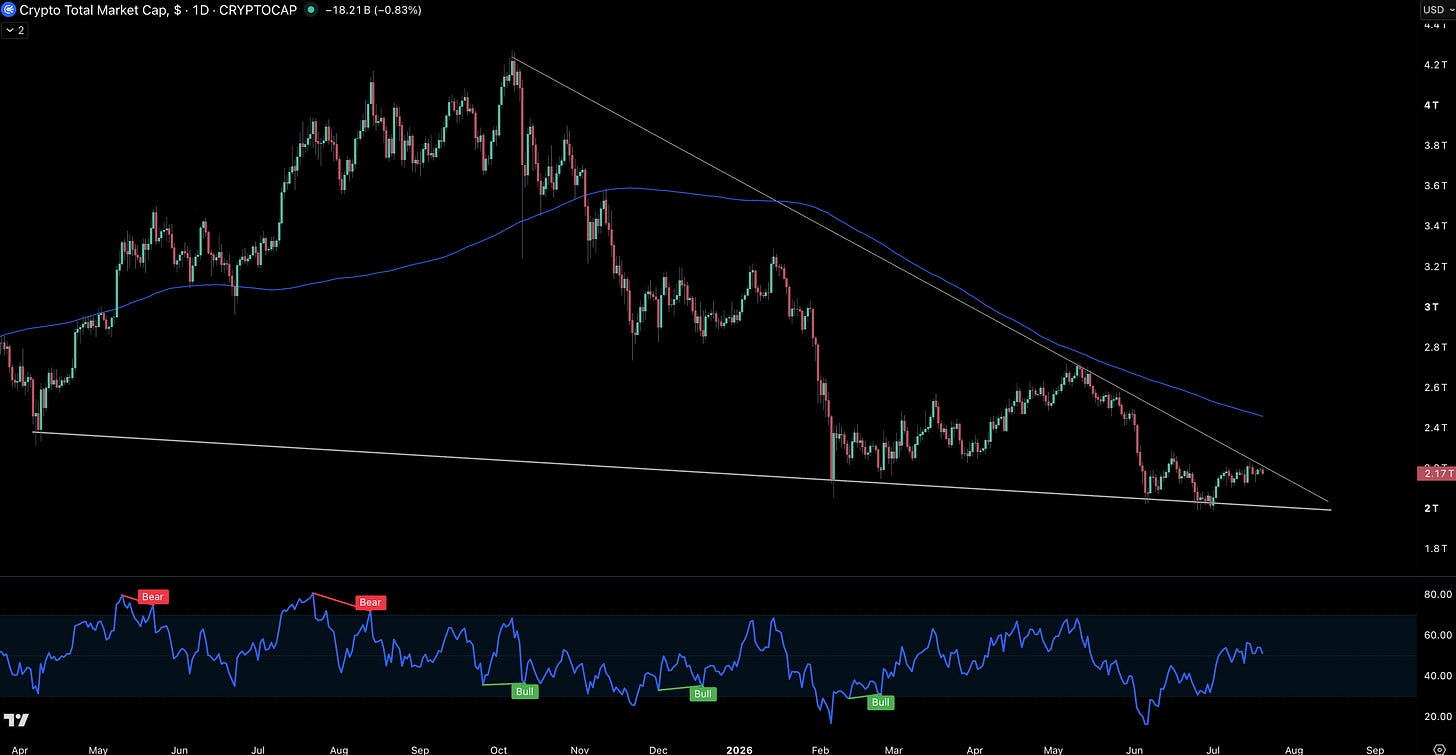
Volatility has been suppressed to such an extent that a larger breakout move is becoming increasingly likely in either direction.
This makes sense given the wedge pattern the market is showing is expected to resolve within the next ~25 days.
Crypto markets closed the week up 16% versus the NASDAQ from the June 2026 bottom.
Over the past several weeks, we've highlighted the clear seller exhaustion in the ratio, with relative outperformance increasingly looking likely.
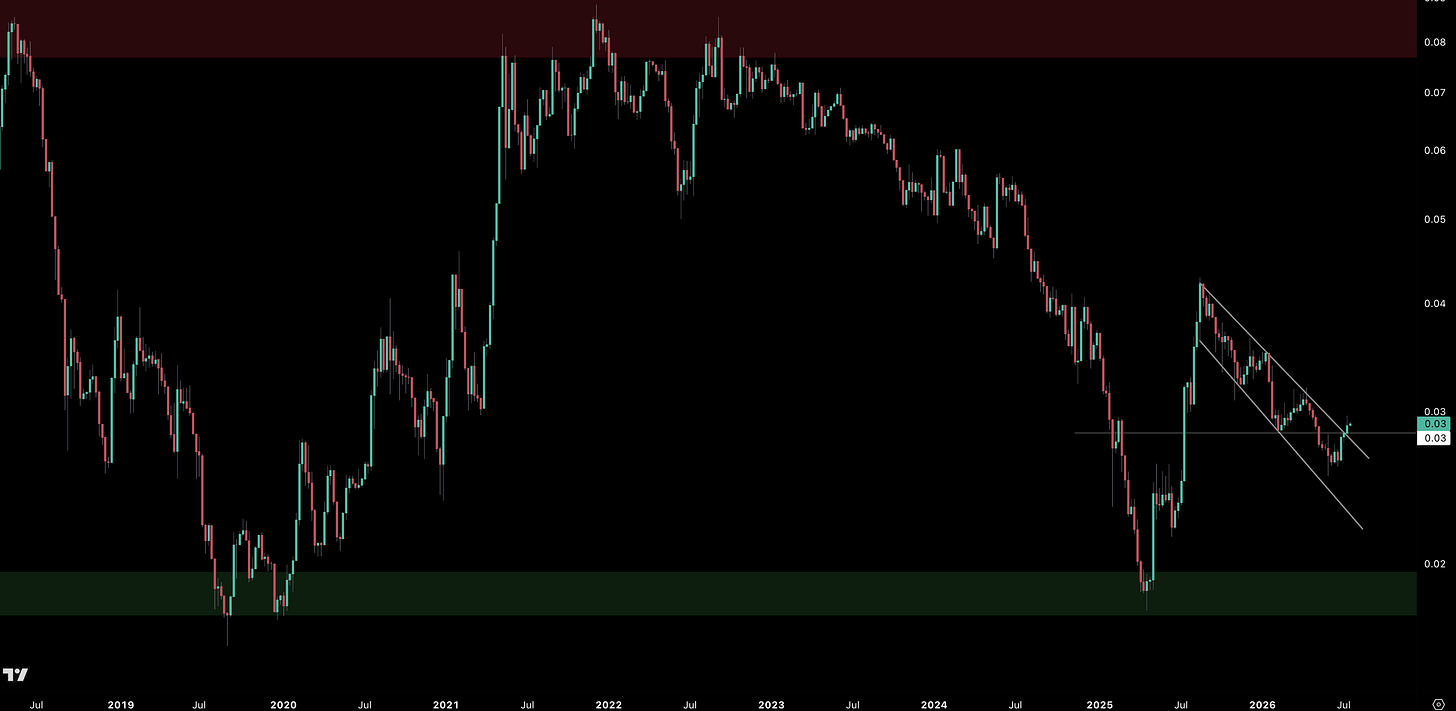
ETH stole the show last week - up +2% vs. BTC and so far printing a 3rd consecutive positive month.
It’s now looking to confirm 2 pattern breakouts at the same time which can often be a more powerful signal of momentum change.
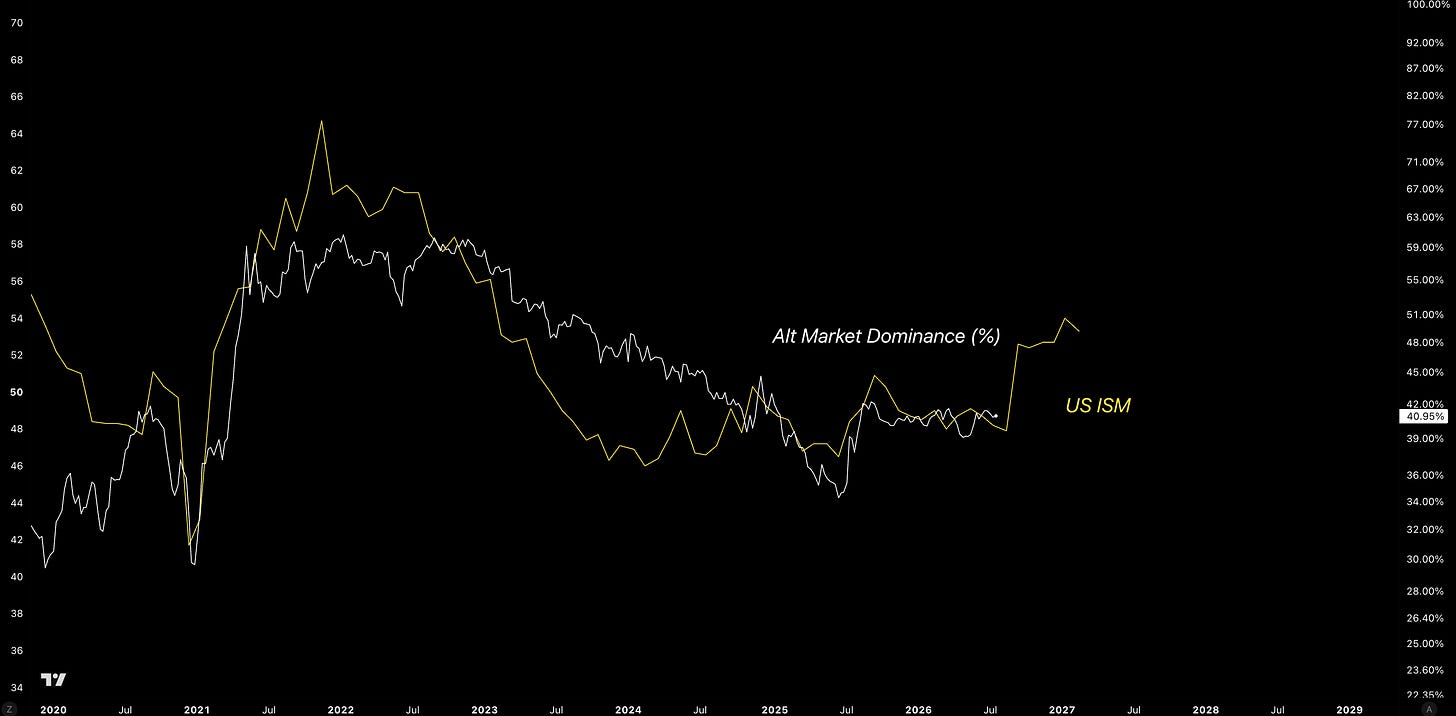
Alt coin market cap dominance has remained steady as we would expect at this stage in the economic cycle.
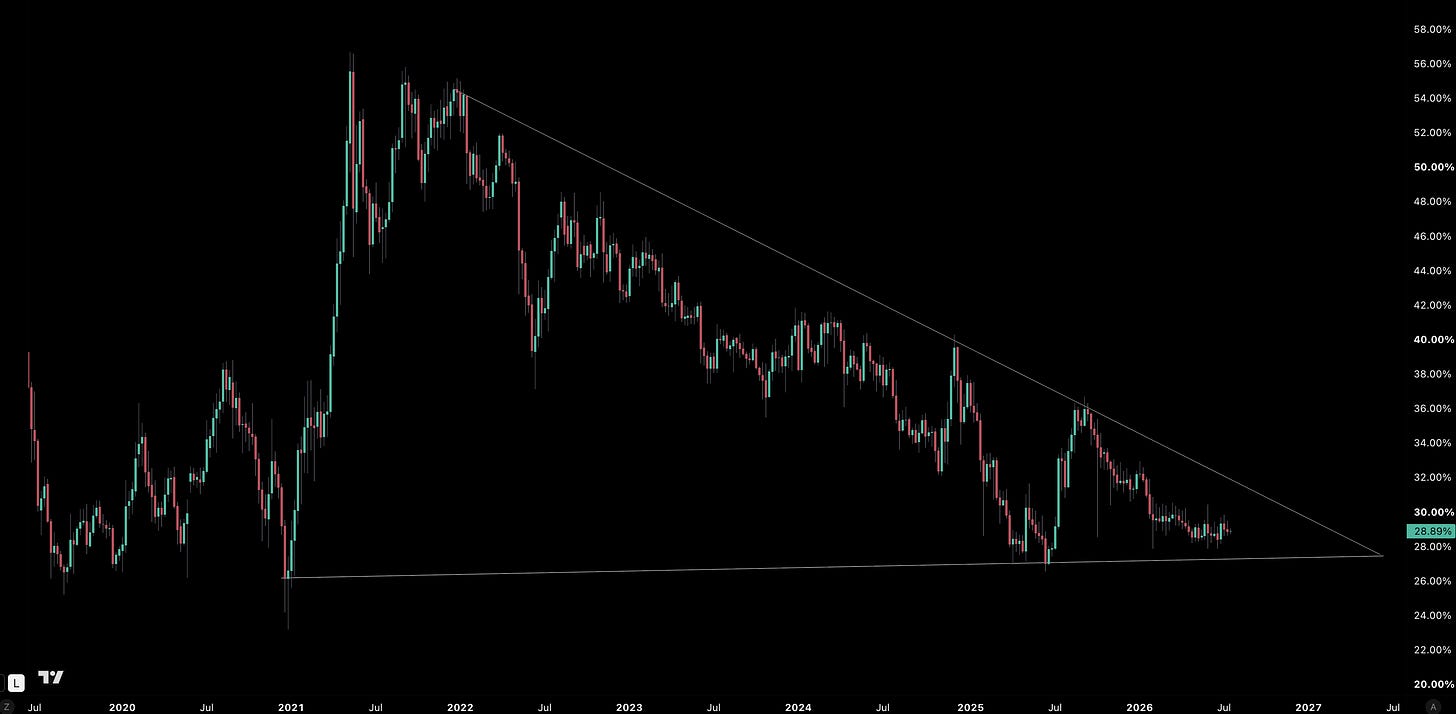
Alt coin market cap dominance (%).
We expect capital to rotate further into alt coins at the end of summer/start of autumn as the sharp economic recovery continues to feed through to crypto markets.
State of Yields
Stablecoin lending yields:
~3.22% on Aave (USDC) — utilisation rates have come down slightly to 89%.
~3.29% on Aave (USDe) — utilisation at ~54%. Slightly higher utilisation vs. last week.
Fixed-rate DeFi lending: yield premium in fixed markets marginally expanding from last week:
Pendle sUSDAi: ~8.82% (Oct–Feb 2026 maturities)
sUSDe: ~4.47%
ETH yield benchmarks:
Lido staking: ~2.15% - slight decrease from last week
Re7 Capital is a research-driven digital asset investment firm specialising in DeFi yield and liquid alpha strategies.
Disclaimers
The content is for informational purposes only. None of the content is meant to be investment advice. Use your own discretion and independent decision regarding investments. The opinions expressed in all Re7 public research articles are the independent opinions of the authors at the time of publication and not the opinions of the affiliates of Re7.
Please see here for full disclaimers.
Thanks for reading Re7 Research! Subscribe for free to receive new posts and support our work.