The Weekly: Aggregation Theory Meets Reality
APR 13, 2026
This week, we revisit aggregation theory in DeFi and examine why DEX aggregators have not captured value uniformly across ecosystems. We also break down the latest market move, the current liquidity backdrop, and what compressed DeFi yields signal about leverage demand.
Last week, Re7 Capital advanced its institutional infrastructure through a new partnership with Zodia Custody, reflecting the growing demand for onchain fund structures meeting institutional security standards. Zodia Custody will support transparent onchain representation of investments in Re7’s BTC Yield and Market Neutral Strategies, providing secure custody infrastructure for these fund interests. Eligible clients will be able to hold them within institutional-grade cold wallets, ensuring investor capital remains protected.
This collaboration highlights the accelerating institutional adoption of onchain investment vehicles that combine robust operational rigour with uncompromising security. Read more on our blog.
Weekly Summary
We cover:
A re-visit to aggregation theory for the DEX sector
Why the theory hasn’t materialised universally across ecosystems
Market update
Aggregation Theory Meets Reality
For many years now, there has been a somewhat consensus thesis that aggregators would ultimately capture most of the value in DeFi by owning the user relationship and routing around decentralised exchanges (DEXs) by commoditising liquidity venues.
This is one form of aggregation theory.
The surface-level analogy to fintech and TradFi was compelling — in every major internet market, the layer that controlled user distribution ended up capturing disproportionate value from the layers beneath it.
Google routed around publishers, Amazon routed around brands, Facebook routed around media…
Yet, DEX aggregator volume dominance for the top two ecosystems — Ethereum and Solana — has failed to drive meaningful activity.
Aggregator share over the past 2 years has never sustained >20%.
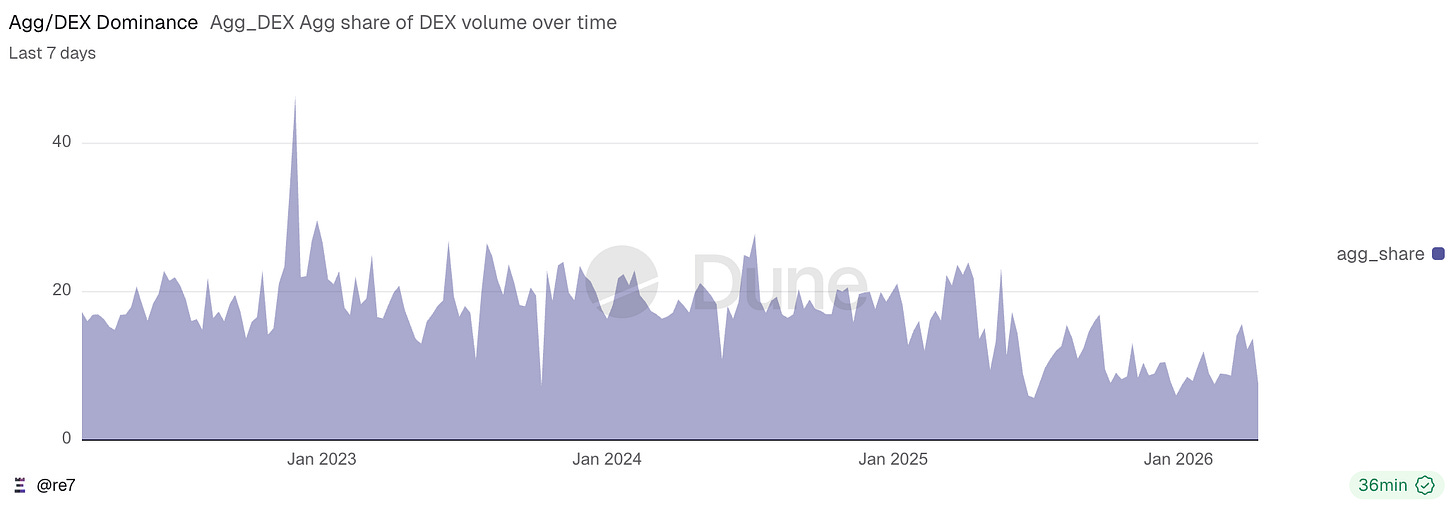
Aggregator volume/DEX volume ratio for Ethereum and Solana ecosystems combined over the past 4 years.
As we often learn, the picture is always more nuanced than black or white. Not all chains are structured the same way.
DEX aggregation volume dominance on Ethereum has never meaningfully surpassed >10%. On high volatility days, aggregator volume goes down, not up.
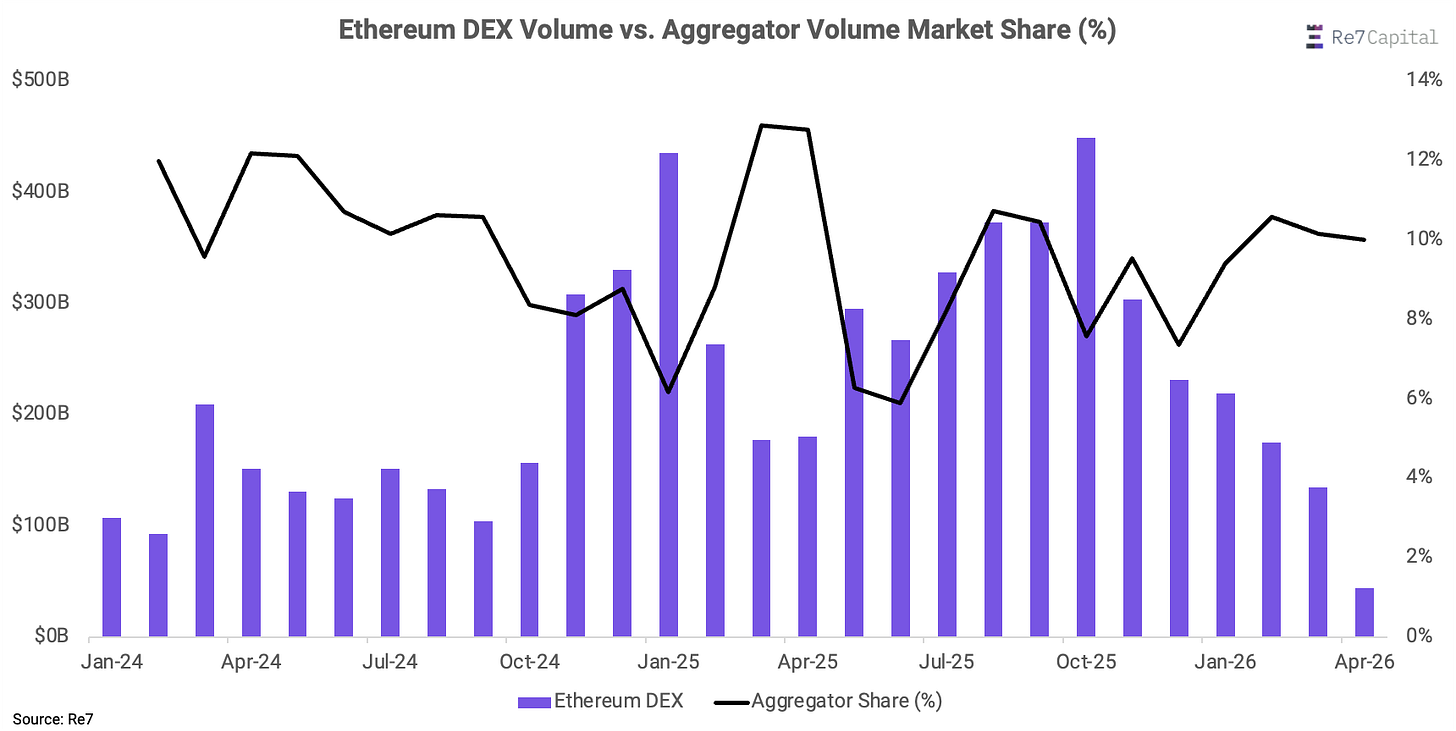
This provides the first clue — gas costs can punish complex routing more when chain congestion increases. On higher volatility days, we can reasonably expect higher relative fees onchain including on L2s.
With this thinking, we should therefore expect reliably lower cost, low latency, and higher throughput chains to be more conducive environments for DEX aggregators.
This is because transaction costs are negligible so complex routing is cost effective where prices can update near real-time.
We see this in the data. Solana DEX aggregator volume dominance is 3x higher vs. Ethereum with its dominance increasing 2x over 3 years.
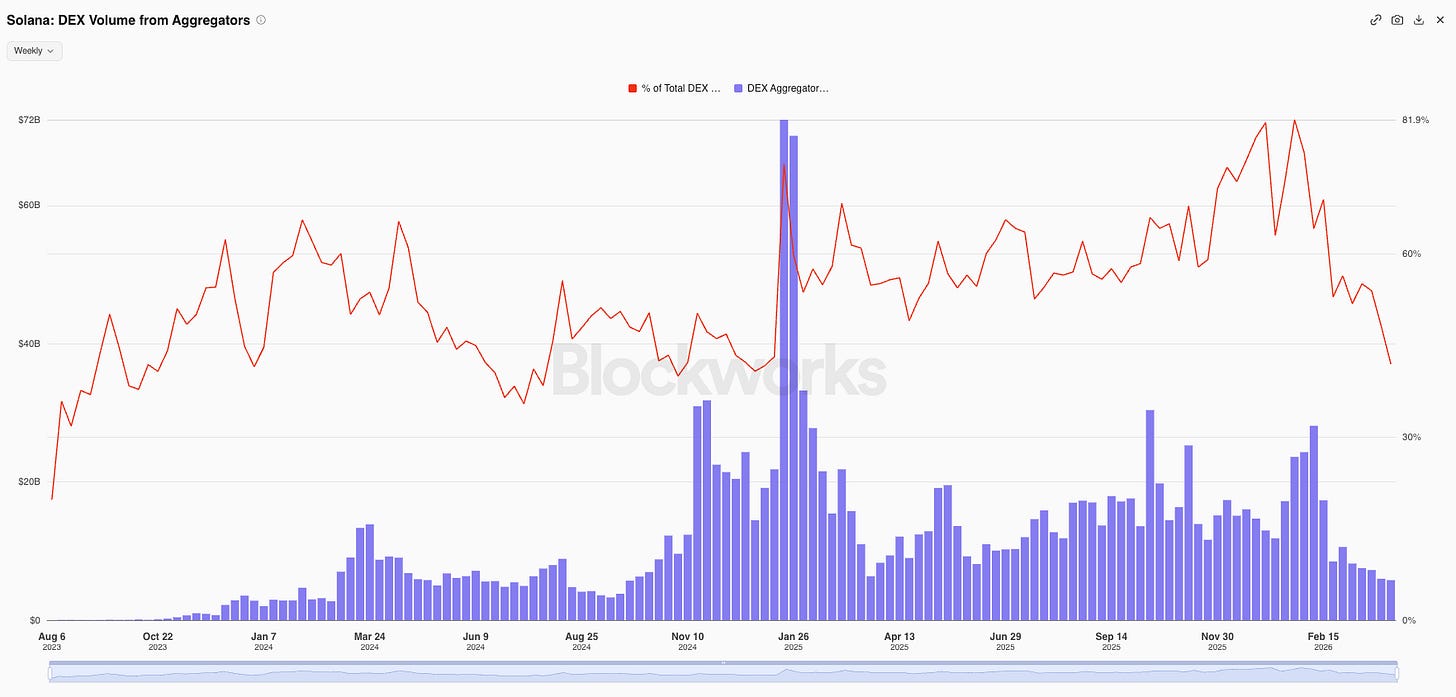
Solana DEX volumes ($) vs. % of DEX volume from aggregators (weekly).
Another reason for this divergence is there is a structural need for aggregators.
Solana’s liquidity is fragmented across an increasing number of long tail of AMMs, so splitting routes across venues genuinely improves execution.
Negligible fees mean complex multi-hop routing costs the same as a single swap — sophistication is free.
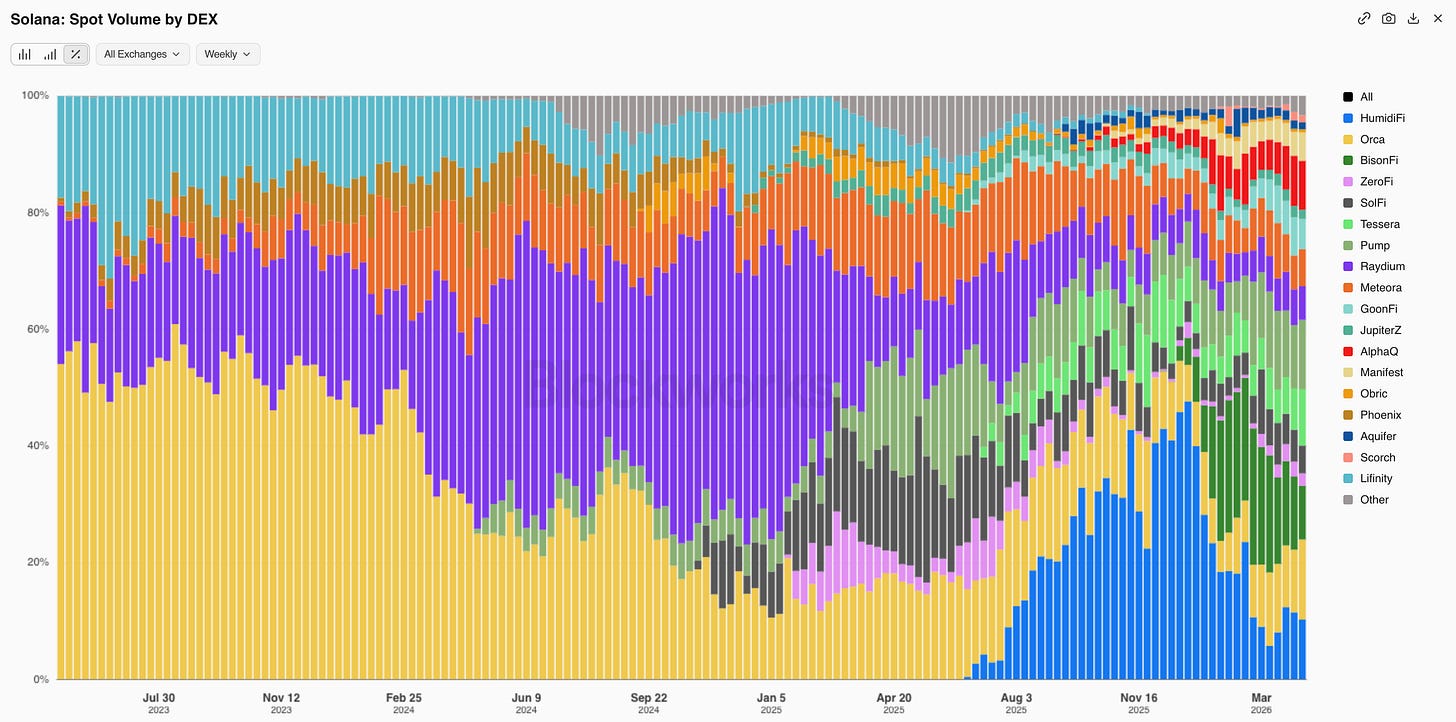
Shares of spot volume by DEX on Solana.
On Ethereum, volume is concentrated in a handful of deep Uniswap v3 pools, so Uniswap’s own router already finds the best price in one hop. And on the rare occasions an aggregator can improve on price, Ethereum’s gas costs for multi-hop routes frequently wipe out the gain anyway.
Take key distribution channels on Ethereum like Metamask. The majority of the volume flows through Uniswap pools without the need for aggregators.
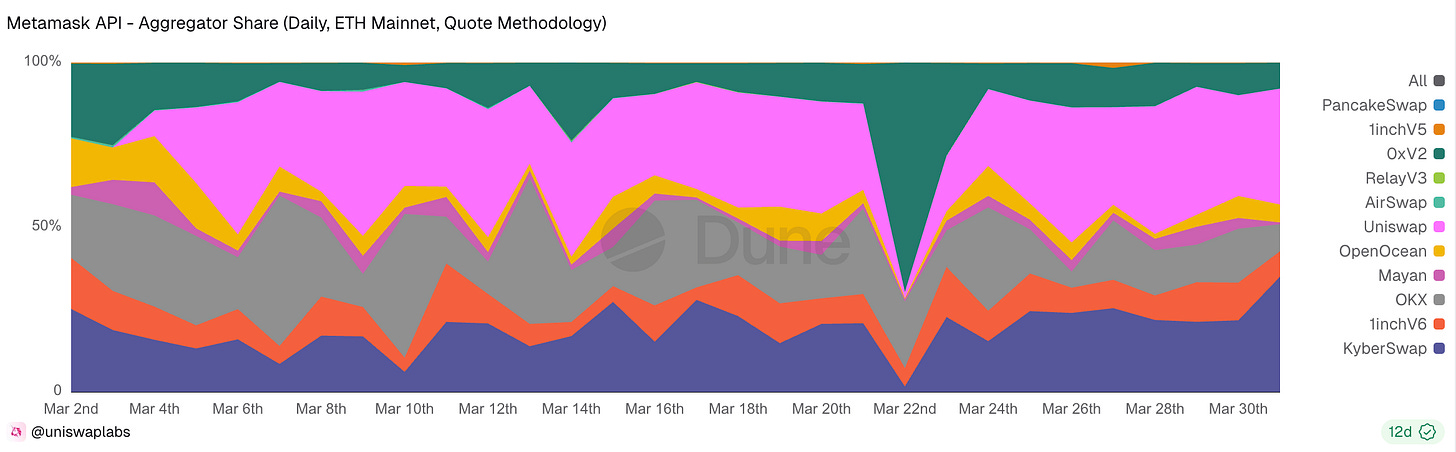
Share of Metamask swap volume by liquidity source that won internal quote (March 2026).
Context is Everything
So taken together, Ethereum’s liquidity structure, gas economics, and the early dominance of native DEX routing have collectively prevented aggregators from establishing the foothold the thesis predicted.
The conditions that made Jupiter indispensable on Solana — fragmented liquidity, negligible routing costs, no single dominant venue — simply don’t exist on Ethereum in the same way.
Aggregation theory may yet play out over longer timeframes or in new contexts, but for now the data suggests it is less a universal law of DeFi and more a function of chain architecture and where liquidity happens to settle.
Market Update
Crypto markets gained +2% last week despite ongoing turbulence with peace negotiations talks between the US and Israel.
Despite negotiations collapsing on the first day the re-introduction of new blockade threats over the weekend, it feels investors are now becoming fatigued with headlines.
What is becoming increasingly likely is Trump will be looking for an offramp and declare strategic success.
This is what the charts maybe sniffing out.
Crypto markets are opening positively +0.2% on Monday where we’re looking for a re-test bounce from breaking out of the wedge pattern since October 2025…
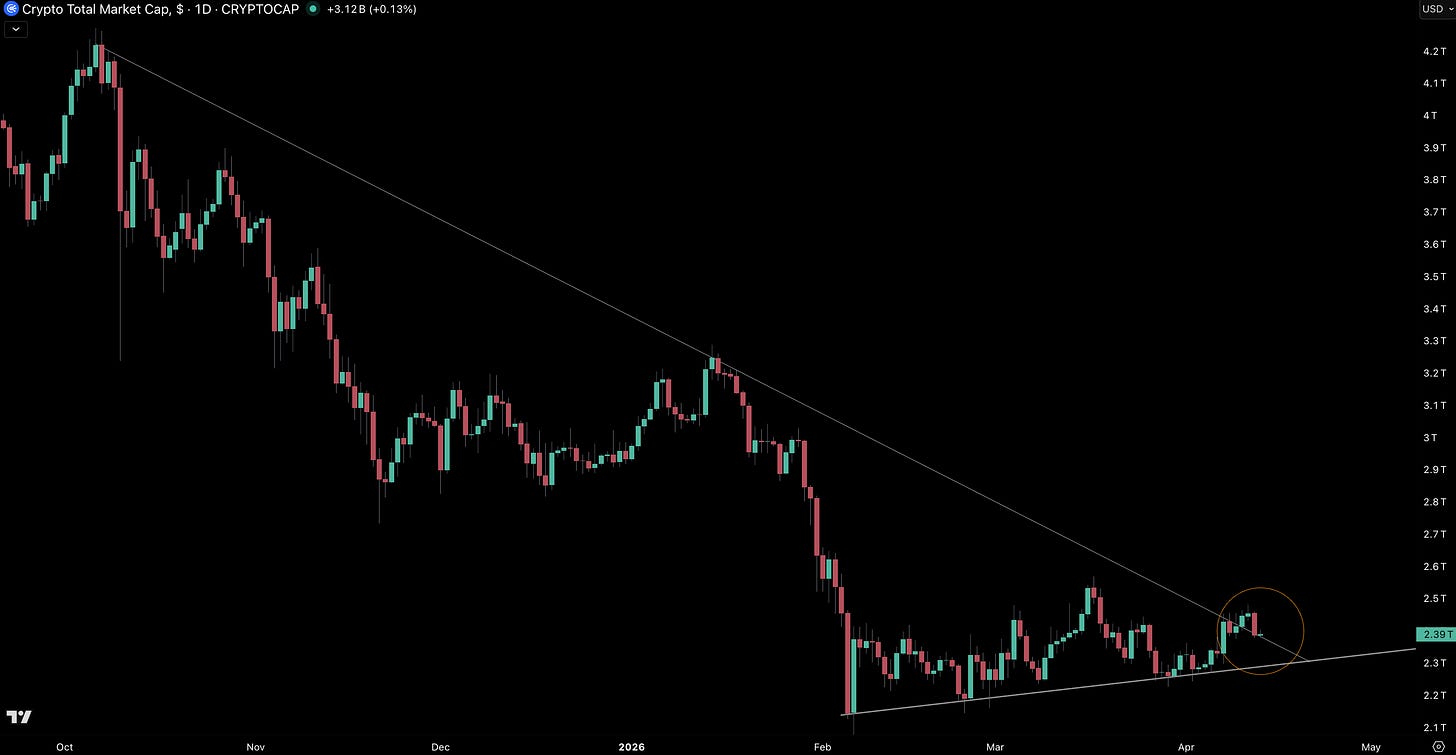
Global crypto market capitalisation ($; daily).
The weekly chart is even clearer. It doesn’t scream risk off…
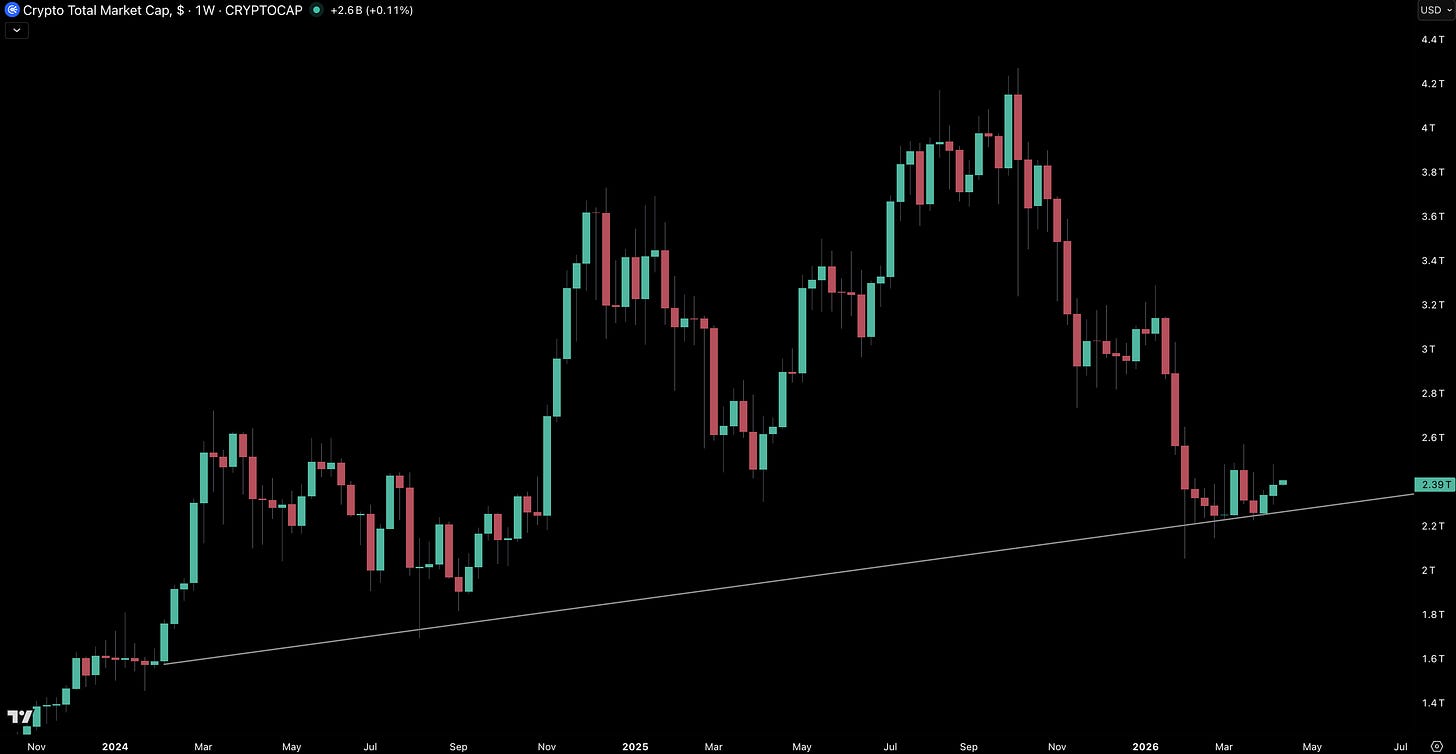
Global crypto market capitalisation ($; weekly).
The data so far still directionally supports the view that the recent drawdowns was primarily driven by systematic deleveraging, rather than a deterioration in underlying crypto fundamentals or macro backdrop heading into the conflict…
We’ve just seen the largest spike in US domestic liquidity. These are typically seen during periods of rising liquidity trends and rarely seen during prolonged periods of financial tightening by the Fed.
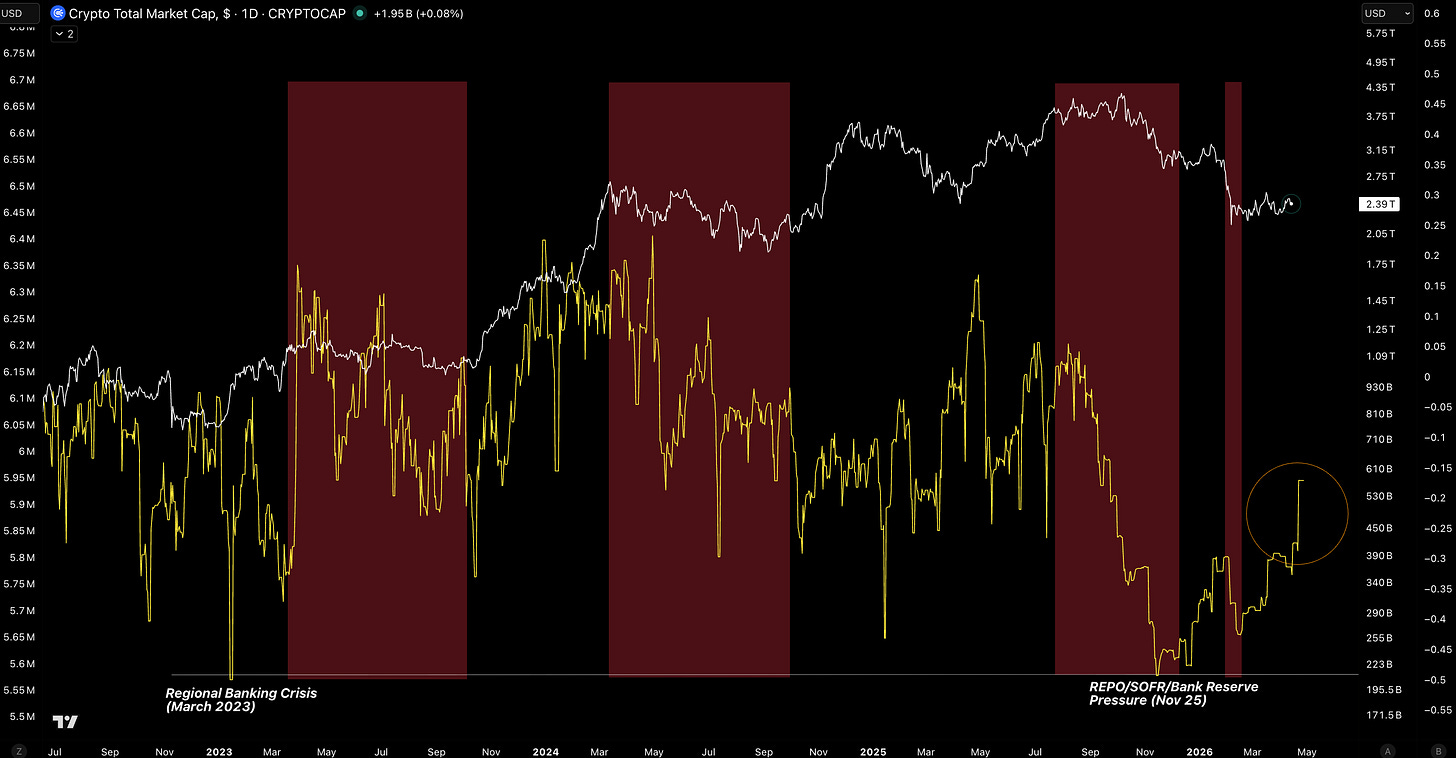
Global crypto market capitalisation vs. US domestic liquidity index.
And the reason this is important is that these undercurrents are occurring as investors remain deeply skeptical, fearful, and poorly positioned for any upside volatility that could follow.
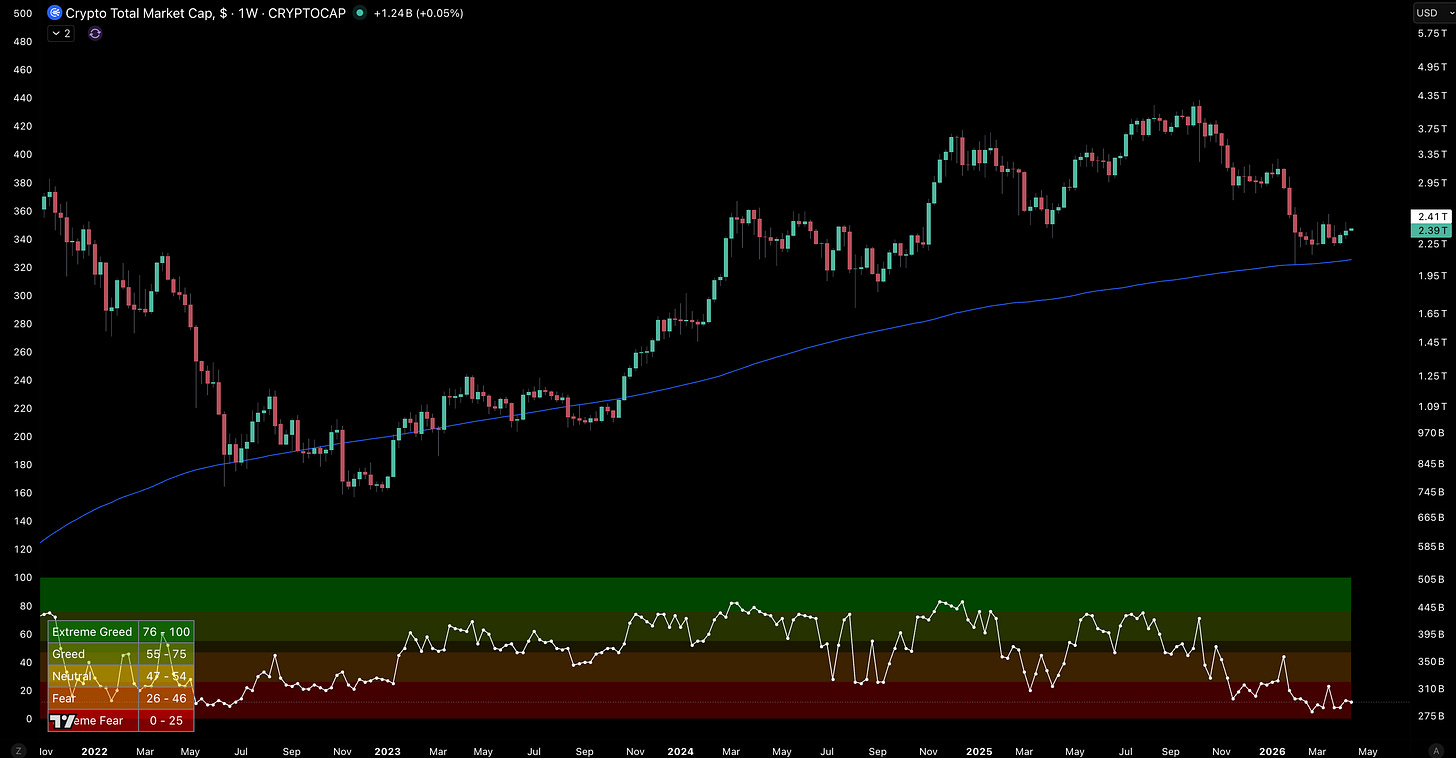
Crypto Fear & Greed Index (weekly) vs. global market capitalisation ($).
State of Yields
The yield premium has compressed to near zero — stablecoin supply more than doubled between 2024 and 2026, but borrowing demand never came in the concentrated bursts that drove rates higher in previous cycles.
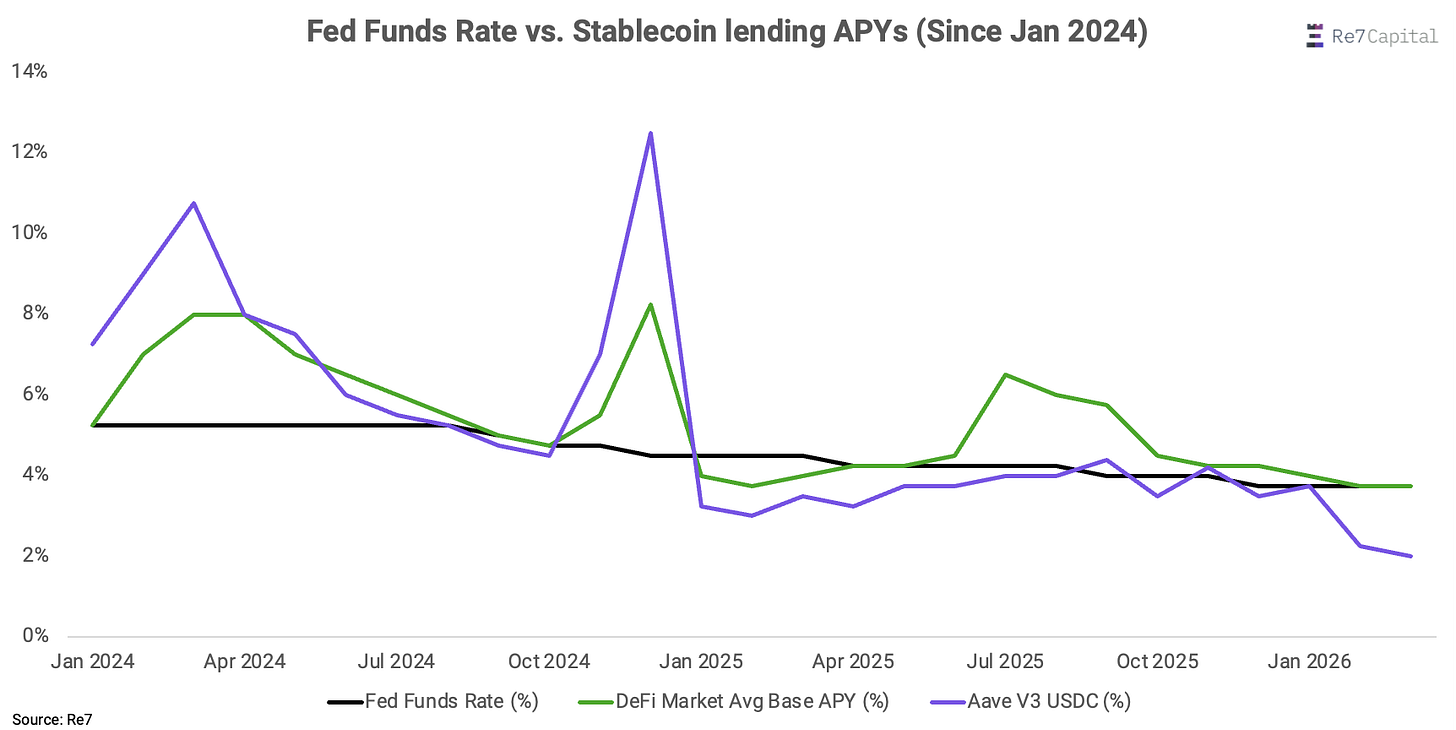
In other words, DeFi yields were never a structural premium over TradFi; they are a cyclical expression of the demand for leverage.
Stablecoin lending yields:
~2.26% on Aave (USDC), still below the ~3.7% 3-month T-bill rate. Variable-rate premiums remain compressed.
Fixed-rate DeFi lending: yield premium in fixed markets marginally expanding from last week:
Pendle sNUSD: 8.46% (Jun 2026)
Pendle sUSDAi: 7-8% (Jun-Oct 2026 maturities)
sUSDe holding: ~3.6%, slightly up from ~3.5% last week
ETH yield benchmarks:
Lido staking: ~2.36% (flat over the past week)
Disclaimers
The content is for informational purposes only. None of the content is meant to be investment advice. Use your own discretion and independent decision regarding investments. The opinions expressed in all Re7 public research articles are the independent opinions of the authors at the time of publication and not the opinions of the affiliates of Re7.
Please see here for full disclaimers.