The Weekly: When Does A $5.5T Tokenised Securities Market Become Plausible?
JUN 1, 2026
Re7 Capital's weekly research covers Citi's $5.5T tokenised securities forecast, the role of stablecoins and AI in driving adoption, plus the latest DeFi yield benchmarks and crypto market outlook.
Re7 Capital has continued to expand its institutional product suite and distribution reach through Q1 and into Q2:
ETH Yield Strategy — Re7 has launched mRe7ETH on Optimism, an ETH-denominated, market-neutral yield strategy designed for institutional allocators.
Anchorage Digital integration - Re7 has partnered with Anchorage to allow Qualified Custody of mRe7ETH. DATs and other institutional ETH holders that are mandated to Qualified Custody can now access mRe7ETH.
Telegram Wallet integration — Re7’s DeFi yield strategies are now available within Telegram’s self-custody TON Wallet, enabling users to access on-chain yield directly within the app.
Zodia Custody partnership — Re7 partnered with Zodia Custody, which provides custody and off-exchange settlement, and enables on-chain representation of Re7’s BTC Yield and Market Neutral strategies.
Weekly Summary
We cover:
Citi’s roadmap for a $5.5T tokenised securities market by 2030.
Why stablecoins may be the key driver of tokenised Treasury adoption.
The institutional, global and AI trends that could make the forecast achievable.
When Does A $5.5T Tokenised Securities Market Become Plausible?
Real-world assets continue to break out on-chain.
Tokenised RWAs have now reached a new all-time high of $32B, with more than 833k holders globally. Stablecoins are already much larger, with supply approaching $300B and more than 260m holders. The direction of travel is clear, but we are still very early in the broader adoption cycle.
Citi has just released a new report projecting that the tokenised securities market could reach $5.5T by 2030.
The numbers imply a steep adoption curve.
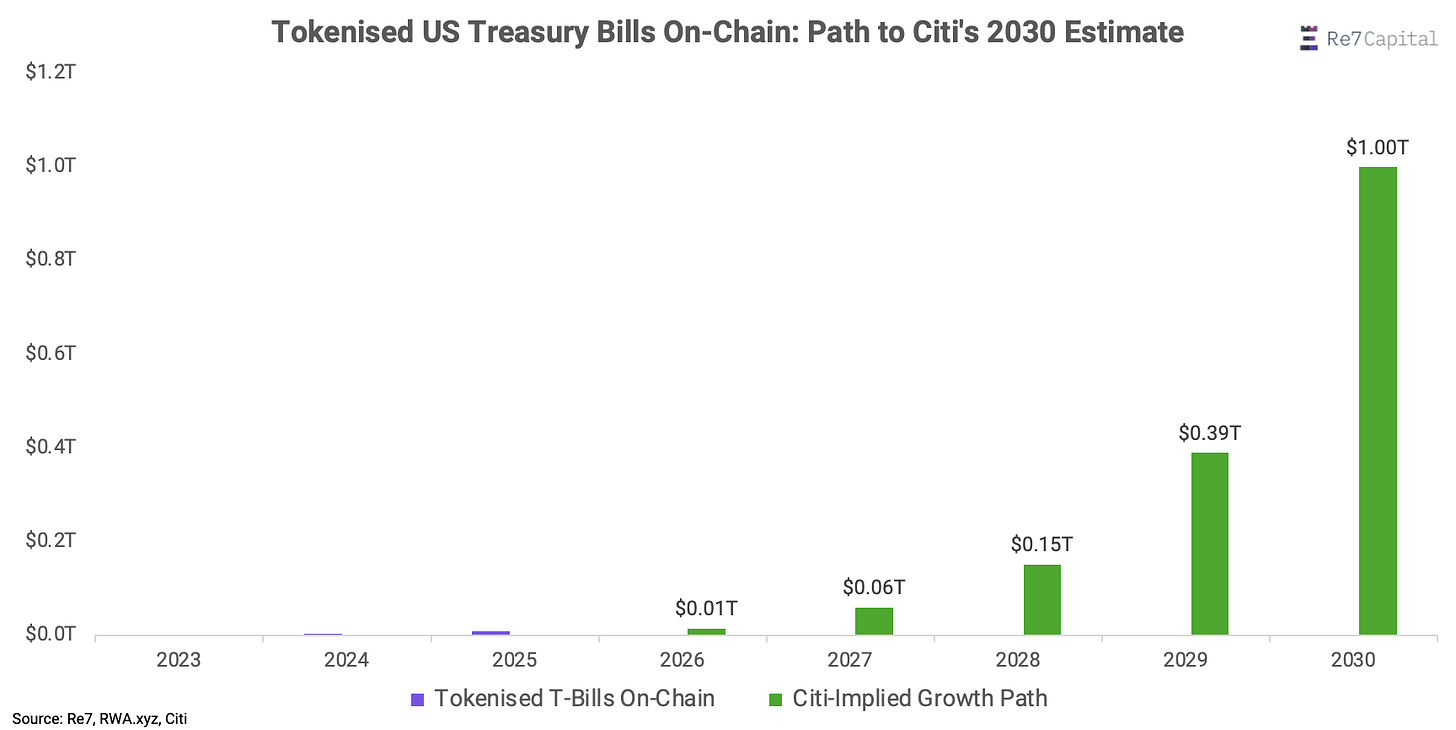
Tokenised T-bills would need to grow at roughly +256% per year from 2025 to 2030, reaching an end-state equivalent to around 15% penetration of the T-bill market.
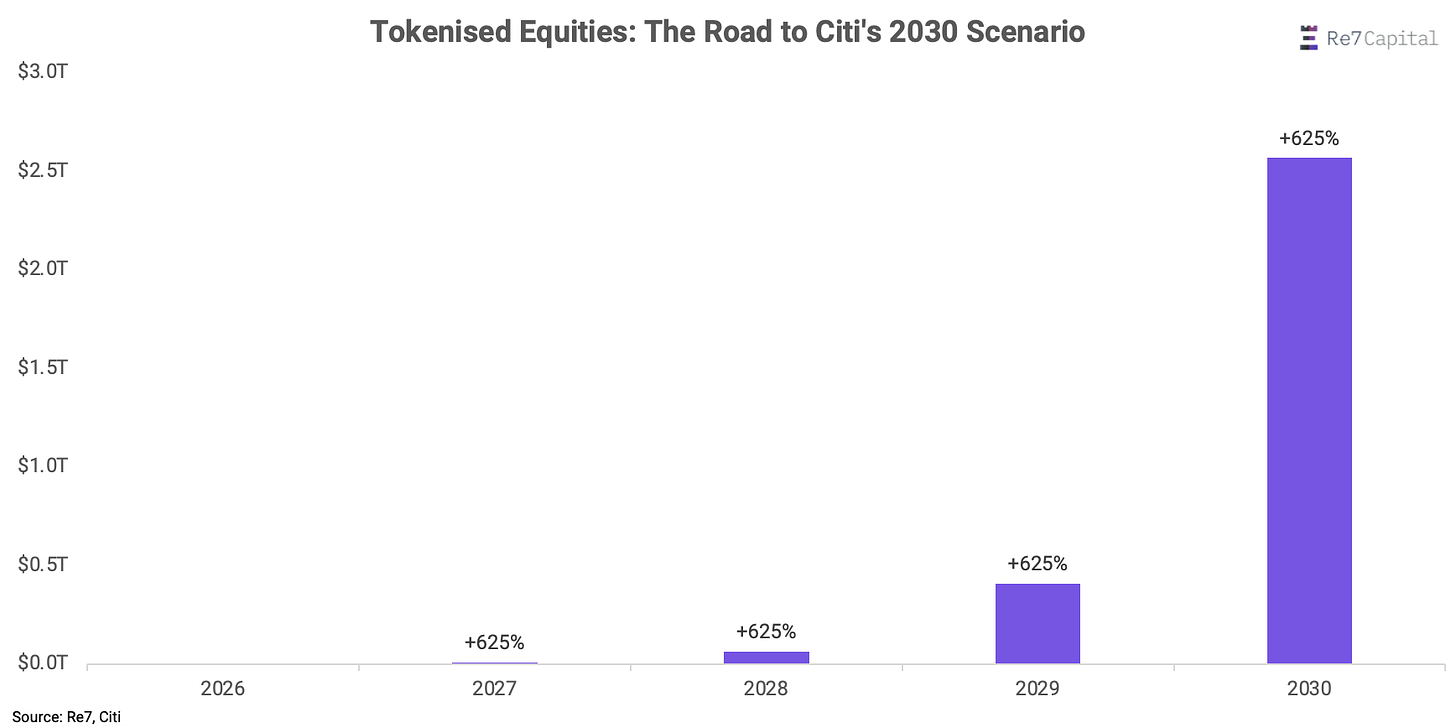
Meanwhile, tokenised equities would need to grow even faster, at roughly +625% per year, with Citi’s $2.6T target equivalent to ~10% of the current value of NASDAQ-listed companies.
At first glance, these assumptions look aggressive.
The more interesting question is what would need to be true for them to be reasonable.
The clearest driver is stablecoins. Every additional dollar of stablecoin supply creates demand for reserve assets, primarily short-duration U.S. Treasuries. If stablecoins keep evolving into a global digital dollar network, tokenised T-bills become a natural reserve layer.
The second driver is institutional infrastructure. Banks, asset managers, exchanges and custodians are moving from pilots to production, integrating blockchain rails into custody, settlement, collateral management and fund issuance.
Regulatory clarity is also improving, with the CLARITY Act and stablecoin legislation helping reduce one of the largest blockers to institutional adoption.
Third is global distribution. Tokenisation is not just about digitising U.S. assets for U.S. investors. It is a lower-friction access layer for global capital.
The fourth driver is AI. As financial activity becomes more automated, programmable assets and always-on settlement become more valuable. Autonomous agents are more naturally suited to on-chain financial infrastructure than legacy systems built around business hours and manual reconciliation.

Canonical: Blockchains as the substrate for physical AI.
Citi’s forecast is aggressive but if stablecoins continue scaling, institutions keep adopting blockchain infrastructure, global investors use tokenisation as a new access layer, and AI accelerates demand for programmable finance, then the growth curve starts to look less unreasonable.
The next five years are effectively a test of whether these adoption curves compound together.
Market Update
The crypto market contracted for its third consecutive week (-3%), reaching its 2026 support line. Overall markets are tentative and buoyant sentiment remains concentrated in AI for now.
However, the expression of the AI trade will likely manifest in different ways over the long term.
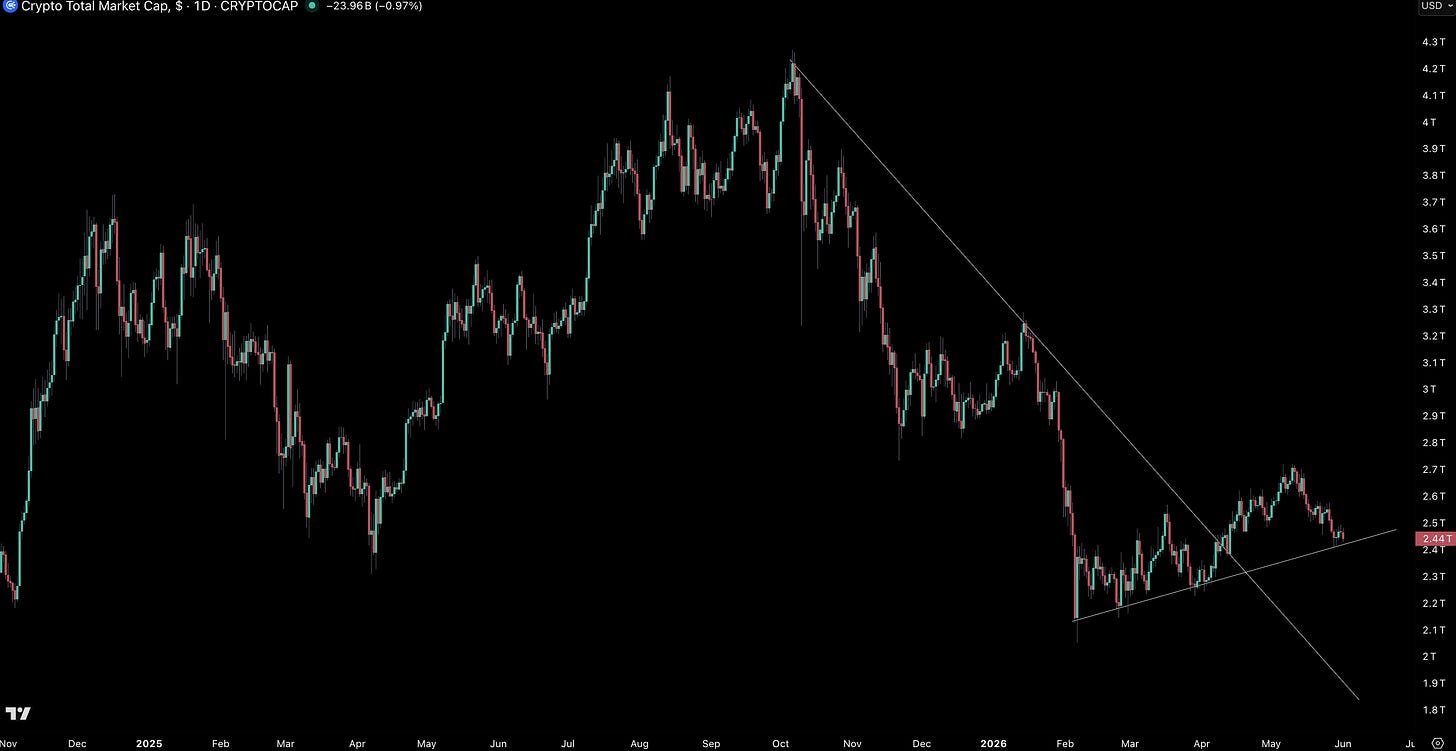
Global crypto market capitalisation ($; daily)
While BTC looks vulnerable, the liquidity picture remains constructive. Narrow US liquidity continues to accelerate on a forward-looking basis.
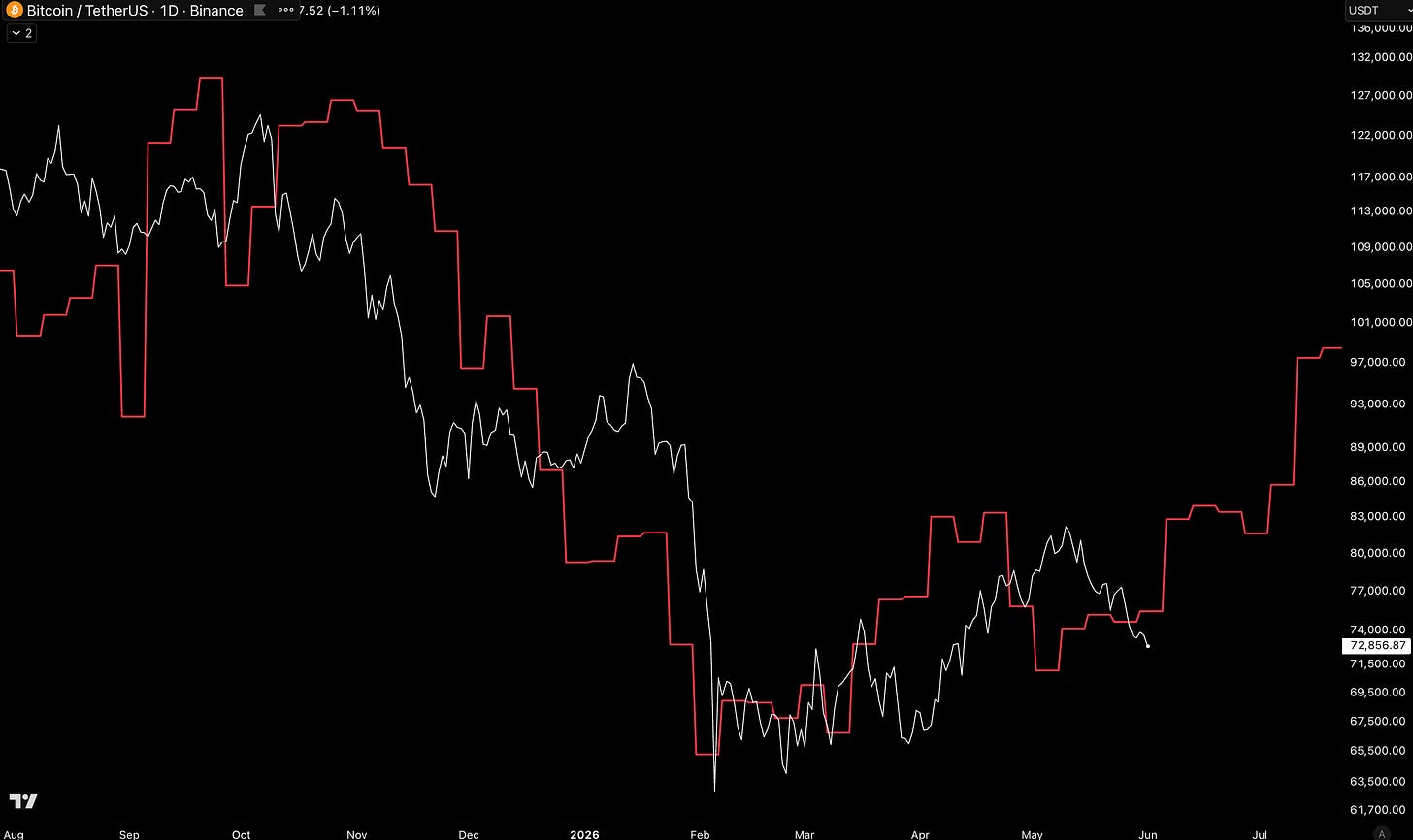
BTC/USDT vs. US narrow liquidity with 90 day lead.
AI capex has been absorbing incremental risk capital, leaving crypto behind. But if the rotation shifts from AI beneficiaries to AI infrastructure, crypto is well positioned as a key substrate for programmable payments, settlement and agents.
The crypto/NDX ratio is now approaching decade-long support, with reversal risk building over the next 1–2 weeks…
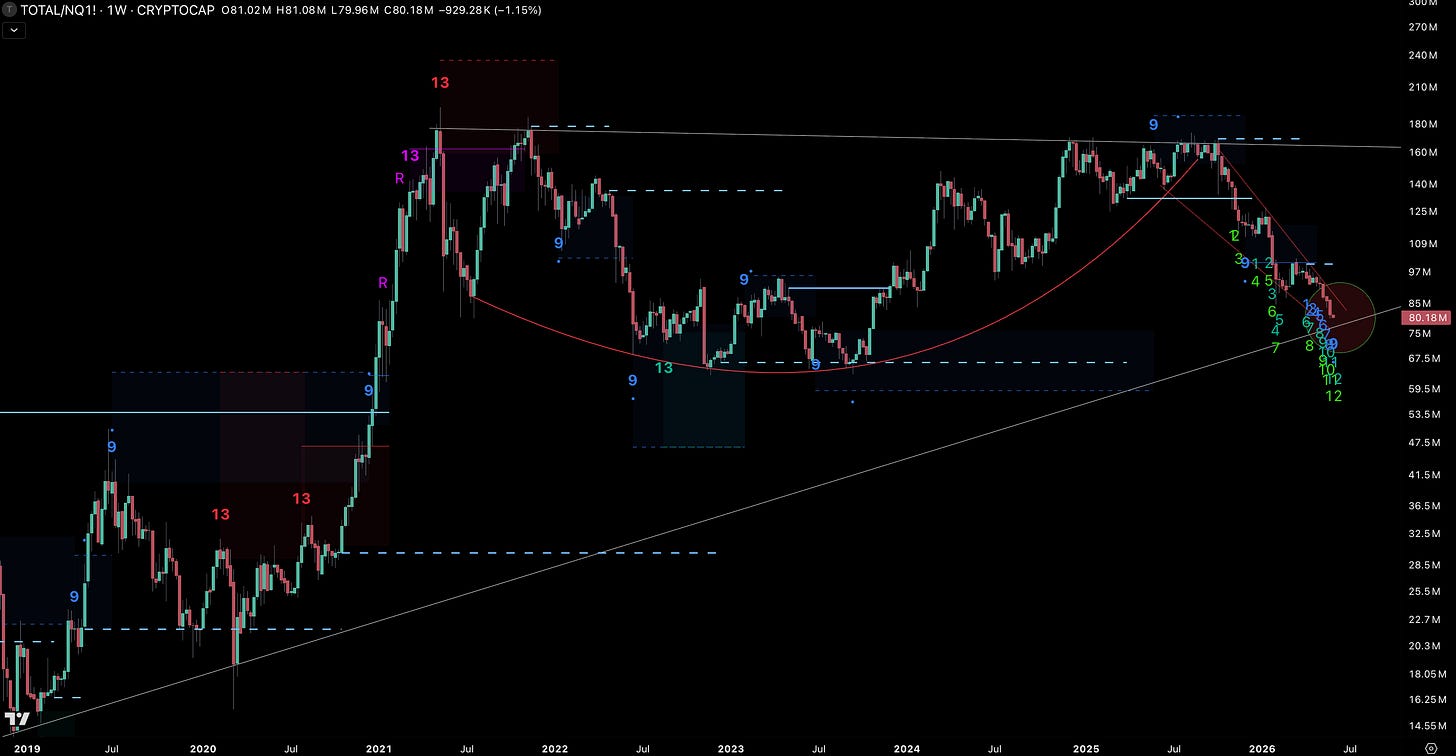
Crypto/QQQ ratio (weekly).
…while sitting 2 standard deviations below its log-regression trend since 2013. A bullish divergence may also be forming as these support levels come into view.
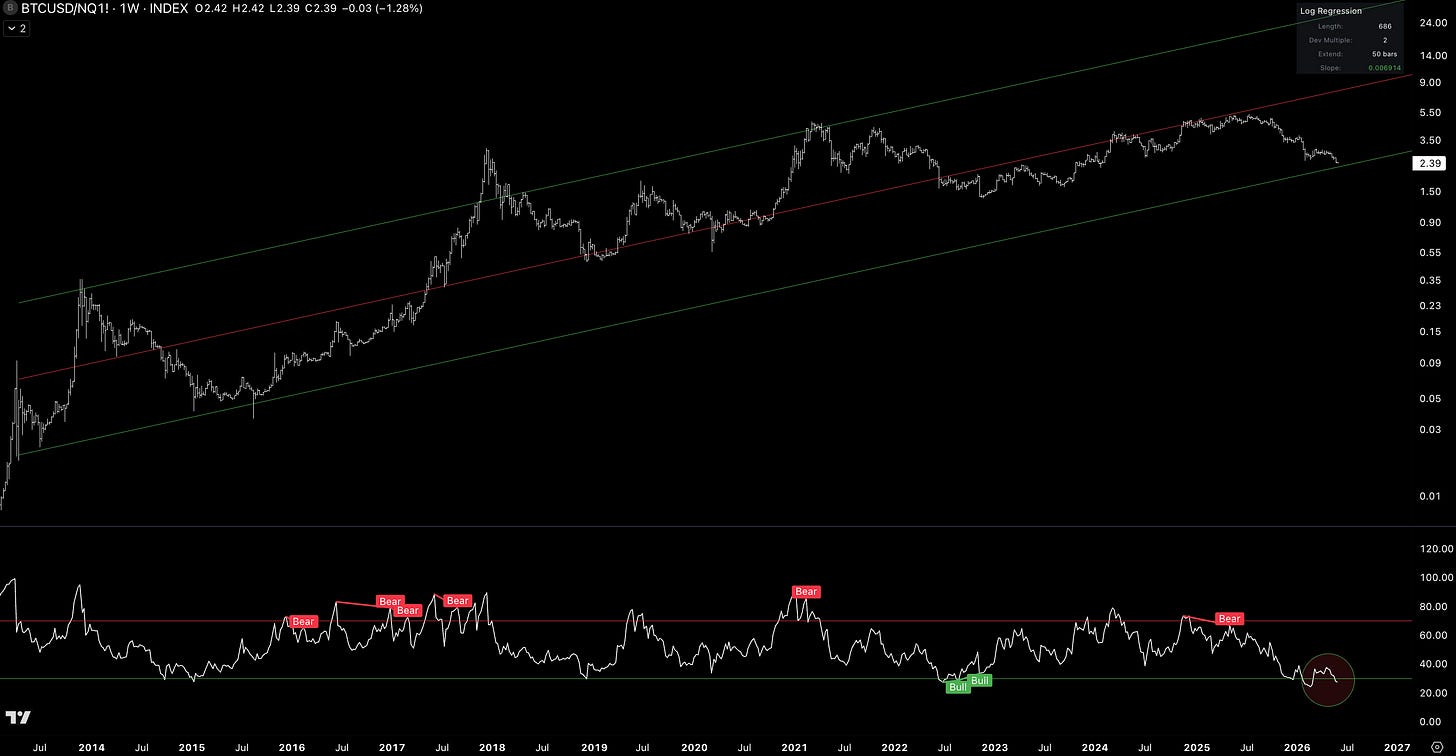
Crypto/QQQ ratio log regression since 2013.
State of Yields
Stablecoin lending yields:
~3.3% on Aave (USDC) — utilisation rates for USDC markets are still elevated but have seemed to stabilise at ~90%.
5% on Aave (MegaUSD) — same as last week again. Utilisation rates at ~66%.
Fixed-rate DeFi lending: yield premium in fixed markets marginally expanding from last week:
Pendle sNUSD: 8.57% (Jun 2026)
Pendle sUSDAi: ~7.7% (Jun-Oct 2026 maturities)
sUSDe: ~4%
ETH yield benchmarks:
Lido staking: ~2.39% - slight increase from previous week.
About Re7
Re7 Capital is a research-driven digital asset investment firm specialising in DeFi yield and liquid alpha strategies.
Disclaimers
The content is for informational purposes only. None of the content is meant to be investment advice. Use your own discretion and independent decision regarding investments. The opinions expressed in all Re7 public research articles are the independent opinions of the authors at the time of publication and not the opinions of the affiliates of Re7.
Please see here for full disclaimers.