The Weekly: Stablecoin Growth Is Pausing, Not Peaking
AUG 10, 2026
Stablecoin growth pauses as yields rise, but tokenized RWAs keep DeFi liquidity expanding. BTC eyes $65k breakout amid strong inflows.
Last month, Re7 Capital turned 5 years old! 🎉
Re7 went live in the days of DeFi summer, with a dream of growing into a leading financial player of the digital assets economy and a thesis that liquidity provisioning would propel it into the heart of its industry. Five years and over $1.5 billion deployed across DeFi protocols later, that thesis has held.
Today, Re7 stands as an institutional-grade DeFi liquidity provider, an investor across both liquid and private markets, and one of the leading DeFi vault curators globally.

Weekly Summary
We cover:
Why DeFi yield is making a comeback
Three markets signalling stronger leverage demand
Stablecoin Growth Is Pausing, Not Peaking
Stablecoin Growth Hit a Macro Ceiling
Stablecoin supply has historically been highly sensitive to the relative attractiveness of on-chain yields versus the risk-free rate.
Last cycle, stablecoin growth peaked as inflation broke convincingly above the Fed’s 2% target and Treasury yields began their sharp repricing higher.
As the US 10Y moved from <2% to ~5%, capital had an increasingly attractive alternative to taking risk on-chain. DeFi yields compressed, liquidity left the system, and stablecoin supply contracted.
That relationship began to reverse almost exactly when the US 10Y peaked around 5% in October 2023.
Markets increasingly understood that there was a limit to how much tightening the economy and financial system could absorb.
Treasury yields and term premia fell, the opportunity cost of holding capital on-chain declined, and stablecoin supply began another sustained expansion.
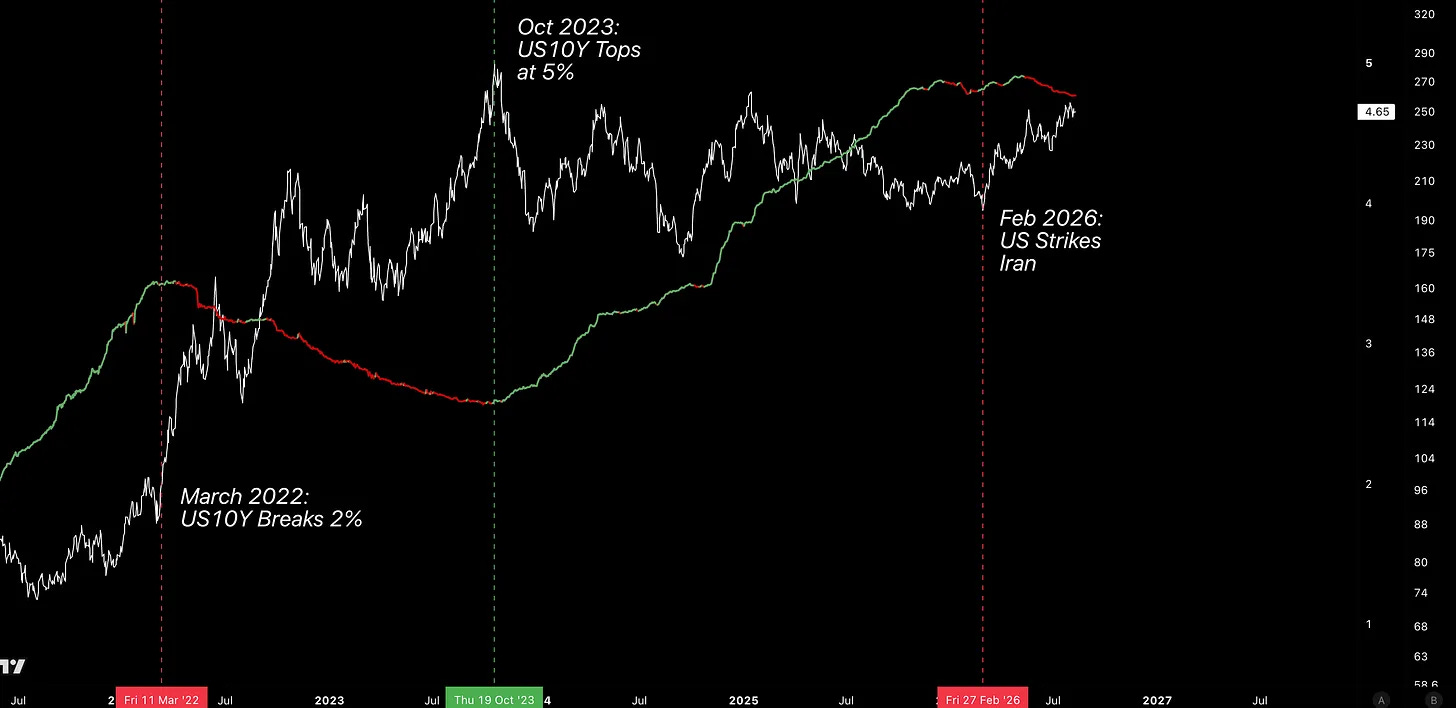
US 10-year vs. stablecoin market cap (proxy: USDC, USDT, DAI)
Importantly, stablecoin supply never returned to its previous trough, suggesting each cycle is building from a structurally higher base.
We may now be seeing the same mechanism temporarily working in reverse.
The recent geopolitical shock around Iran has increased inflation and term-premia concerns, pushing the 10Y back towards 5% and raising the hurdle rate for capital to remain on-chain. Stablecoin growth has consequently stalled.
How High Can Yields Really Go?
But there is likely a ceiling to this dynamic. The US cannot indefinitely tolerate materially higher long-end yields given the scale of government refinancing and the tightening they transmit through the economy.
At some point, either inflation fears moderate, growth weakens, or policy/liquidity conditions respond. Yields and term premia then compress, lowering the hurdle rate for capital to move back out along the risk curve.
There are already signs policymakers are sensitive to this upper bound. US 10Y yields and USD/JPY have tracked closely, while the Treasury’s unusual decision to sell euros to support the yen suggests concern around excessive rate differentials.
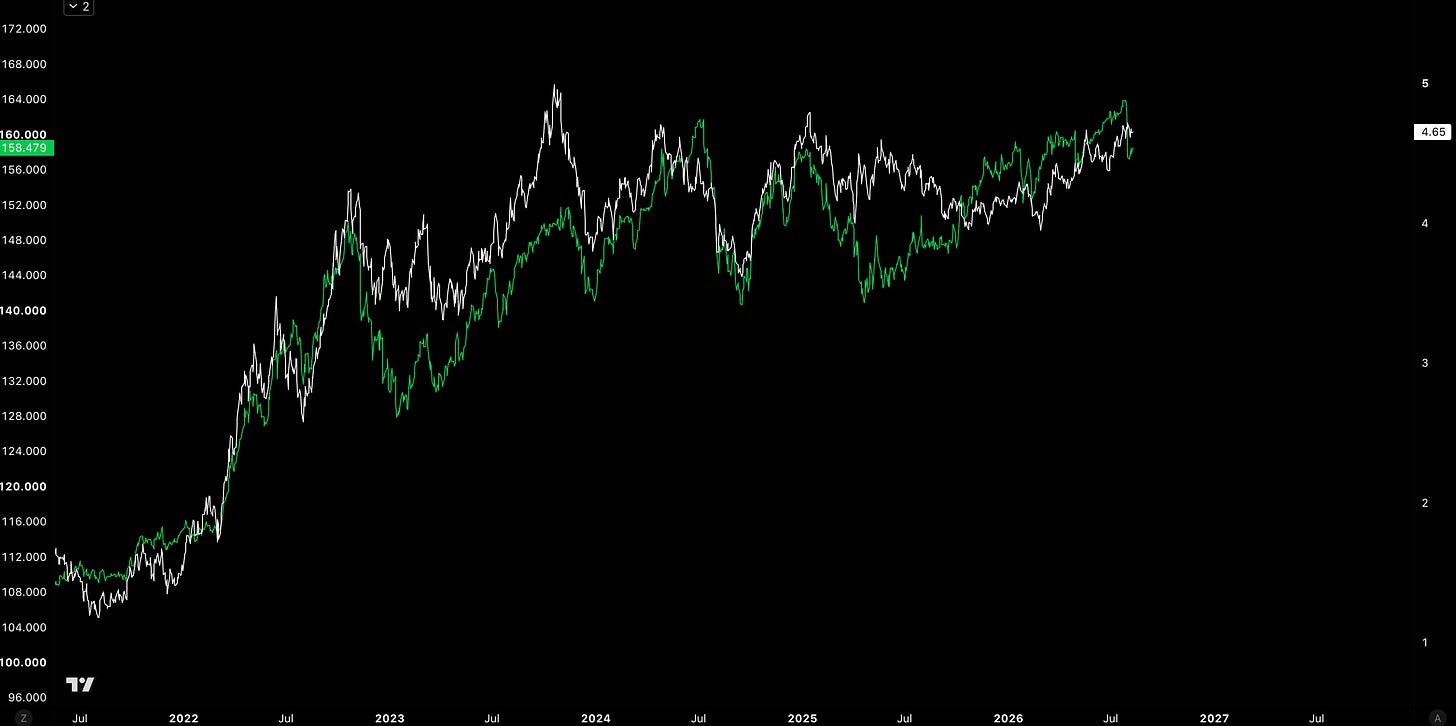
A wider US–Japan rate differential tends to weaken the yen, increasing the risk of Japanese Treasury selling — creating a natural constraint on how far the long end can rise before policy responds.
This makes the current stablecoin slowdown look more cyclical than structural. If Treasury yields are approaching the upper end of what the system can sustainably absorb, the next repricing could produce another acceleration in stablecoin growth.

Scott Bessent’s notepad with his proposal to buy Japanese yen.
That said, stablecoin and tokenised-money adoption hasn’t paused. From Stripe, Wells Fargo, Circle, BNY Mellon, Visa, and Mastercard all pushing stablecoin innovation in the last two months alone.
On-Chain Growth Hasn’t Stopped - It’s Shifted
Yet, on-chain growth has not disappeared while stablecoins have stalled; its expression has simply changed.
Tokenised Treasuries and other RWAs directly benefit from higher rates and have continued expanding as stablecoin growth has moderated.
Capital can now remain on-chain while moving between cash-like stablecoins, tokenised risk-free yield and higher-yielding DeFi opportunities.
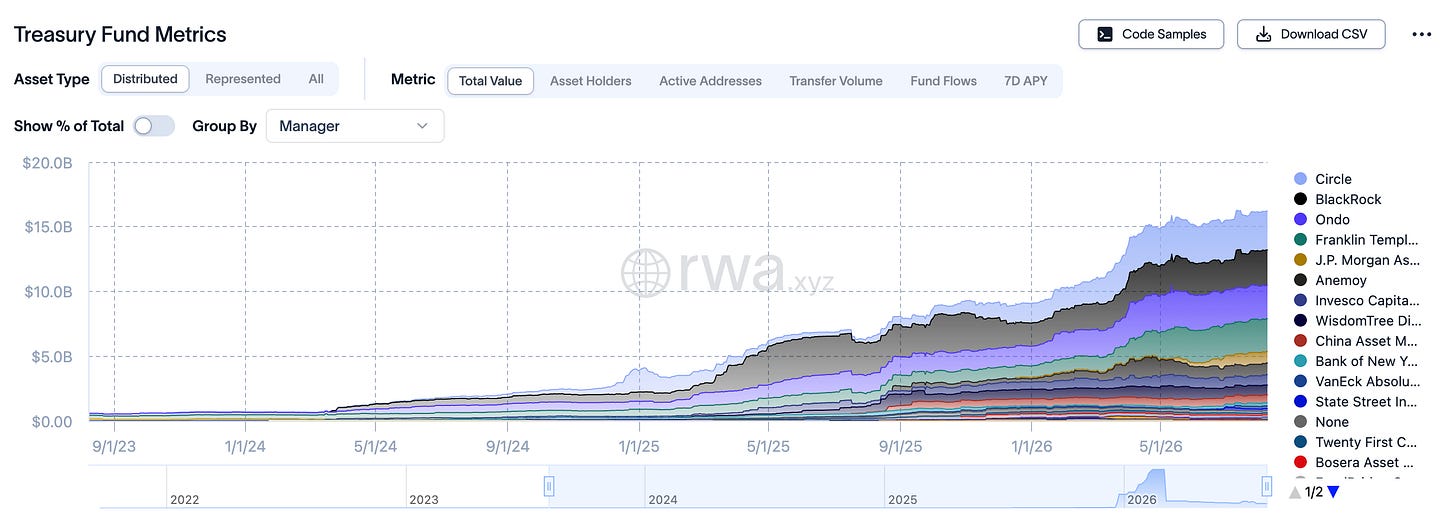
Total value of treasury funds on-chain (USD).
The Next Liquidity Expansion
Tokenisation is creating a broader and more persistent on-chain capital base, smoothing what was previously a much more binary liquidity cycle.
As the macro hurdle rate falls again, the result should be not just more on-chain liquidity, but a broader and richer DeFi yield environment.
The most significant phase of stablecoin and tokenised asset growth may therefore still be ahead.
Market Update
Crypto markets were marginally up last week (+1.4%) and are looking to resume the trend to test resistance.
This follows the bullish weekly and monthly signals across beta, L1 relative ratios and alt indices that we highlighted last month.
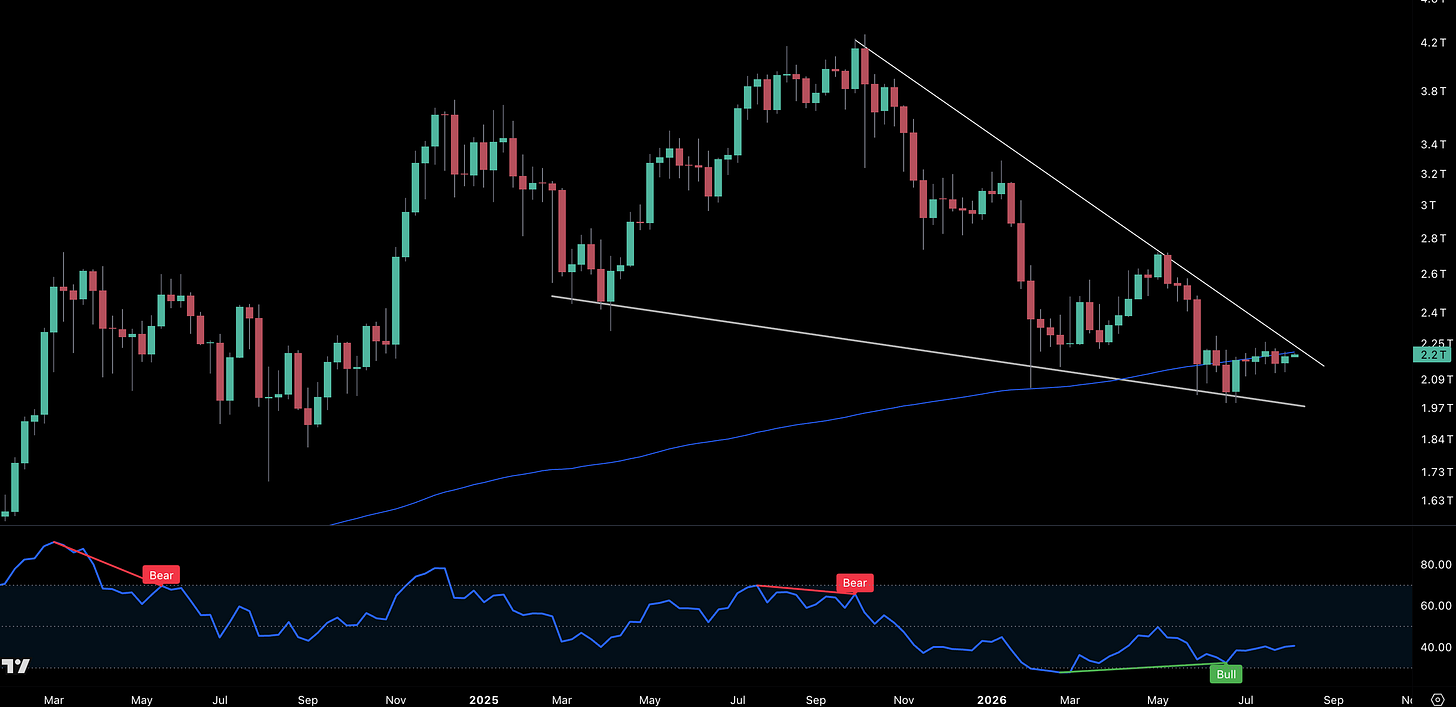
Global crypto market capitalisation (weekly).
BTC will need to close above $65k to open a move towards the next major resistance at $70k.
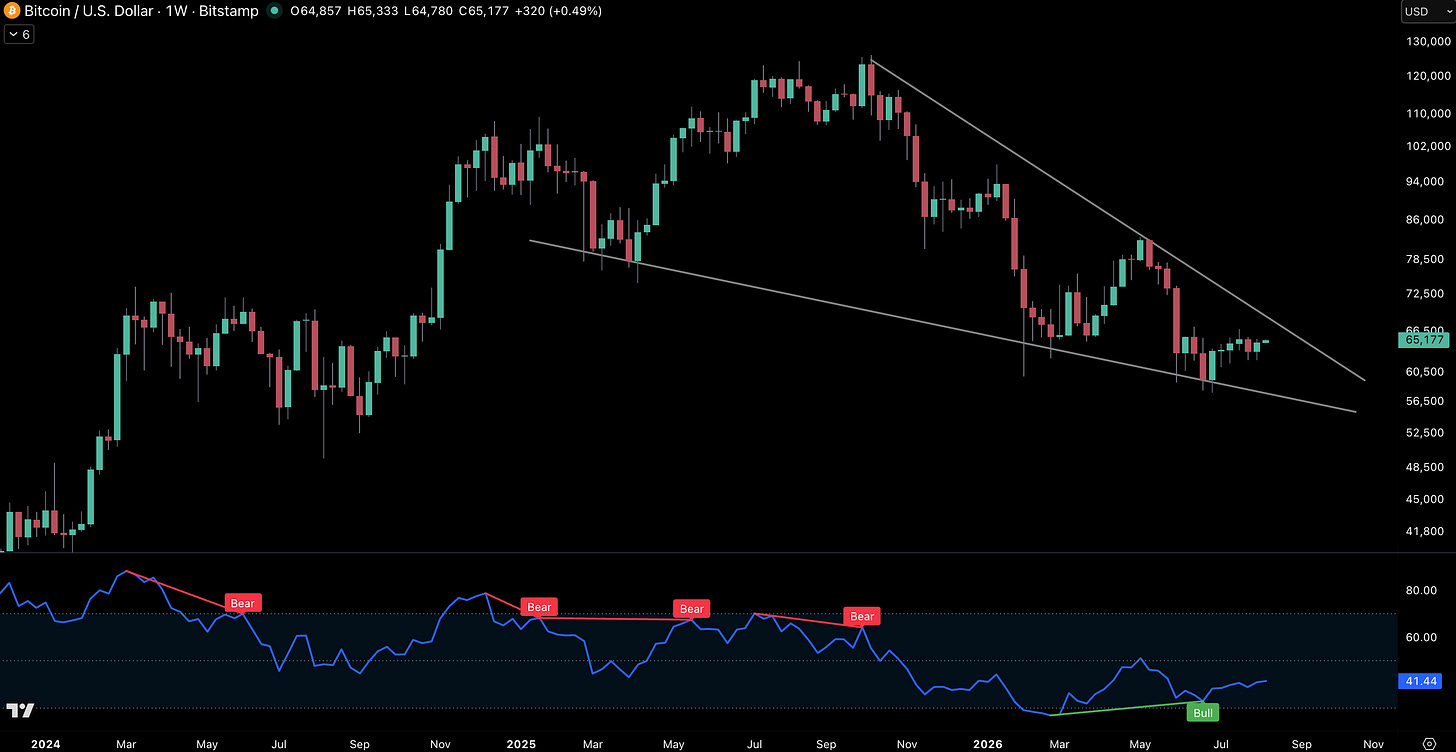
BTC/USD (weekly).
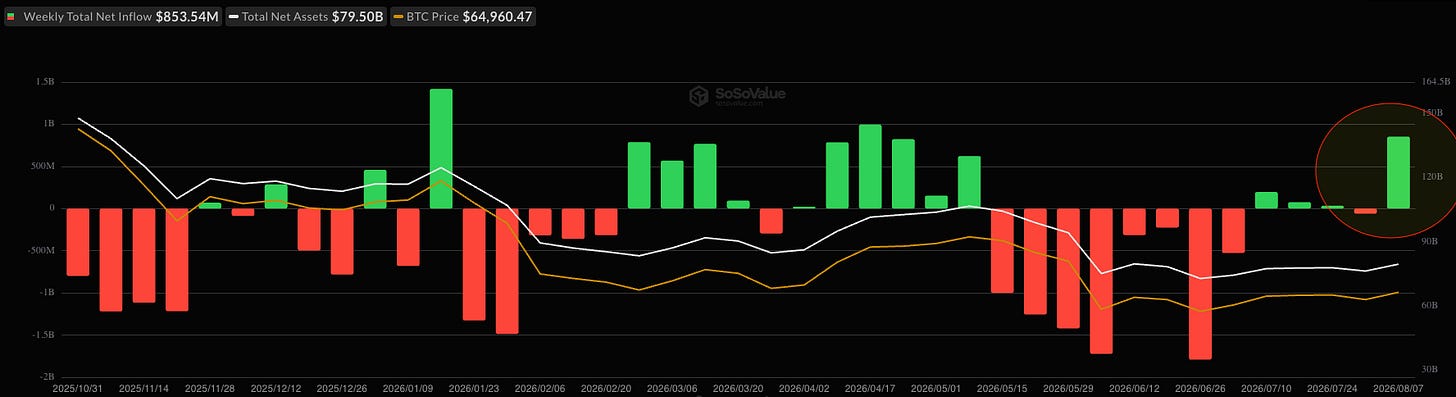
Bitcoin’s price stability has been supported by >$850m of net inflows last week — the strongest since mid-April.
The path of least resistance for crypto/NASDAQ remains to the upside after longer-term DeMark buy signals were printed.
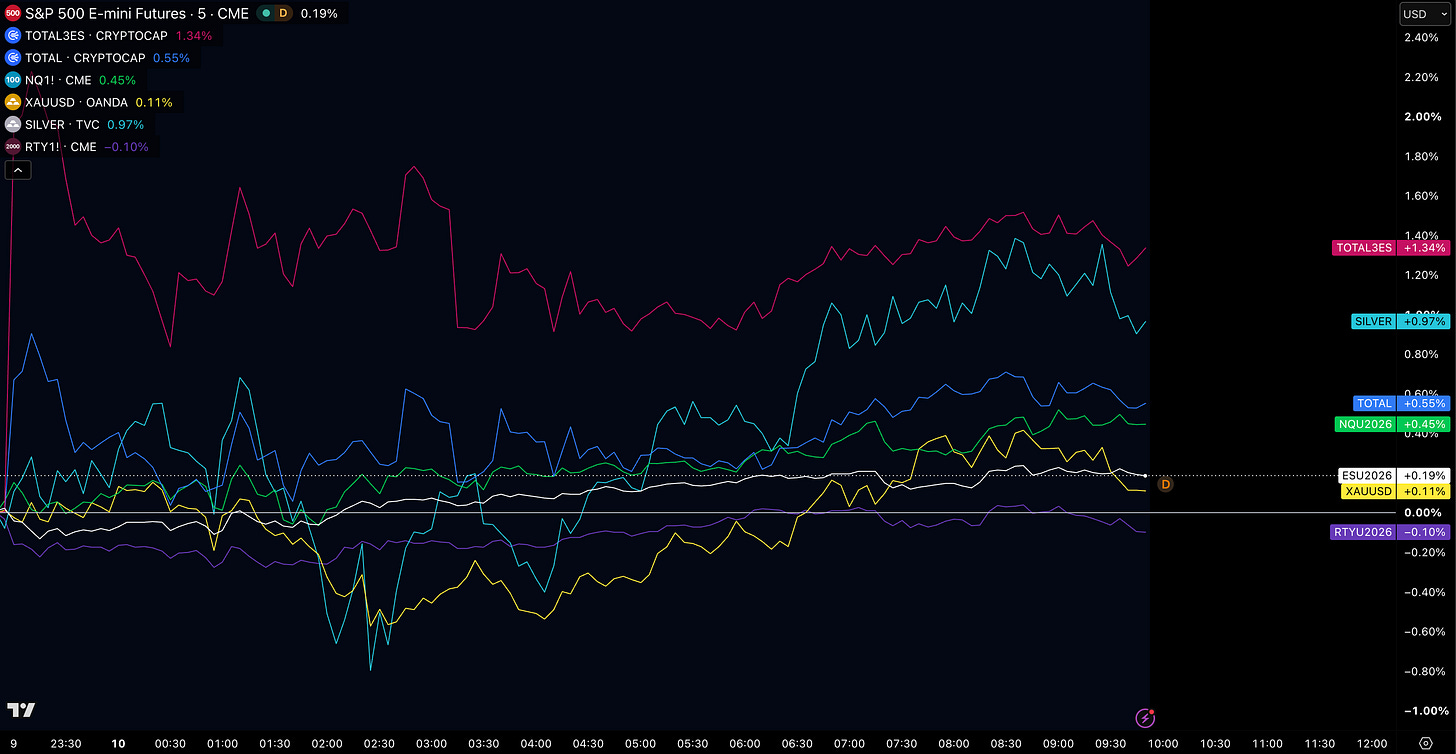
The positive opening to the week for crypto is translating to relative strength between the two once again.
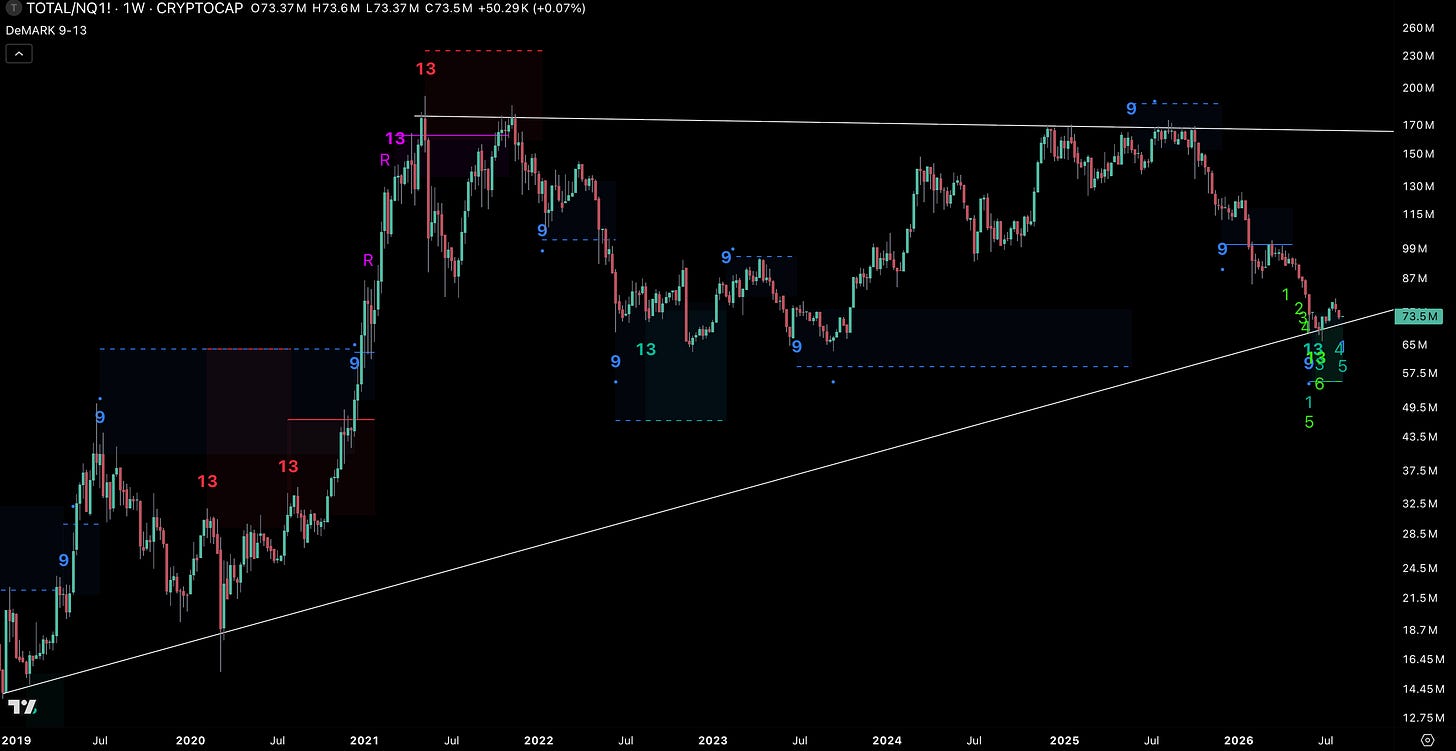
Crypto/NASDAQ futures ratio (weekly).
In fact, the alt market is leading the charge (pink) versus other major sector indices since Sunday’s futures open, providing an early indication of investor appetite this week.
State of Yields
Stablecoin lending yields:
~3.37% on Aave (USDC) — 70 bps lower than last week.
~3.26% on Aave (USDe) — utilisation at ~75%. 70 bps higher than last week.
~4.8% on Maple (syrupUSDC).
Fixed-rate DeFi lending: yield premium in fixed markets marginally expanding from last week:
Pendle sUSDAi: ~9.8% (Oct 2026 – Feb 2027 maturities).
sUSDe: ~4.3% - 10 bps higher than last week.
ETH yield benchmarks:
Lido staking: ~2.2% - 10 bps higher than last week.
About Re7
Re7 Capital is a research-driven digital asset investment firm specialising in DeFi yield and liquid alpha strategies.
Disclaimers
The content is for informational purposes only. None of the content is meant to be investment advice. Use your own discretion and independent decision regarding investments. The opinions expressed in all Re7 public research articles are the independent opinions of the authors at the time of publication and not the opinions of the affiliates of Re7.
Please see here for full disclaimers.