The Weekly: Trading Cards Move Onchain
SEP 28, 2026
Trading cards are moving onchain. We explore tokenised Pokémon cards, onchain gacha, the $3bn TCG market, plus BTC, ETF flows and DeFi yields this week.

Re7 Celebrates 5 Years. In recognition, The Hedge Fund Journal featured Re7 Capital. Read the full profile to find out how we think about risk in DeFi, and why we treat it closer to a credit discipline than a trading strategy.
—
Evgeny Gokhberg joined 1000x Podcast: What It’s Like Running A Billion-Dollar Market-Neutral Fund In Crypto.
—
New Institutional Report, written in collaboration with Zodia Custody. How should institutions think about DeFi? Our latest report applies a traditional finance lens to the question: where yield comes from, the risks behind it, and what institutional-grade participation requires.
—
We are hiring!
Senior Legal Counsel - Apply here.
Re7 Labs x Kamino: Introducing the Plume Vaults.
Re7 Labs, in partnership with Kamino, launched a dedicated Plume Vaults market - bringing curated lending and borrowing to a new class of onchain products.
Re7's OP Morpho WETH vault was integrated by AlchemixFi.
The market lends against Re7ETH - Re7's flagship ETH Yield strategy - and wstETH.
Learn more: app.re7labs.xyz

Weekly Summary
We cover:
Why trading cards are becoming increasingly financialised.
How tokenisation improves the trading and ownership experience.
The emergence of onchain TCG marketplaces as a new crypto vertical.
Trading Cards Move Onchain
Last week, we discussed how crypto markets are increasingly moving onchain across spot, perpetuals and options as execution, UX and infrastructure improve.
The same infrastructure is now pulling entirely new asset classes onchain. Trading cards are one of the clearest examples.
The Financialisation Of Trading Cards
Trading cards have become considerably more liquid and financialised.
PSA grading provides standardisation, marketplaces such as eBay, Whatnot and Fanatics Collect provide liquidity, while price indices give investors a way to track the market.
Pokémon has been a standout collection, with another sharp acceleration over the past year.
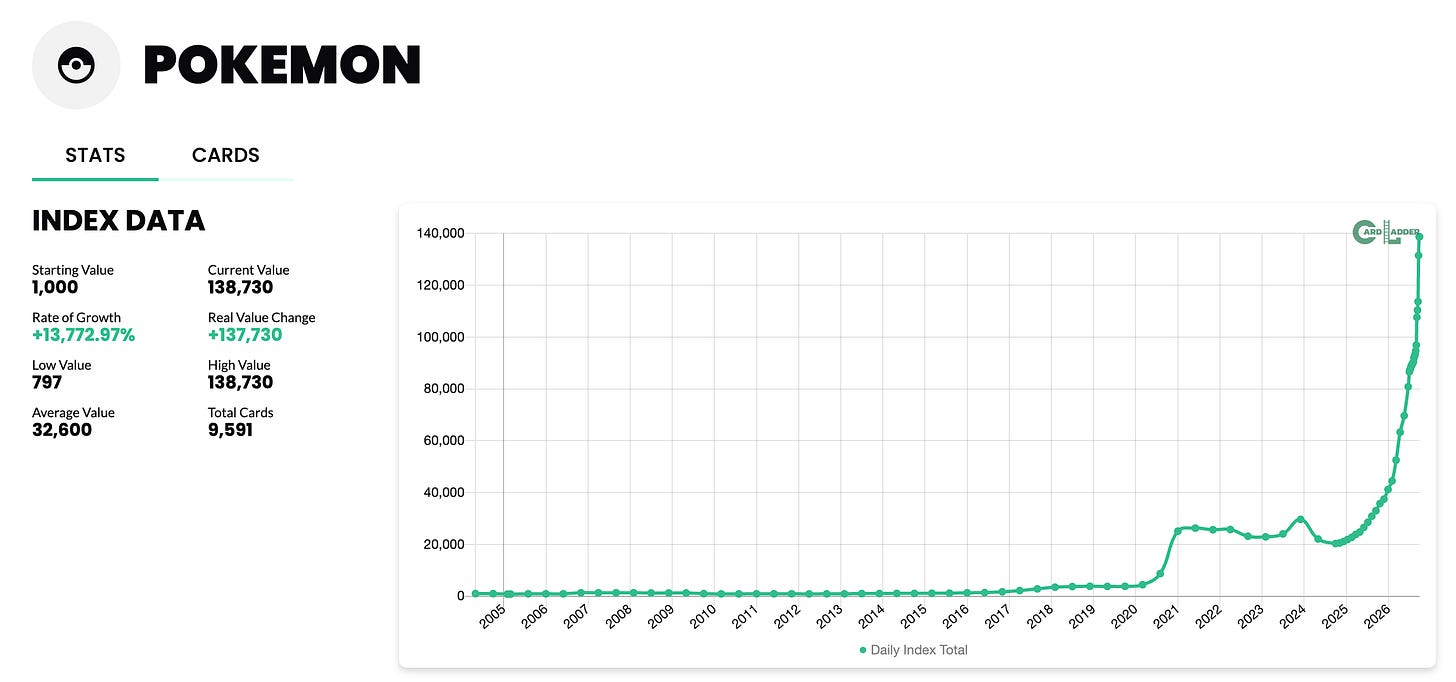
Card Ladder Pokémon Index since 2004.
Several secular trends sit behind the move:
Financialisation: grading, price indices and deeper marketplaces have improved standardisation, transparency and liquidity.
Tokenisation: vaulting and onchain trading have brought crypto capital and new trading behaviour into the market.
Streaming and media: Whatnot, TikTok and high-profile sales have turned collecting into entertainment and kept it in the mainstream.
Asian demand: Chinese and wider Asian collectors have expanded the buyer base, with Japanese sets repricing sharply.
Nostalgia and scarcity: millennials are now at peak spending power, while sold-out product and secondary premiums reinforce demand.
Monthly secondary marketplace volume is now approaching $900m, compared with less than $100m only a few years ago.
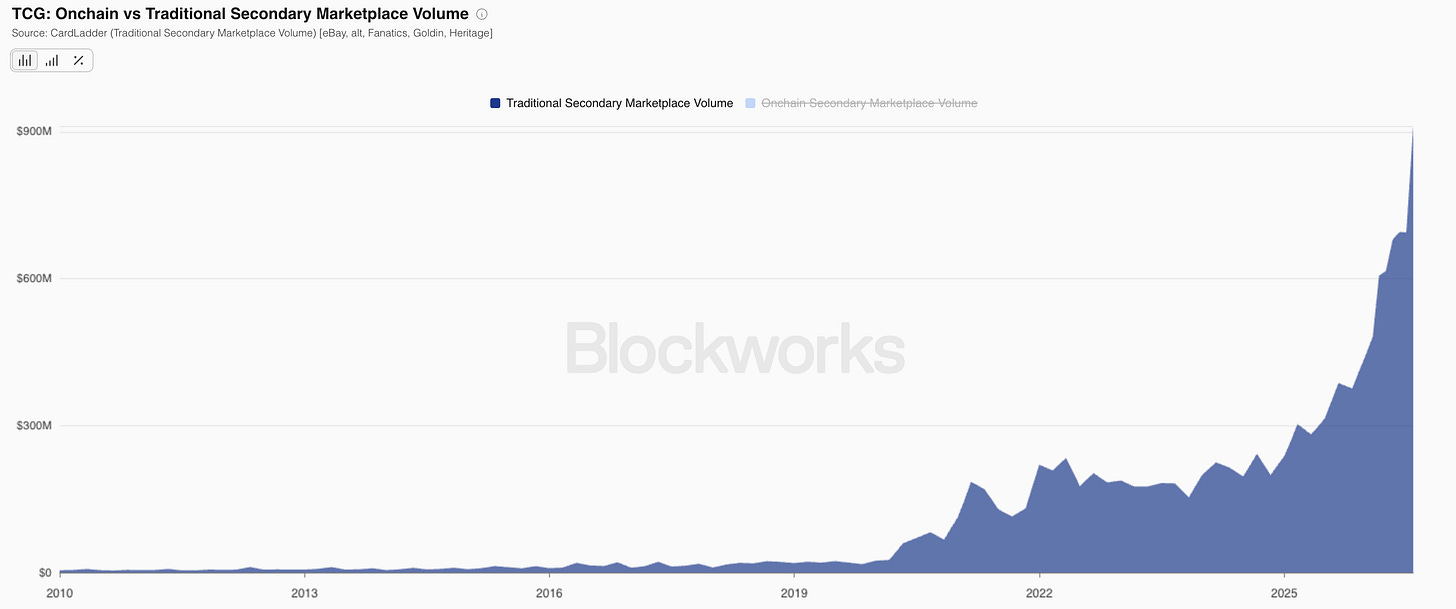
Monthly trading card secondary marketplace volume.
Why Put Cards Onchain?
Physical trading has plenty of friction. Cards need to be shipped, insured and authenticated, while cross-border trading adds customs, delays and risk.
Onchain platforms can vault graded cards and represent ownership digitally, so the card stays in one place while ownership changes in seconds.
The benefits are straightforward:
Instant settlement: no need to ship the card.
Global access: trade the same inventory without customs or cross-border delivery.
Provenance: grade, certification and ownership history are easier to verify.
Liquidity: cards can trade repeatedly without repeated shipping or authentication.
Financialisation: cards can be fractionalised, used as collateral or included in indices.
Tokenisation also enables products that are difficult to build around physical inventory.
Onchain gacha is a major example. Users buy a pack, reveal a card and can immediately sell it back, combining collecting, trading and speculation in one flow.
More Inventory Is Moving Onchain
Collector Crypt’s tokenised inventory has grown from almost zero at the end of 2024 to around 0.43% of the total PSA population.
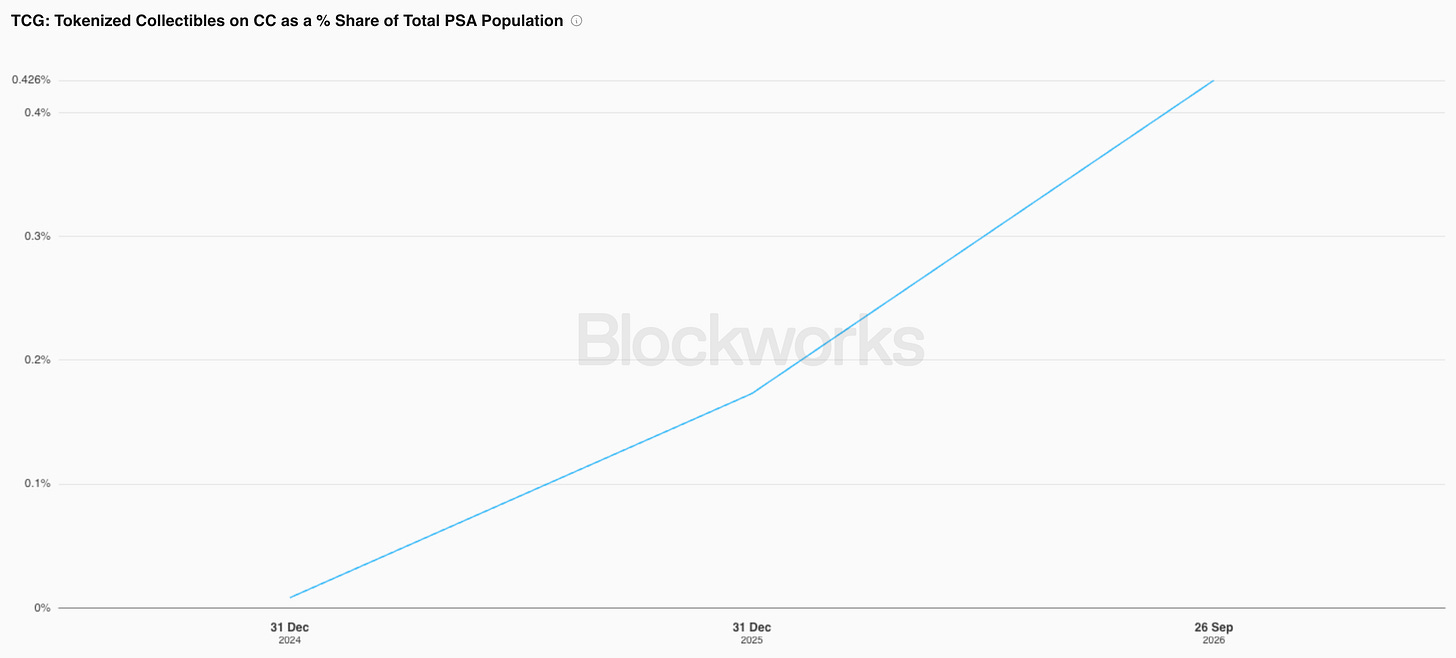
Collector Crypt tokenised inventory as a share of the total PSA population.
Secondary trading is also following, with onchain venues accounting for around 1% of monthly secondary-market volume, roughly 2x their share a year ago.
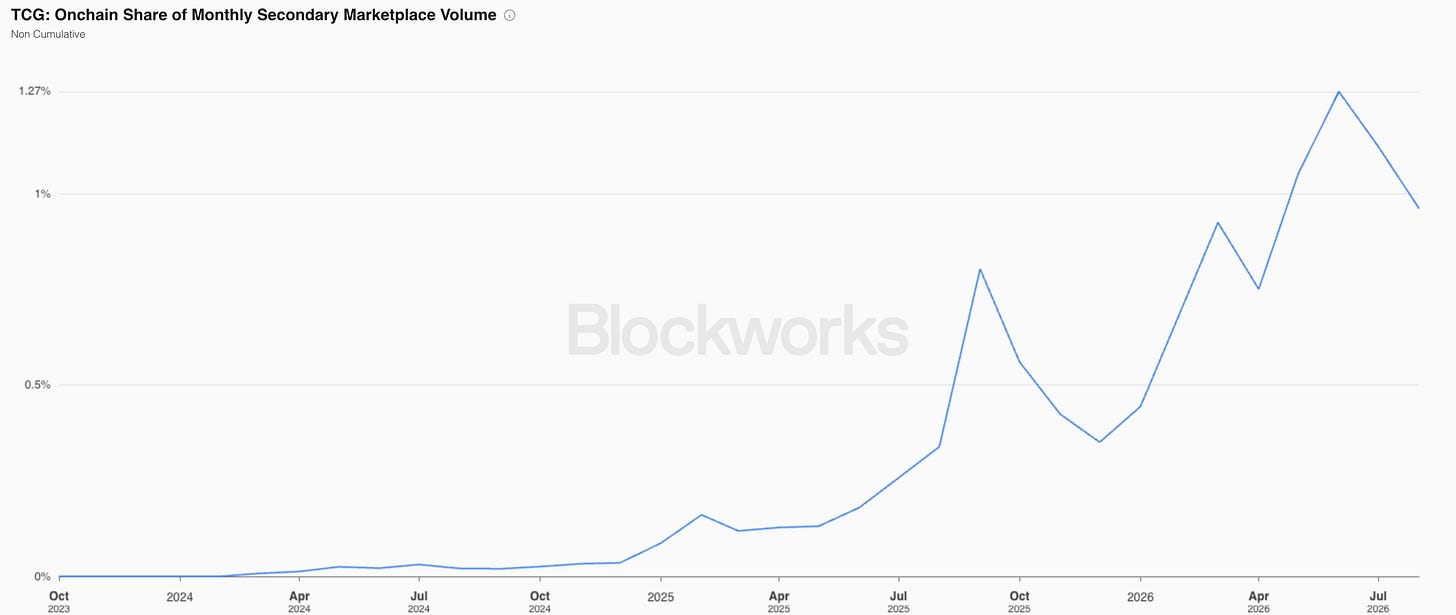
Onchain share of monthly trading card secondary-market volume.
Penetration remains low, despite strong underlying demand. Over the past eight years, the Card Ladder Pokémon Index has outperformed every other major market in the comparison.
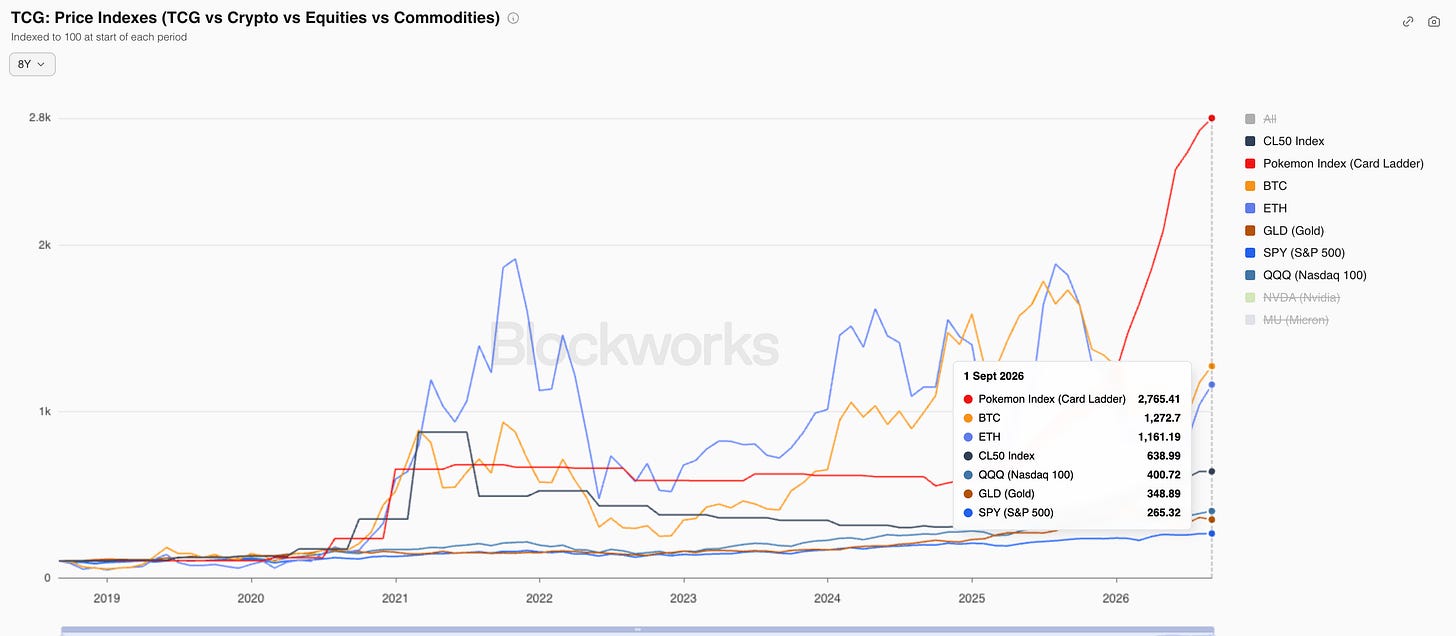
Indexed performance of Pokémon versus major asset classes over the past eight years.
Rising prices give owners more value to trade and borrow against, while better liquidity attracts more capital.
Marketplaces Are Monetising It
Onchain TCG marketplaces have scaled quickly with the market. Weekly GMV has repeatedly reached $60–100m, while onchain secondary volume is now around 1% of the total market, roughly 2x a year ago.
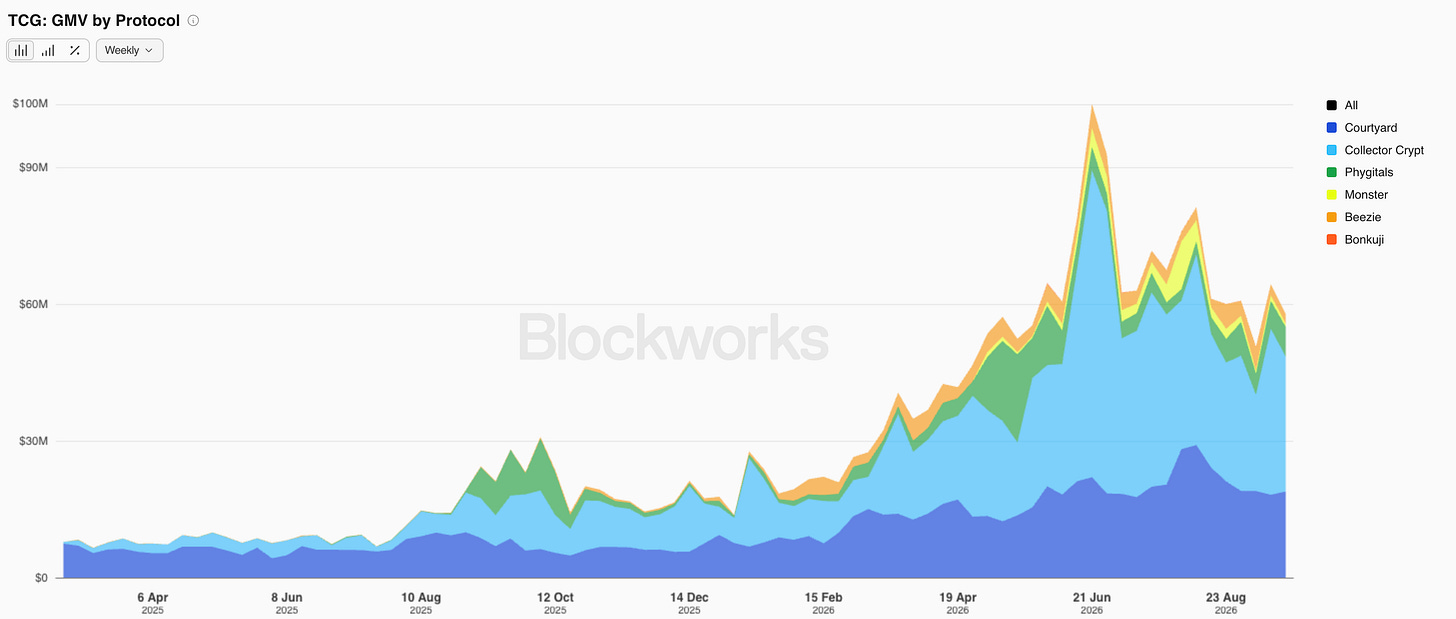
Weekly onchain TCG GMV by marketplace.
Gacha spend reached almost $700m in Q2 2026, major platforms now running at roughly $3bn in annualised gross revenue and $444m in annualised net revenue.
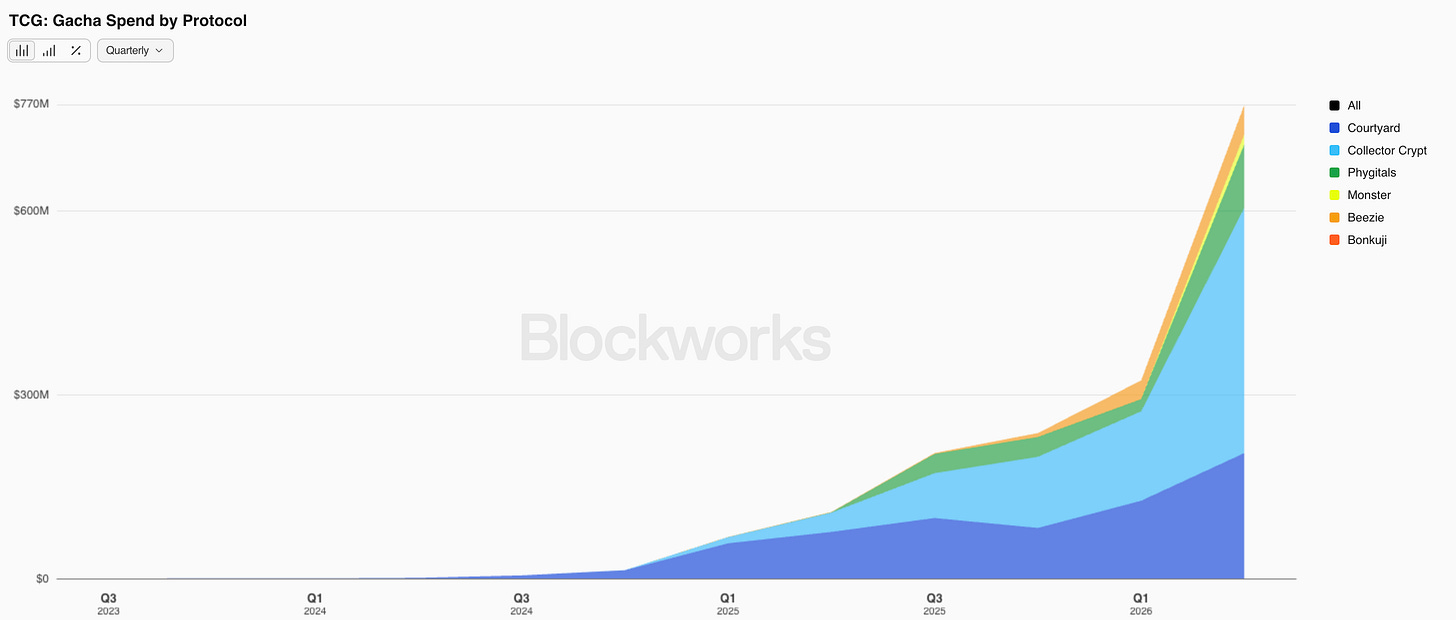
Quarterly onchain TCG gacha spend by marketplace.
Final Remarks
Trading cards barely registered onchain last cycle. Since then, the underlying market has grown, infrastructure has improved and products such as gacha have created new ways to trade and interact with the asset class.
Onchain TCG is already roughly a $3bn market, despite secondary trading still representing only around 1% of the broader market today.
It is another example of crypto infrastructure expanding into markets that previously had little overlap with onchain activity.
Market Update
Crypto markets gained another 4% last week, reaching their highest levels since January 2026, with neither momentum nor DeMark indicators yet pointing to a bearish reversal.
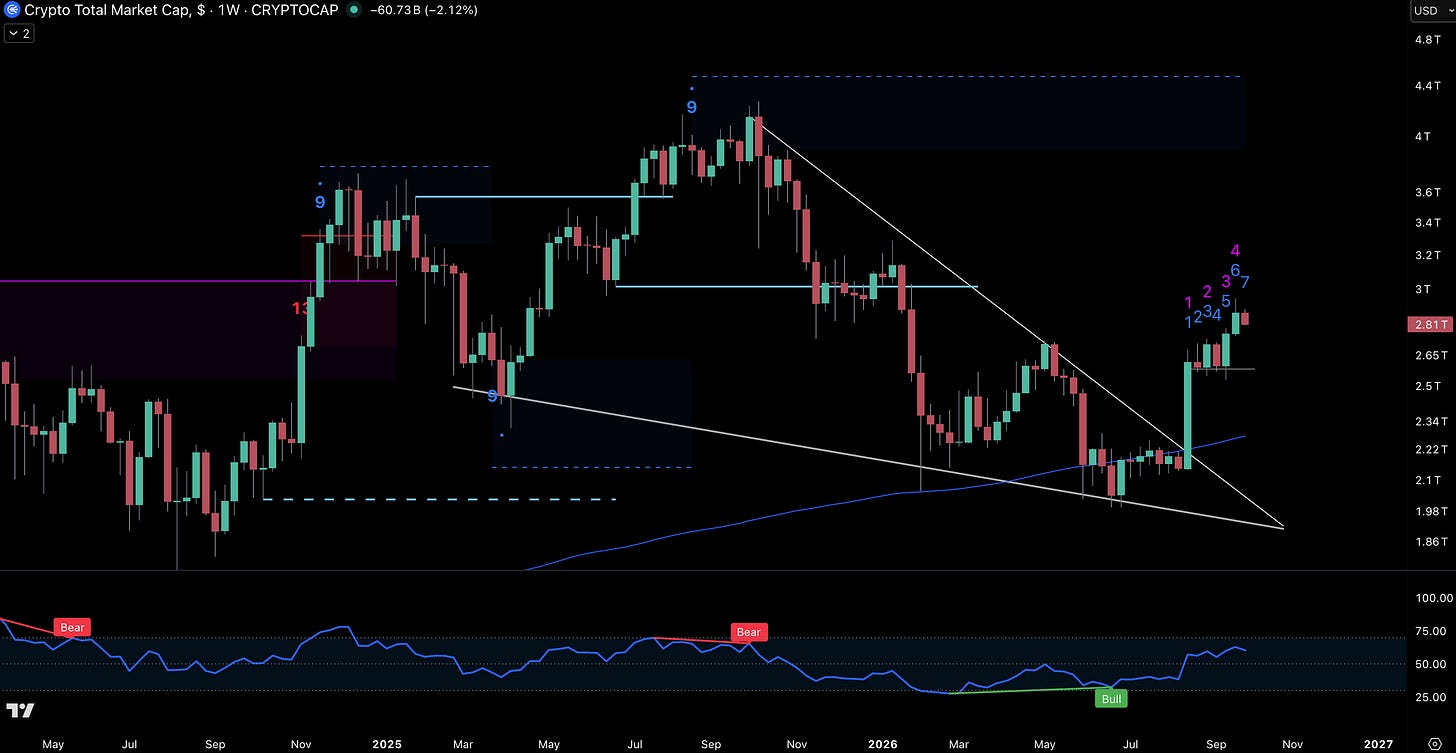
Global crypto market capitalisation index (weekly).
Renewed US-Iran rhetoric has kept a lid on risk for now, while broader markets also look due a period of consolidation with the Nasdaq still near all-time highs after a relentless rally.
BTC’s near-term support is $82k; if it holds, the market likely remains rangebound.
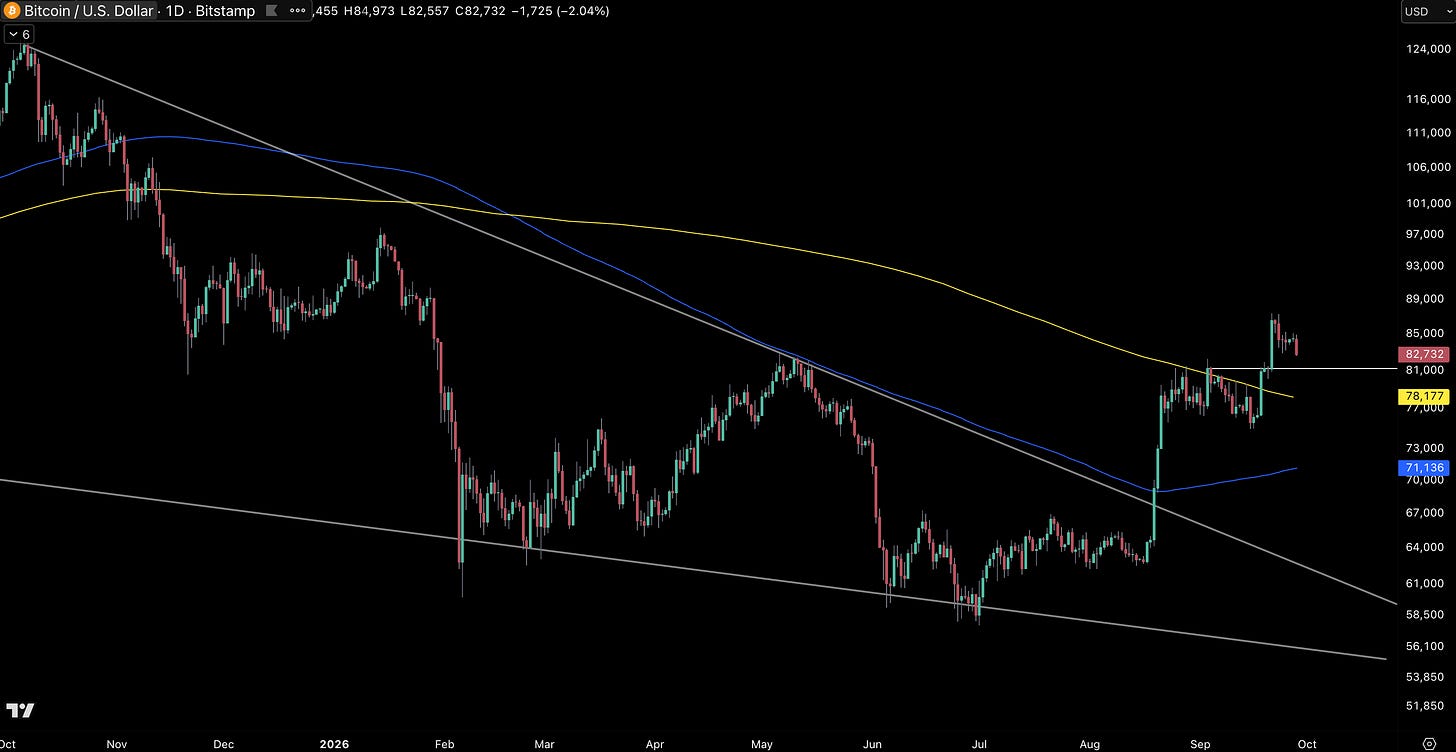
BTC/USD weekly.
Flows have been constructive, with $2.4bn of weekly US spot ETF inflows — the strongest since October 2025 — helping keep the outlook from turning outright bearish.
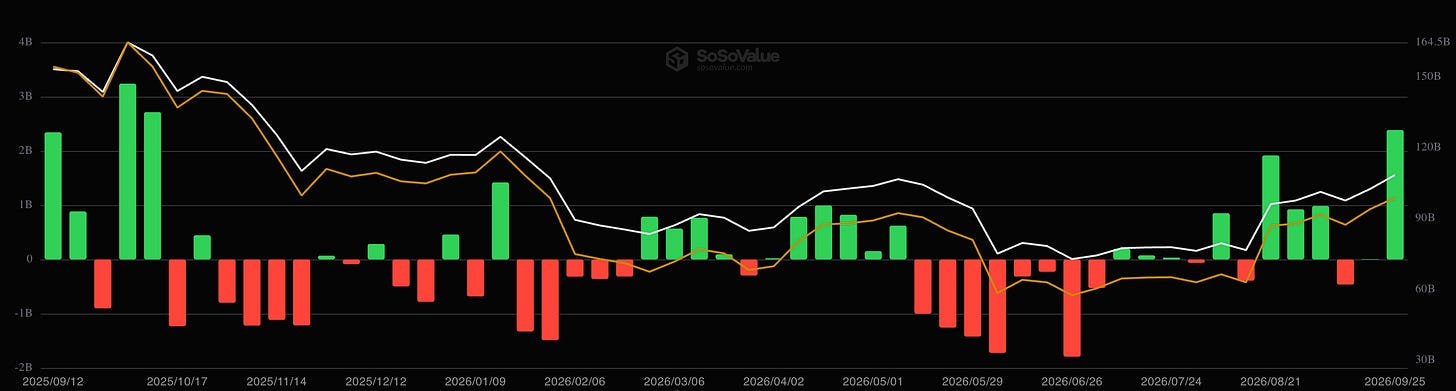
Total Bitcoin spot ETF net inflows.
Weekly spot DEX trades on Solana have climbed to around 200m, putting the network roughly in line with the NYSE and above venues such as Arca, BATS and NYSE American on trade count.
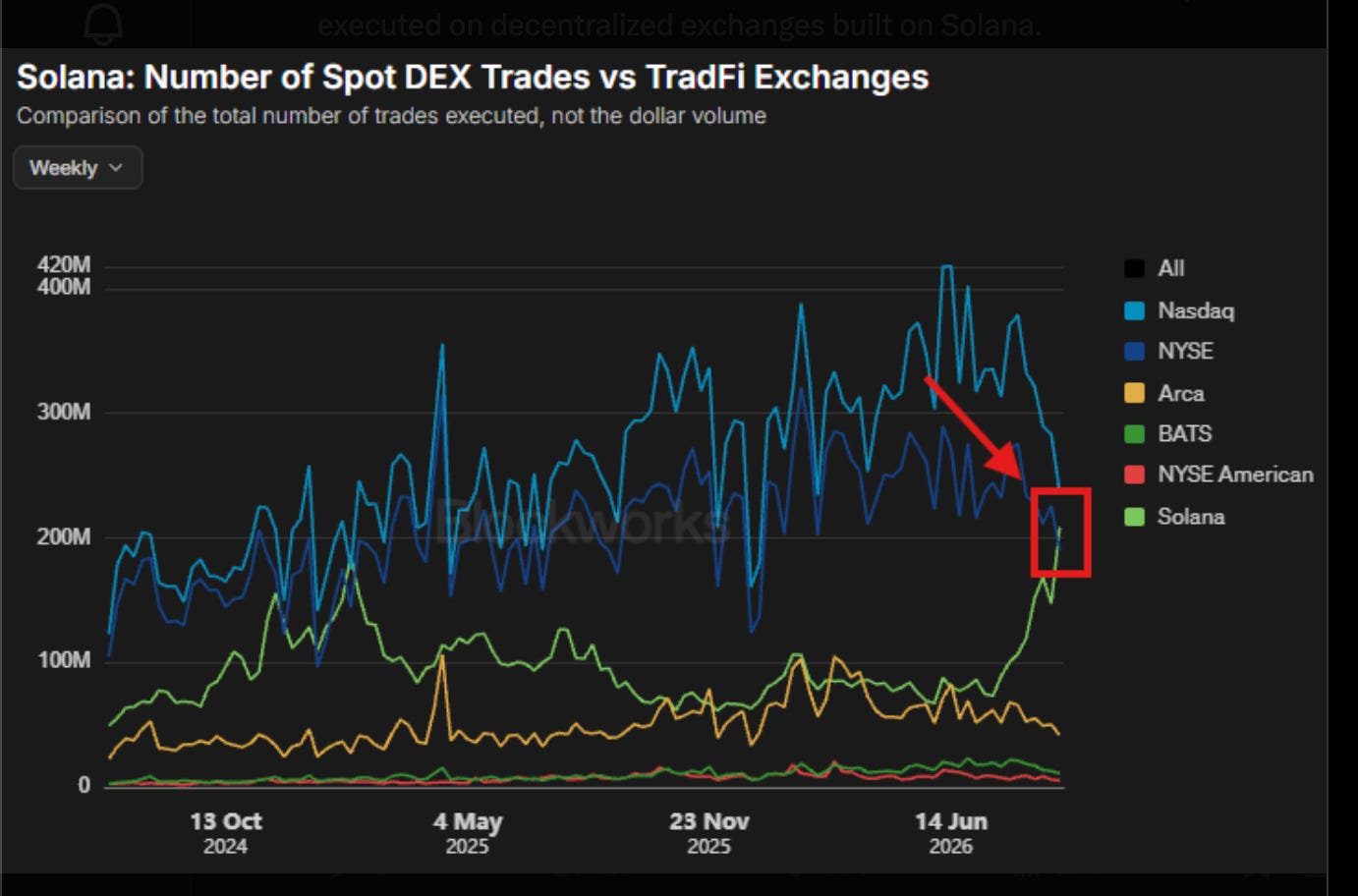
State of Yields
Yields have expanded slightly across the board in light of recent market volatility:
Stablecoin lending yields:
~4.41% on Aave (USDC) — 75 bps higher than last week.
~6.52% on Aave (USDe) — 167 bps higher than last week.
~5.24% on Maple (syrupUSDC) — 17 bps higher than last week.
Fixed-rate DeFi lending: yield premium in fixed markets:
Pendle sUSDAi: ~12.49% (Oct 2026 – Feb 2027 maturities).
sUSDe: ~5.83% — 50 bps lower than last week.
ETH yield benchmarks:
Lido staking: ~2.19% — 3 bps lower than last week.
About Re7
Re7 Capital is a research-driven digital asset investment firm specialising in DeFi yield and liquid alpha strategies.
Re7 Labs is an on-chain asset management and risk curation firm bringing institutional-grade rigour to DeFi.
Disclaimers
The content is for informational purposes only. None of the content is meant to be investment advice. Use your own discretion and independent decision regarding investments. The opinions expressed in all Re7 public research articles are the independent opinions of the authors at the time of publication and not the opinions of the affiliates of Re7.
Please see here for full disclaimers.
Thanks for reading Re7 Research! Subscribe for free to receive new posts and support our work.