The Weekly: From Permission to Integration
OCT 5, 2026
Crypto adoption is moving from permission to integration. This week, Re7 examines why the US is considering promoting dollar stablecoins abroad to reinforce dollar dominance and Treasury demand, and what the Citi–Coinbase stablecoin payments partnership says about how banks and crypto infrastructure divide the work. We also look at the SEC's proposed crypto custody framework for advisers and regulated funds, Hyperliquid perpetuals data arriving on the Bloomberg Terminal, and the UK's tokenisation roadmap.

Re7 Celebrates 5 Years. In recognition, The Hedge Fund Journal featured Re7 Capital. Read the full profile to find out how we think about risk in DeFi, and why we treat it closer to a credit discipline than a trading strategy.
Evgeny Gokhberg joined 1000x Podcast: What It’s Like Running A Billion-Dollar Market-Neutral Fund In Crypto.
New Institutional Report, written in collaboration with Zodia Custody. How should institutions think about DeFi? Our latest report applies a traditional finance lens to the question: where yield comes from, the risks behind it, and what institutional-grade participation requires.
We are hiring!
Senior Legal Counsel — Apply here.
Crypto Fund Operations Manager - Apply here.
Re7 Labs
Re7 Labs has launched a Frax USDai Ecosystem Vault on Mainnet with Frax Finance and USD.AI, deploying frxUSD across curated opportunities in the USDai ecosystem.

Weekly Summary
We cover:
Why the US wants to promote dollar stablecoins abroad
How regulators are building crypto into existing financial frameworks
Why banks integrating stablecoin rails marks a shift in adoption
From Permission to Integration
Over the past two weeks, a series of headlines have pointed to the same shift. Governments, regulators and financial institutions are moving beyond deciding whether crypto belongs within the financial system and towards how to use it.
Individually, none of these developments changes the market overnight. Together, they show crypto increasingly being built into the financial system rather than accommodated at its edges.
The US Wants to Export Stablecoins — Not Contain Them
The Trump administration is considering supporting dollar stablecoin projects overseas, potentially through public-private partnerships involving Treasury, State and the DFC. The stated objectives include reinforcing dollar dominance and increasing demand for US Treasuries.
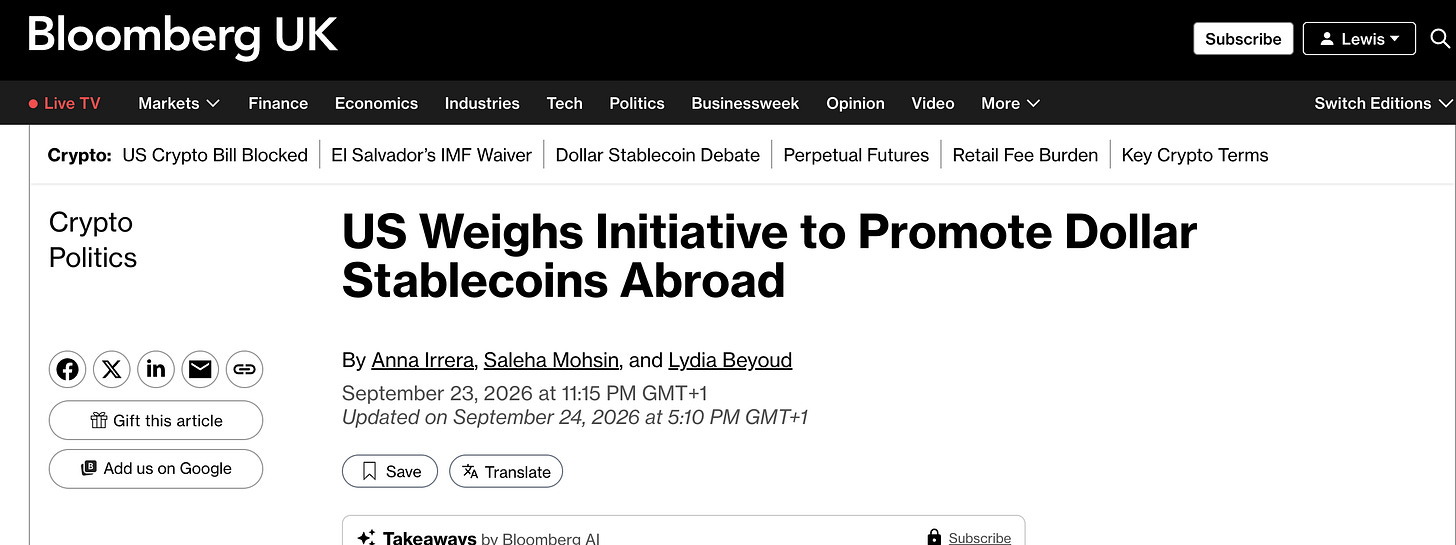
Re7 Take: This reframes stablecoins from a crypto product into an instrument of US monetary power. The US has effectively recognised that dollarisation in the digital economy does not require foreign users to access US banks — blockchains can distribute dollars globally.
The second-order implication is particularly interesting: stablecoin growth becomes structurally aligned with US interests. More USD stablecoins → more offshore dollar usage → potentially more demand for the Treasury assets backing them.
Banks Are Starting to Use the Rails
Citi partnered with Coinbase to enable stablecoin payments for institutional clients, with Coinbase providing crypto infrastructure and Citi handling the banking/settlement side.

Re7 Take: The important development isn’t Citi “getting into crypto.” It is the emerging division of labour: banks retain the regulated customer and fiat relationship while crypto-native infrastructure provides the settlement rail.
That is a much more credible path to adoption than crypto replacing banks outright.
The same convergence is happening in market infrastructure. Hyperliquid perpetual futures data is now live on the Bloomberg Terminal, giving institutional users access to 24/7 pricing across markets including oil, gold and US equities directly within their existing workflow.
Crypto Is Being Fitted Into Institutional Portfolio Infrastructure
The SEC has proposed a dedicated custody framework for advisers and regulated funds holding crypto, including permitting self-custody in certain circumstances and state trust companies as custodians. The SEC explicitly describes the objective as giving advisers and funds a compliant pathway to crypto exposure.
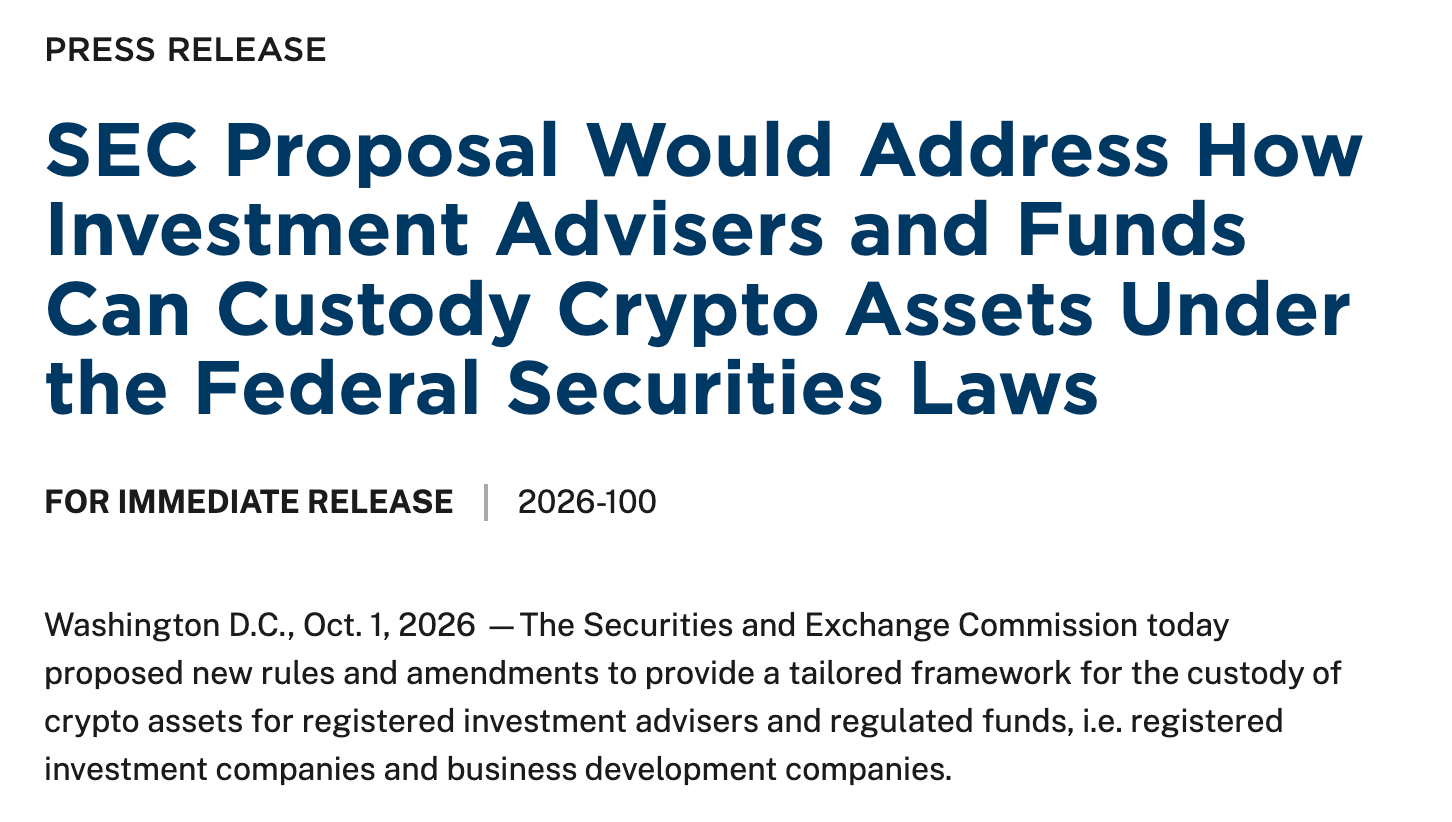
Re7 Take: Institutional adoption ultimately depends less on whether an investment committee likes Bitcoin and more on whether custody, compliance and fiduciary processes permit ownership.
Removing those operational constraints expands the addressable pool of capital.
The same shift is taking place in the UK, where the focus is increasingly on how tokenisation fits within existing financial markets.
The team at Re7 recently discussed the UK’s tokenisation roadmap at the Cross-Border Fund Distribution Conference in London, contributing to the discussion alongside regulators, lawyers and asset managers on where tokenisation is creating value today and what still needs to change for broader institutional adoption.

Re7 discussing the UK’s tokenisation roadmap at the Cross-Border Fund Distribution Conference in London.
Final Remarks
The adoption story is moving from permission to integration.
Governments, regulators and financial institutions are starting to use crypto infrastructure rather than simply make room for it.
Stablecoins are becoming part of US dollar policy, banks are integrating the rails and regulators are building frameworks around ownership and custody. Crypto is becoming harder to separate from the financial system it was once positioned outside of.
Market Update
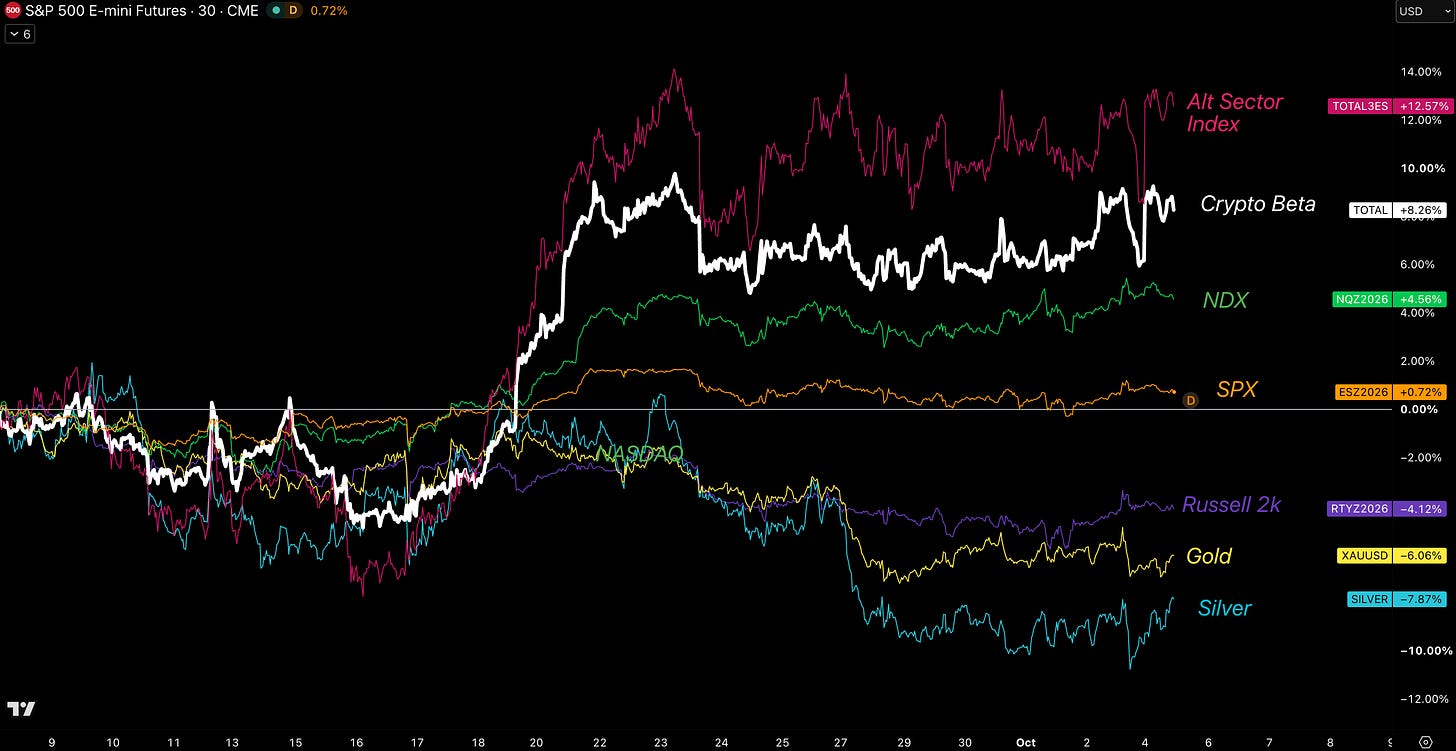
Last week, crypto markets gained a further 2.43%, outperforming NASDAQ/high growth tech by ~90 bps.
Markets remained buoyed by improving macro conditions, with global curves bull steepening and October hike odds falling sharply, alongside improving sentiment as the SEC proposed broader custody options for crypto funds.
Now, BTC is finding heavier selling pressure >$86.5k - the same support level in Dec 2025/Jan 2026.
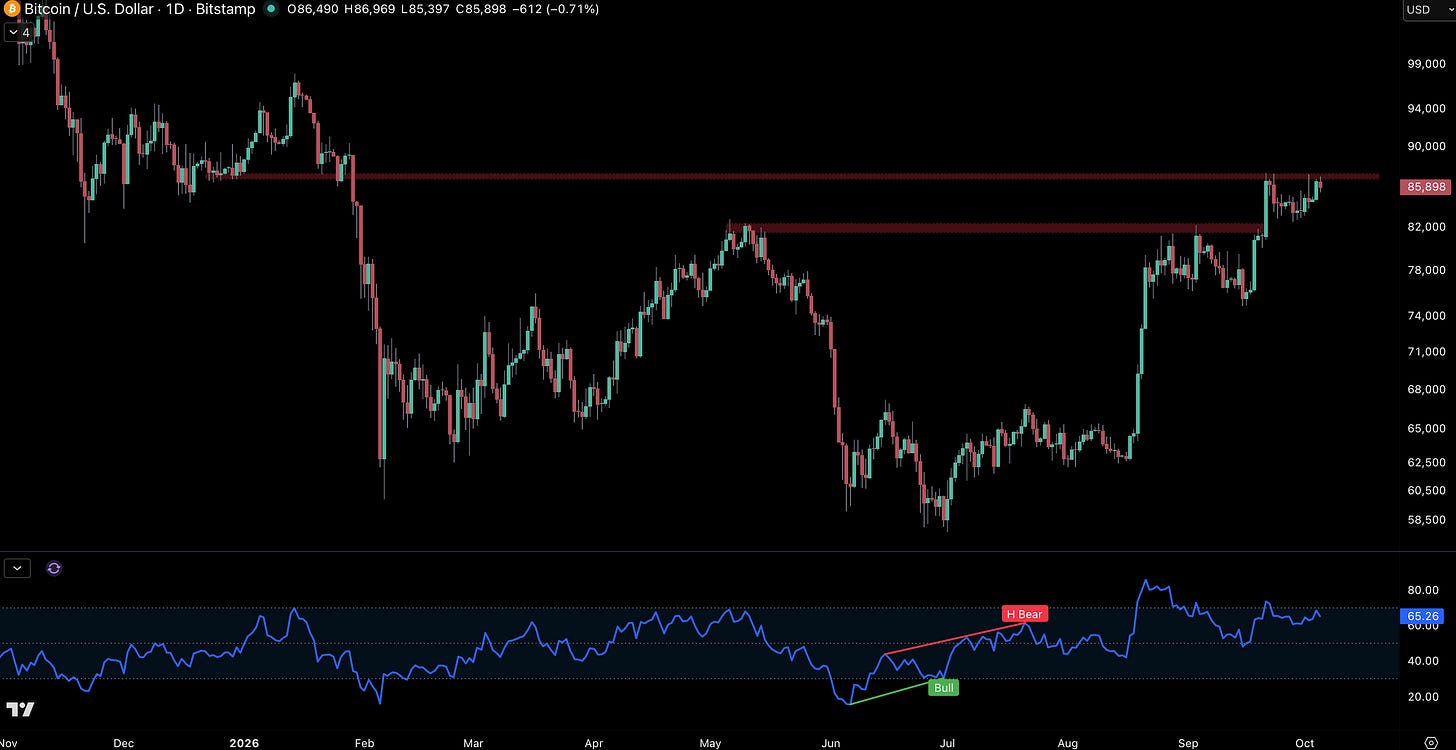
BTC/USD weekly.
Despite the recent chop, crypto and alts continue to outperform other market sector and major indices over the past 30 days.
Perpetual funding rose from ~3% to 10%, pointing to stronger demand for leveraged long exposure but has since cooled.
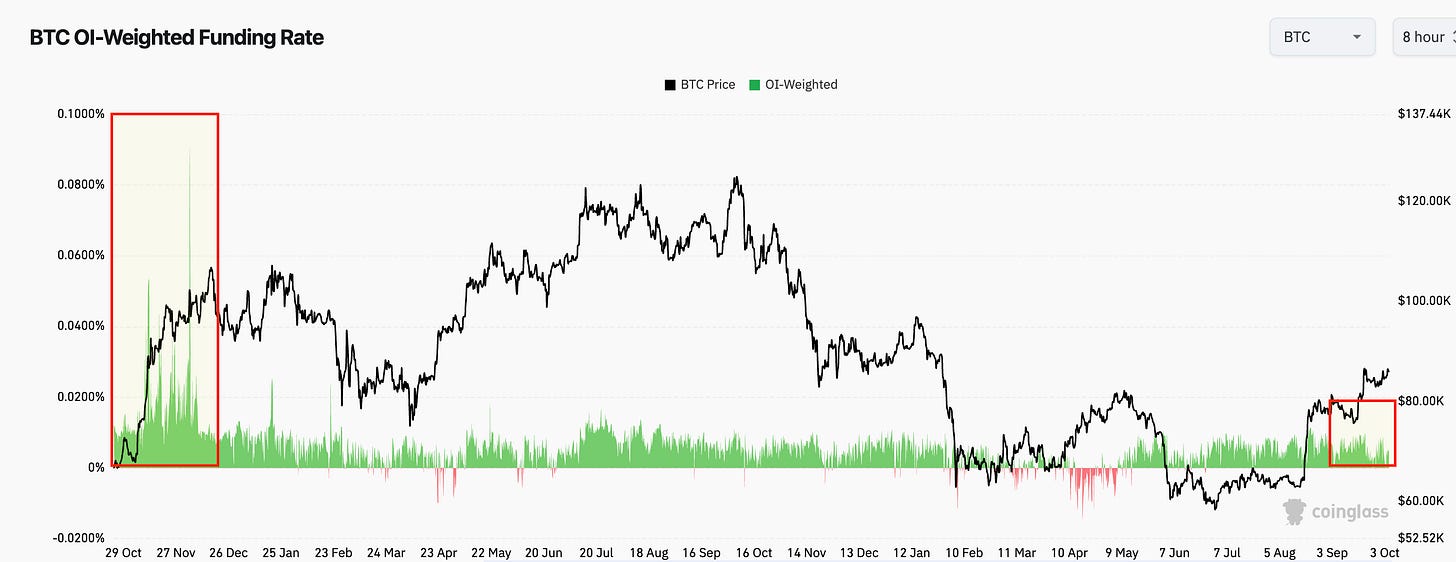
Meanwhile, open interest ended September at ~625k BTC, near a 12-month low, suggesting positioning remains relatively light despite the more bullish bias.
One likely reason for this positioning is seasonality, with October historically one of Bitcoin’s strongest months and Q4 its strongest quarter.
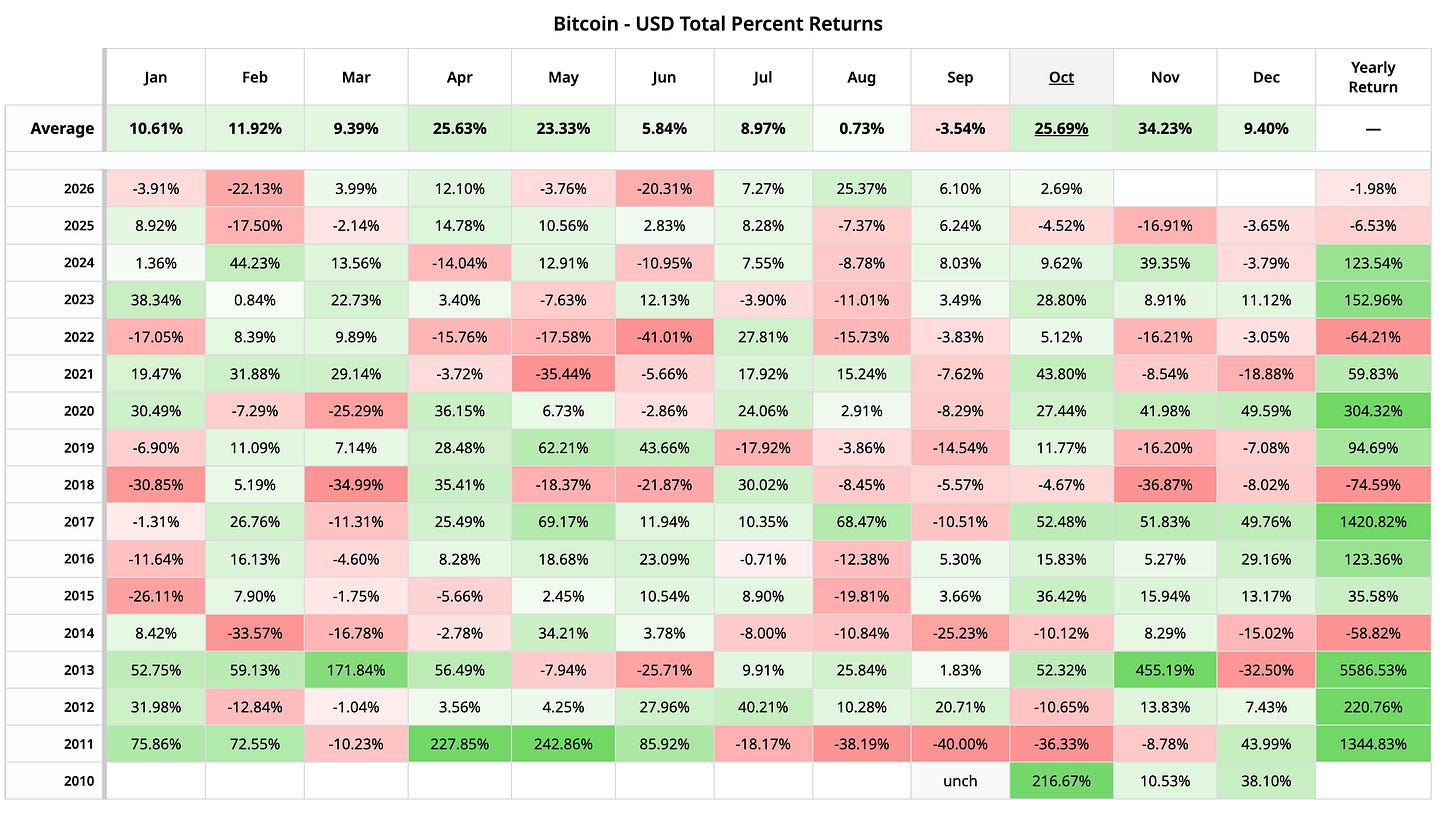
However, with momentum fading into resistance at ~$87k, a near-term pullback or consolidation would provide a healthier reset before another attempt higher to the next mid 90’s target.
State of Yields
Yields have expanded slightly across the board in light of recent market volatility:
Stablecoin lending yields:
~4.49% on Aave (USDC) — 8 bps higher than last week.
~6.83% on Aave (USDe) — 30 bps higher than last week.
~5.12% on Maple (syrupUSDC) — 12 bps lower than last week.
Fixed-rate DeFi lending: yield premium in fixed markets:
Pendle sUSDAi: ~12.47% (Oct 2026 – Feb 2027 maturities).
sUSDe: ~5.38% — ~40 bps lower than last week.
ETH yield benchmarks:
Lido staking: ~2.18% — 1 bps lower than last week.
About Re7
Re7 Capital is a research-driven digital asset investment firm specialising in DeFi yield and liquid alpha strategies.
Re7 Labs is an on-chain asset management and risk curation firm bringing institutional-grade rigour to DeFi.
Disclaimers
The content is for informational purposes only. None of the content is meant to be investment advice. Use your own discretion and independent decision regarding investments. The opinions expressed in all Re7 public research articles are the independent opinions of the authors at the time of publication and not the opinions of the affiliates of Re7.
Please see here for full disclaimers.