The Weekly: The Rise of Interface Apps
AUG 31, 2026
Interface apps are capturing crypto trading volume via Hyperliquid. See this week's DeFi yields, market technicals, and on-chain lending rates.

Stay informed about what matters in crypto. Forget the noise. Get free market-leading crypto research by subscribing to Re7 Capital’s research below:
Re7 Celebrates 5 Years. In recognition, The Hedge Fund Journal featured Re7 Capital. Read the full profile to find out how we think about risk in DeFi, and why we treat it closer to a credit discipline than a trading strategy.
—
Evgeny Gokhberg joined 1000x Podcast: What It’s Like Running A Billion-Dollar Market-Neutral Fund In Crypto.
—
We are hiring!
Senior Legal Counsel - Apply here.
Senior DeFi BD - Apply here.
Weekly Summary
We cover:
Why interface apps are capturing a growing share of crypto trading volume
Why perpetuals are leading the shift, with spot beginning to follow
How distribution and order flow are emerging as a new layer of value capture
The Rise of Interface Apps
A new layer appears to be emerging in crypto trading.
Interface apps are growing rapidly by separating where users trade from where trades are executed.
Rather than building an exchange and bootstrapping liquidity, apps such as Phantom, fomo and tradeXYZ can own the frontend and route orders into existing venues such as Hyperliquid.
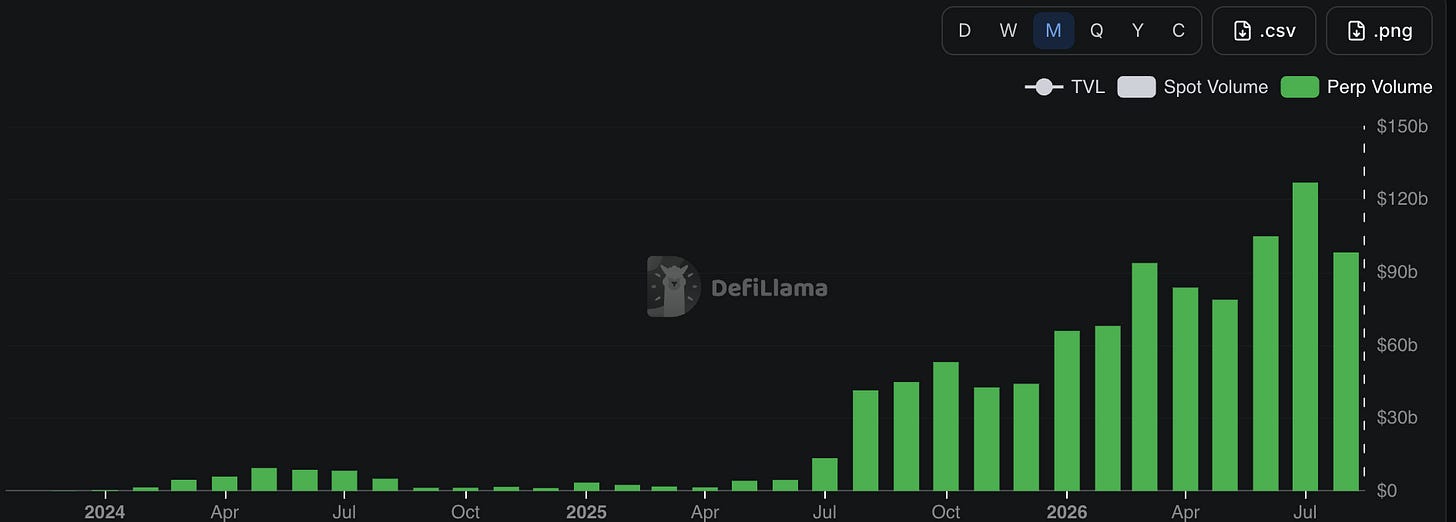
Interface perpetual volume by month since 2024.
Perpetual volume routed through interface apps has grown from almost nothing at the start of 2025 to more than $100b per month at recent peaks.
Importantly, the growth is not simply a function of a larger perpetual market. Interfaces are taking share.
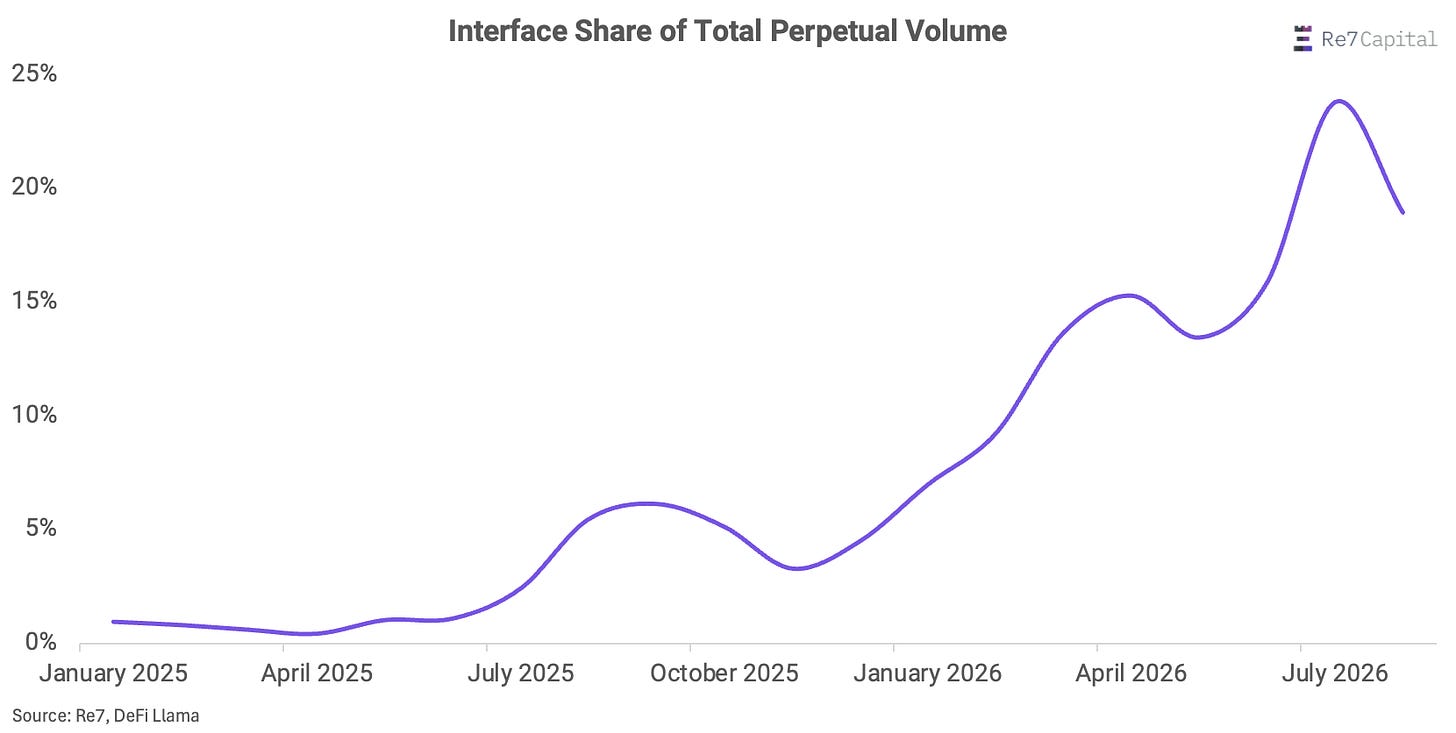
Growing Volume Market Share
The interface share of total perp volume has risen from less than 1% at the start of 2025 to around 20% today, having peaked above 20% in July.
The model has found PMF fastest in perpetuals. Perps are easier to abstract because users primarily care about liquidity, leverage and execution, while high turnover makes routed order flow more valuable. Hyperliquid accelerated the shift by providing deep liquidity and a direct way for interfaces to monetise it.
Spot has lagged because trading is lower frequency and execution remains more fragmented across chains and venues. But interface share is now accelerating from effectively zero, suggesting spot is following the same path with a lag.
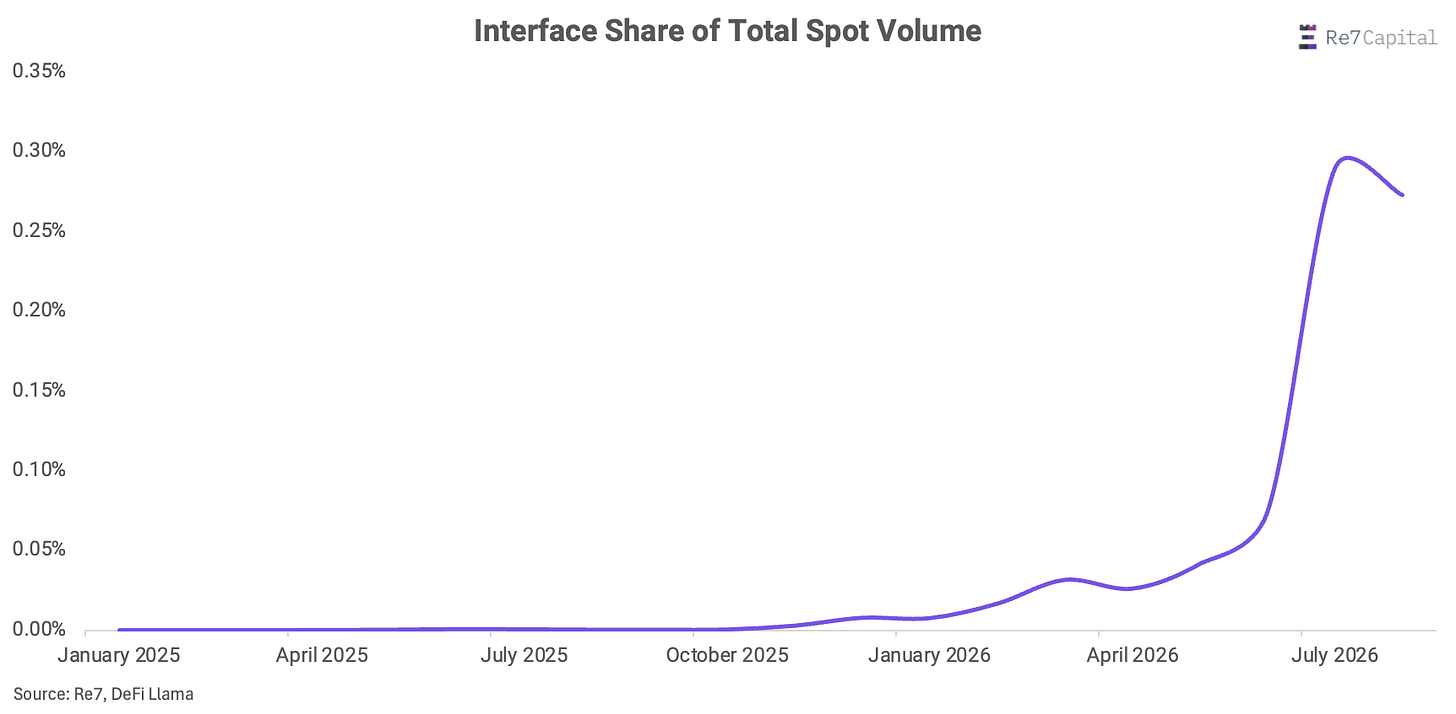
Interface share of spot volume remains only ~0.3%, but the recent acceleration is notable given where perps were only 18 months ago.
Crypto’s Brokerage Layer
The closest TradFi comparison is the brokerage model. A Robinhood customer trades through Robinhood, while execution is routed to external market makers and venues.
Crypto is developing a permissionless version of the same model. Hyperliquid provides the execution infrastructure; interface apps increasingly look like brokers sitting on top.
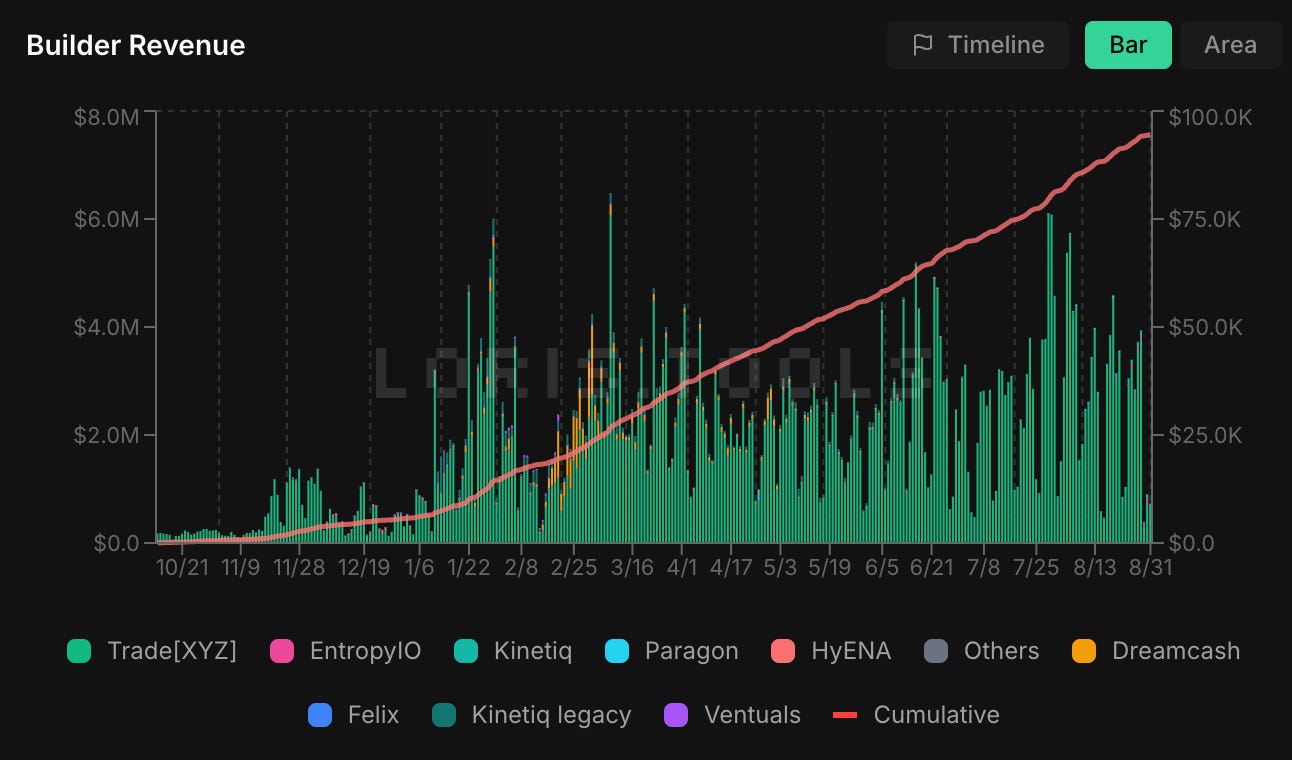
Builder revenue for HIP-3 builders on top of Hyperliquid.
A Phantom user does not necessarily care that a perp ultimately executes through Hyperliquid. The user holds capital and initiates the trade in Phantom, making the underlying venue less important than the application owning the user relationship.
The model is also becoming economically meaningful. Interface protocols generated around $4m of revenue over the past week, equivalent to more than $200m annualised, by monetising order flow without owning the underlying liquidity or execution infrastructure.
Crypto has historically placed most value on protocols that own liquidity and execution. Interface growth creates another source of value capture higher up the stack: distribution and order flow.
As execution becomes increasingly commoditised, the scarce asset becomes the user relationship.
Market Update
Crypto markets stabilised last week, with only a 0.94% drawdown materialising.
Investors remain split on whether a reset towards the low-$70k area is needed before the uptrend resumes following the breakout from the longer-term wedge, or whether momentum can continue as call and spot ETF buying compound each other and crypto trades increasingly on its own fundamentals.
The technical picture offers little resolution, with no DeMark sell signals on either the daily or weekly timeframe.
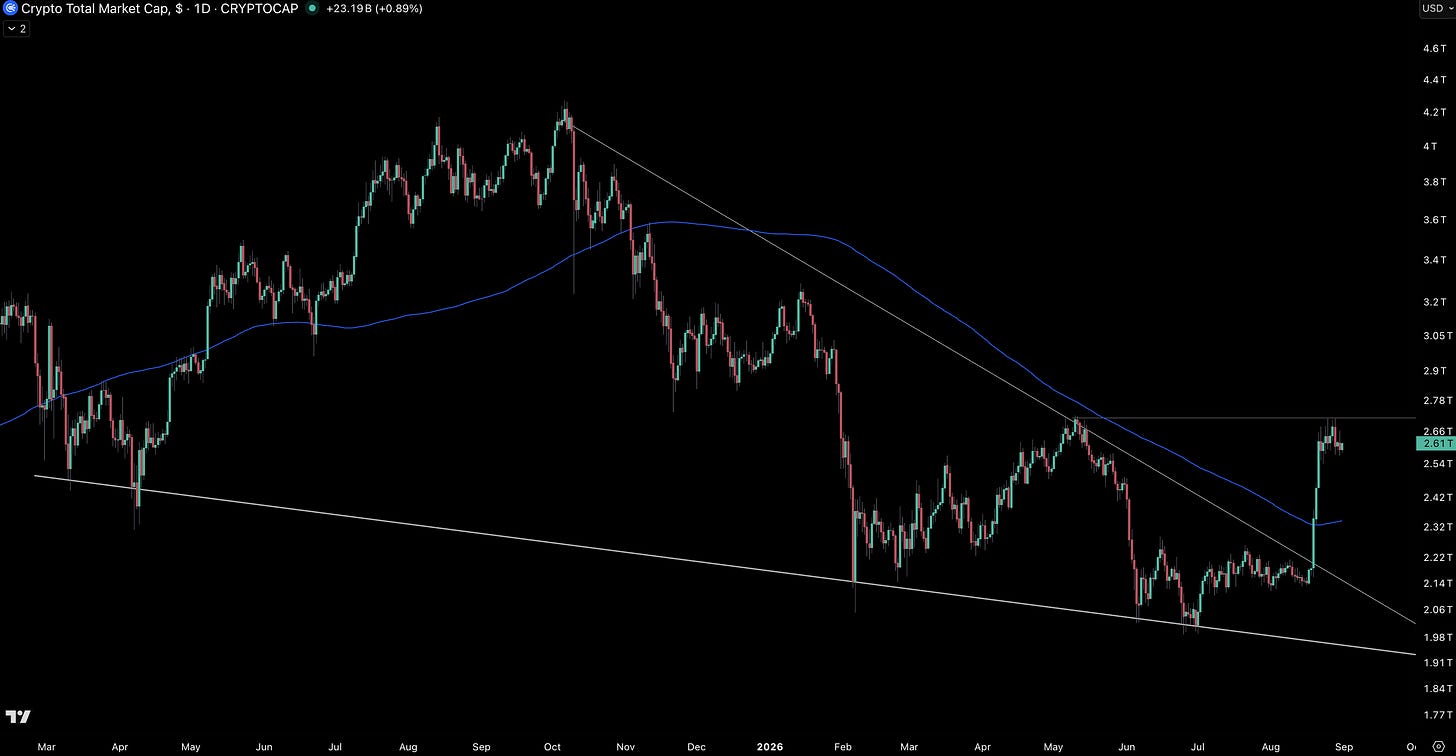
Daily global crypto market capitalisation index ($).
At the same time, relative strength among major L1s continues regardless.
ETH and SOL continue to outperform BTC, with SOL additionally supported by the passage of its disinflation proposal, which materially reduces future token issuance.
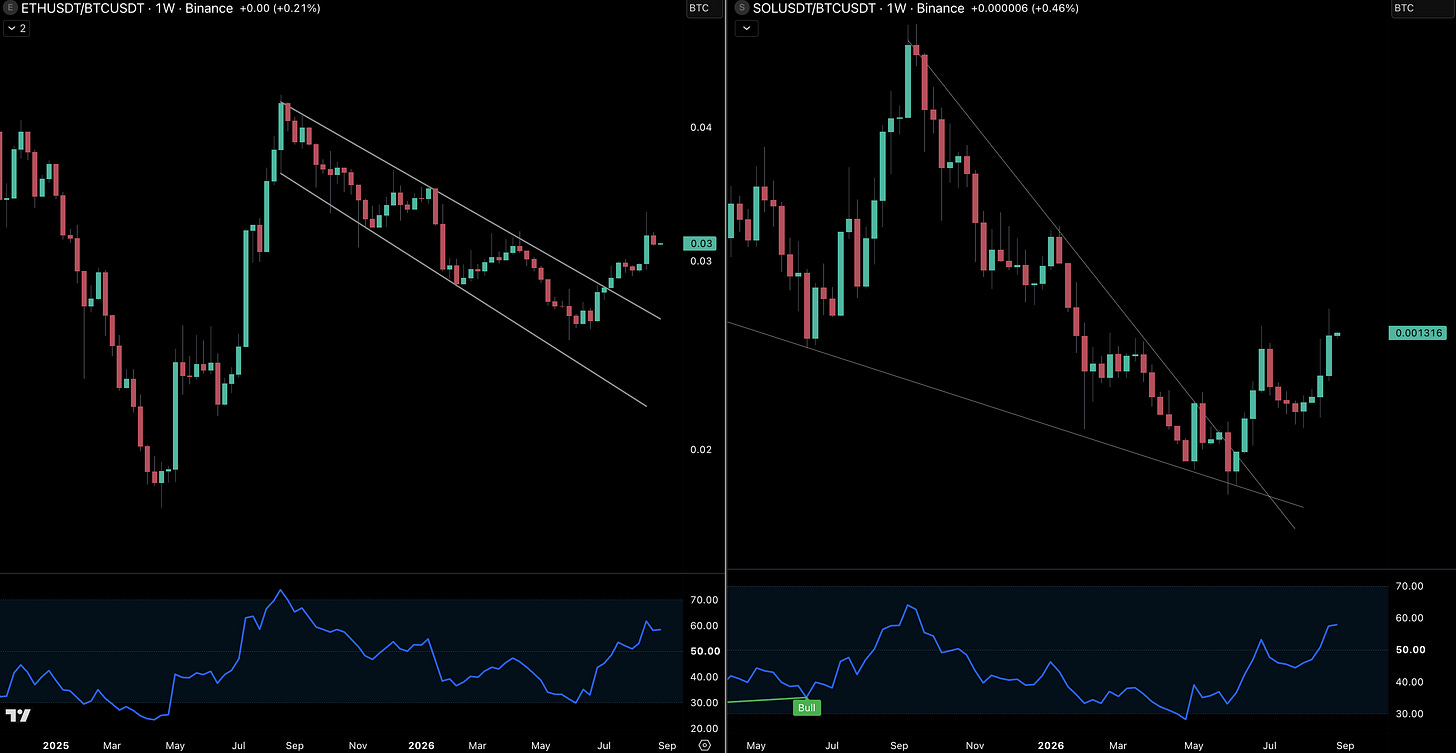
ETH/BTC W (left) and SOL/BTC W (right).
Alts have kept pace with beta so far, but alt dominance has yet to break out from its range since 2022.
As a reminder, the monthly DeMark 9 buy count biases the eventual break higher, consistent with confidence returning more forcefully and profits rotating from beta into alts in the typical cycle pattern.
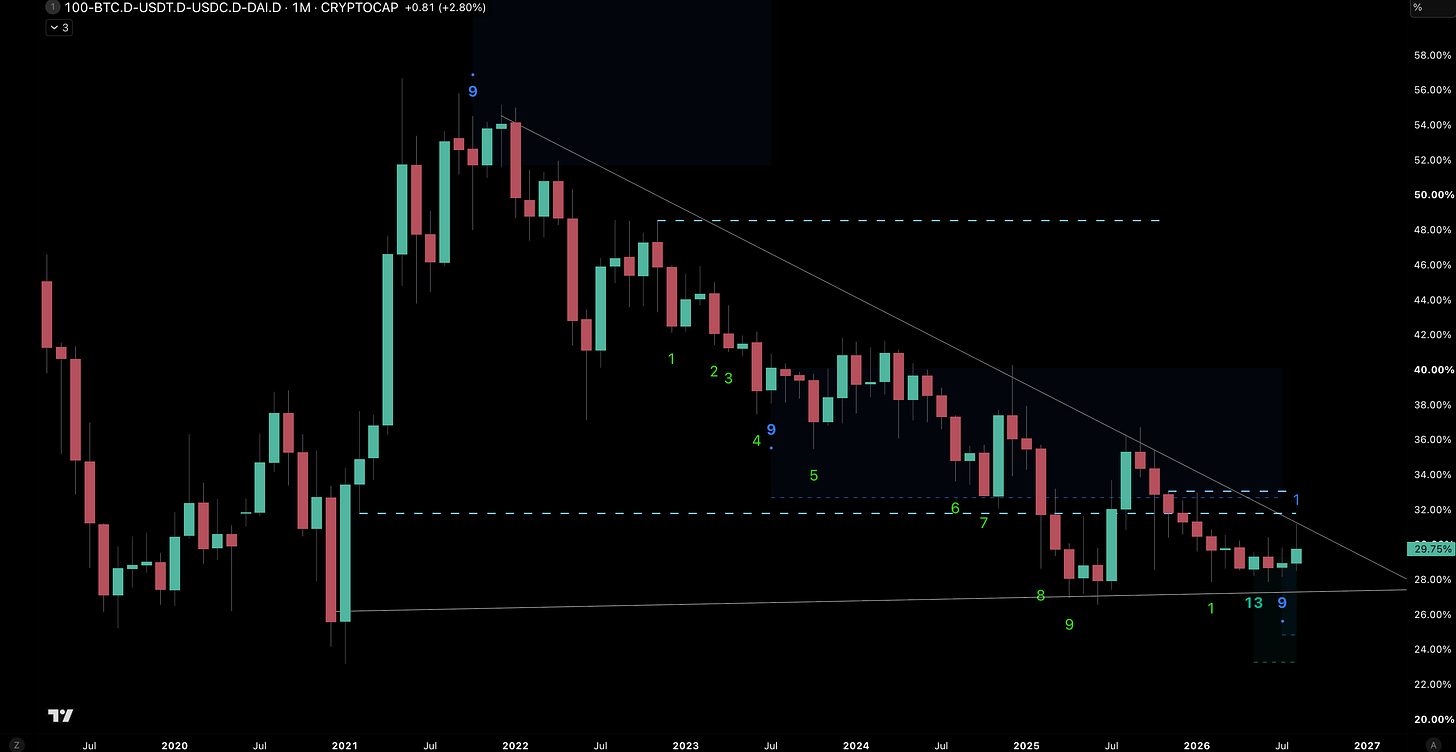
Altcoin market dominance (%).
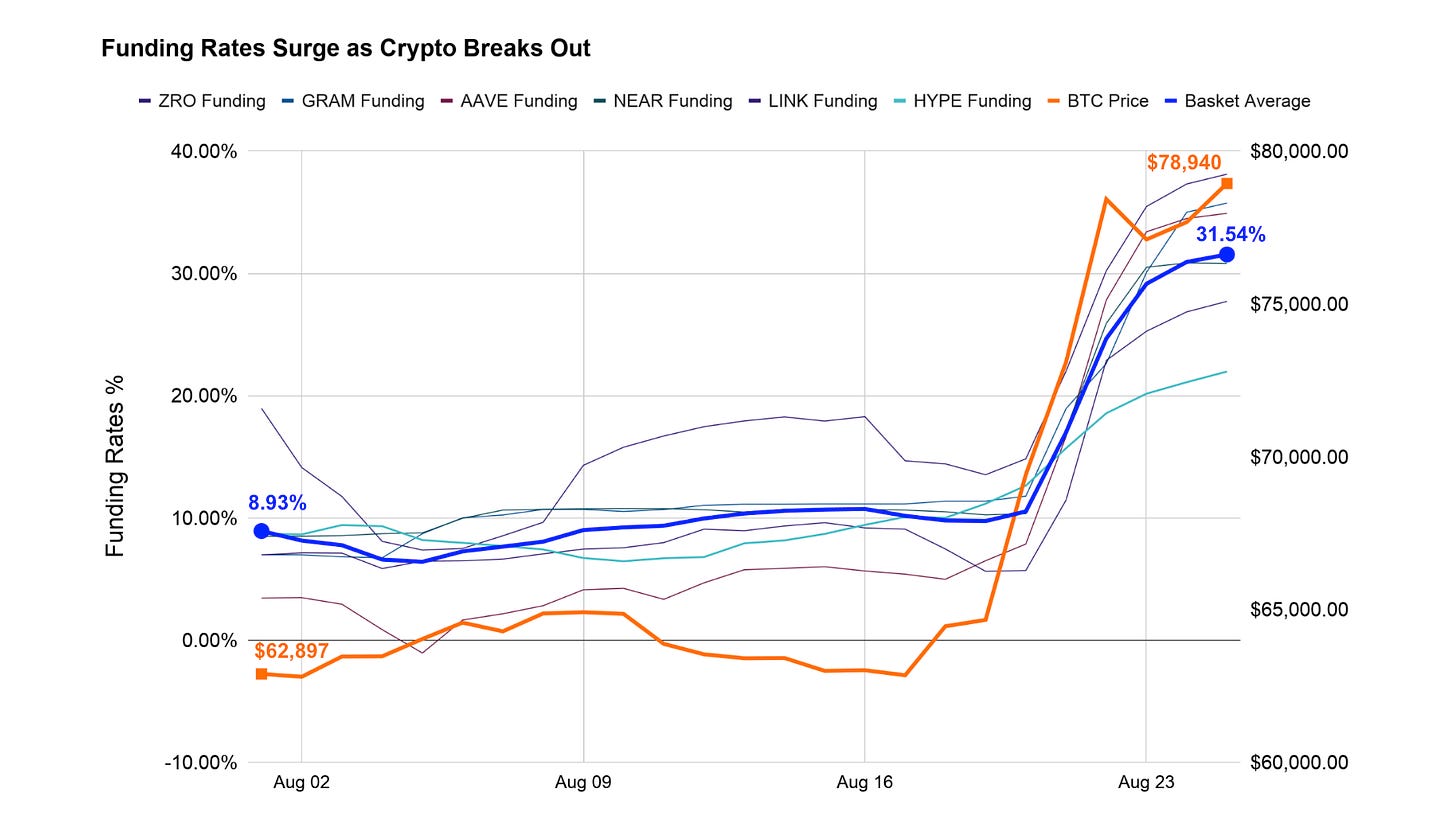
The recent crypto rally has driven a sharp increase in demand for leveraged long exposure, with average annualised funding rates across the basket rising from below 10% to above 30%.
The shift creates increasingly attractive opportunities to capture double-digit yields through delta-neutral basis strategies.
State of Yields
Yields have expanded slightly across the board in light of recent market volatility:
Stablecoin lending yields:
~3.32% on Aave (USDC) — no change from last week.
~3.5% on Aave (USDe) — 90bps higher than last week.
~5.03% on Maple (syrupUSDC) — 20 bps higher than last week.
Fixed-rate DeFi lending: yield premium in fixed markets:
Pendle sUSDAi: ~10.57% (Oct 2026 – Feb 2027 maturities).
sUSDe: ~4.86% — 13 bps lower than last week.
ETH yield benchmarks:
Lido staking: ~2.21% — same as last week.
About Re7
Re7 Capital is a research-driven digital asset investment firm specialising in DeFi yield and liquid alpha strategies.
Disclaimers
The content is for informational purposes only. None of the content is meant to be investment advice. Use your own discretion and independent decision regarding investments. The opinions expressed in all Re7 public research articles are the independent opinions of the authors at the time of publication and not the opinions of the affiliates of Re7.
Please see here for full disclaimers.
Thanks for reading Re7 Research! Subscribe for free to receive new posts and support our work.